Halloween with Bike Durham

 
125062873_3628106797245929_5407822221440118402_o.jpg
 

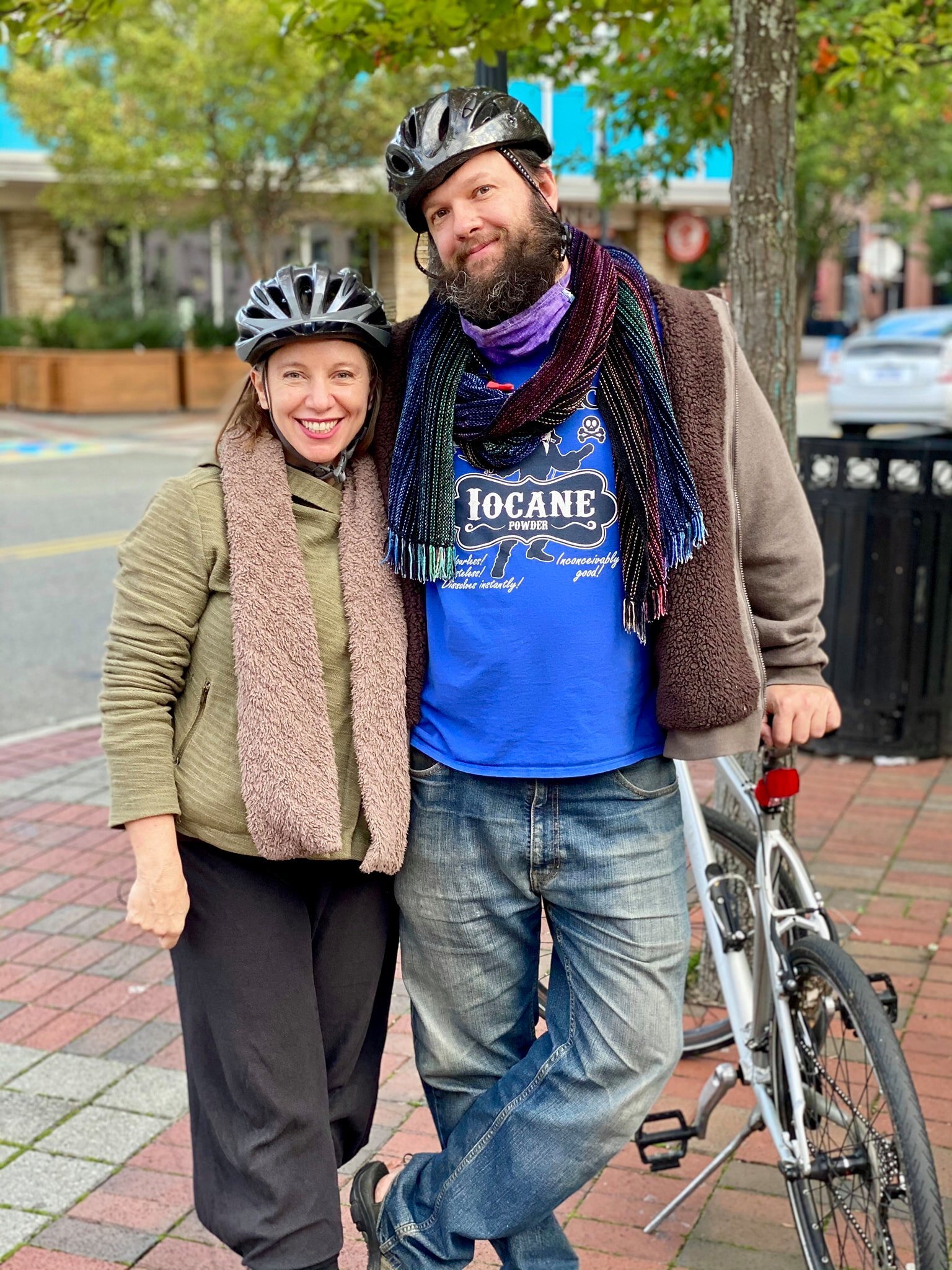
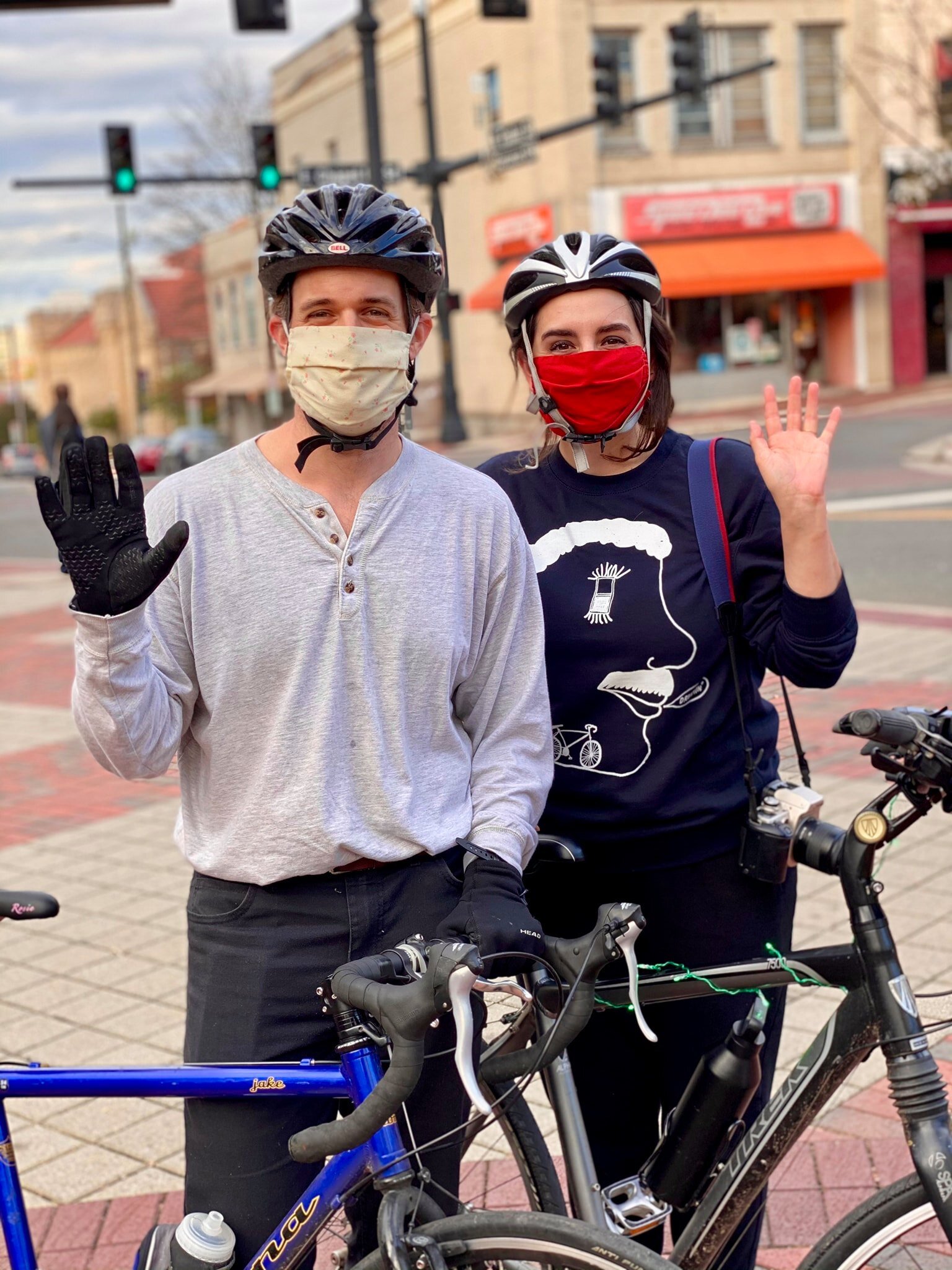
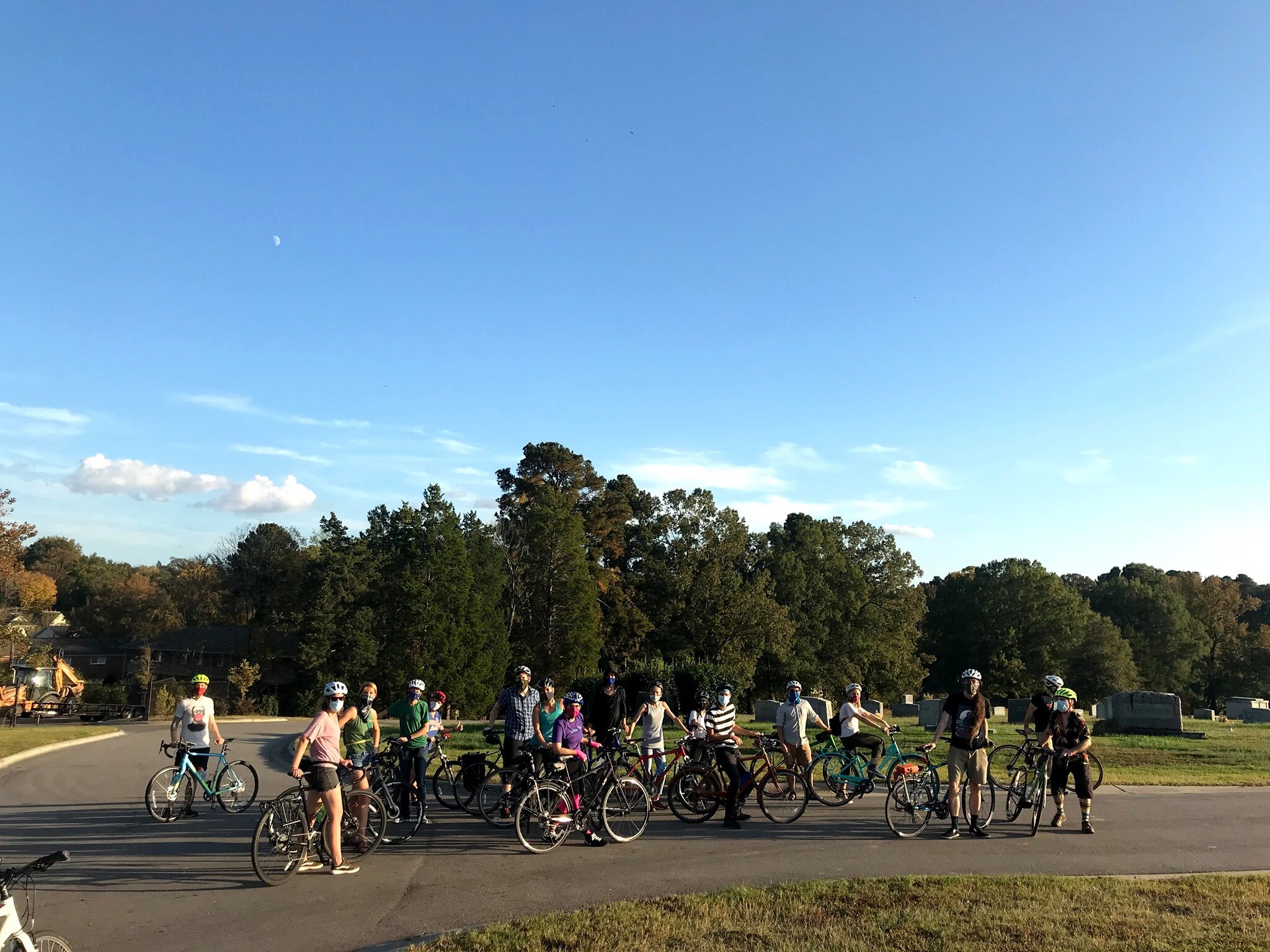
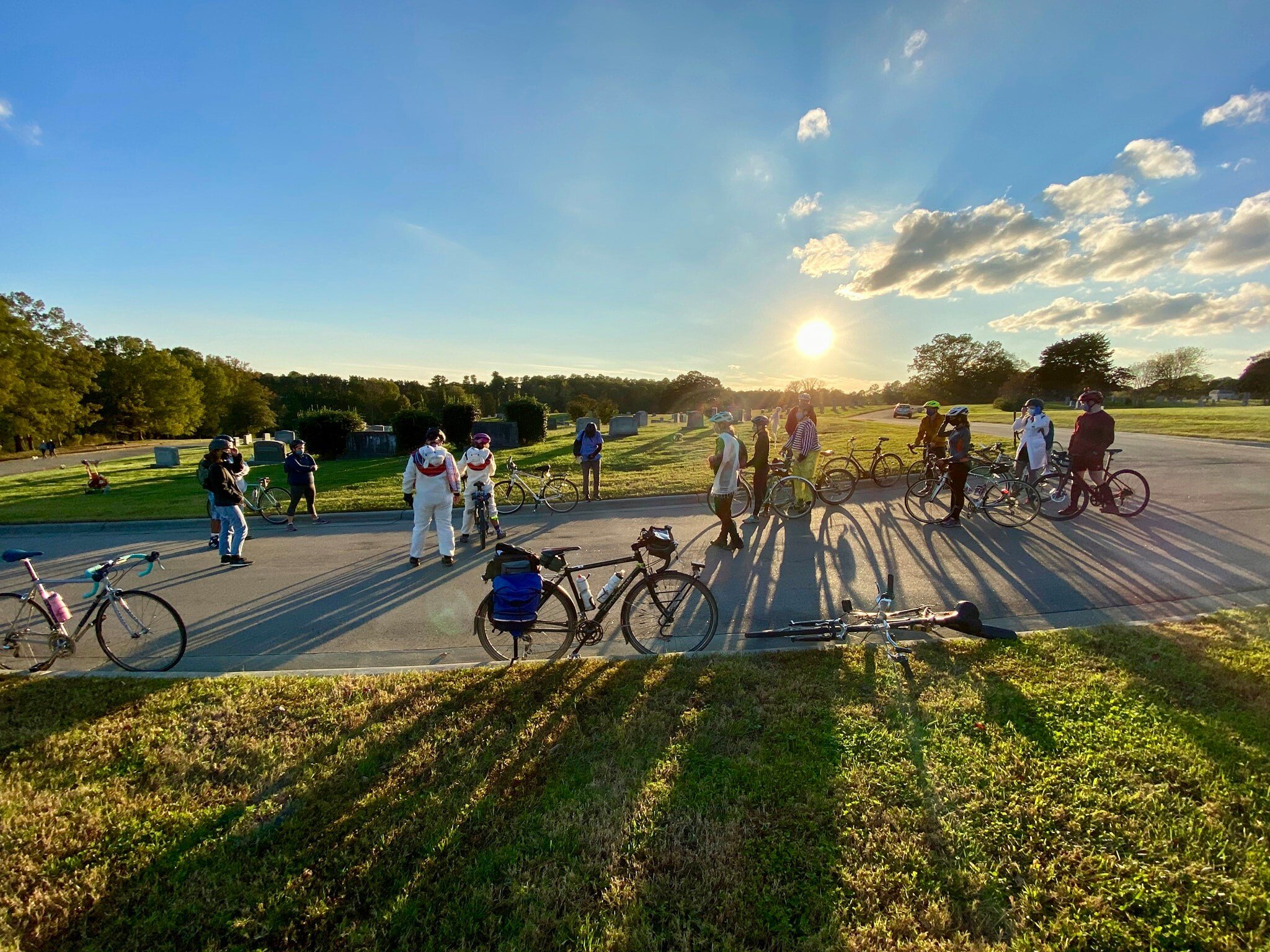
This Halloween, Bike Durham organized the first-ever Ghost Stories Tour, a group ride in which we visited seven haunted locations around Durham. These included Duke’s Parapsychology Lab, where we learned of the poltergeist that haunted Carl Jung, the old Durham County Jail, where the ghost of a drowned boy lingers, and the North Carolina School of Science and Math (formerly Watts Hospital), where a security guard spotted the ghost of a murdered nurse one rainy evening. This ride was special in many ways, not the least of which is that it was our first group ride since the pandemic began.

20201031_171606.jpg
 

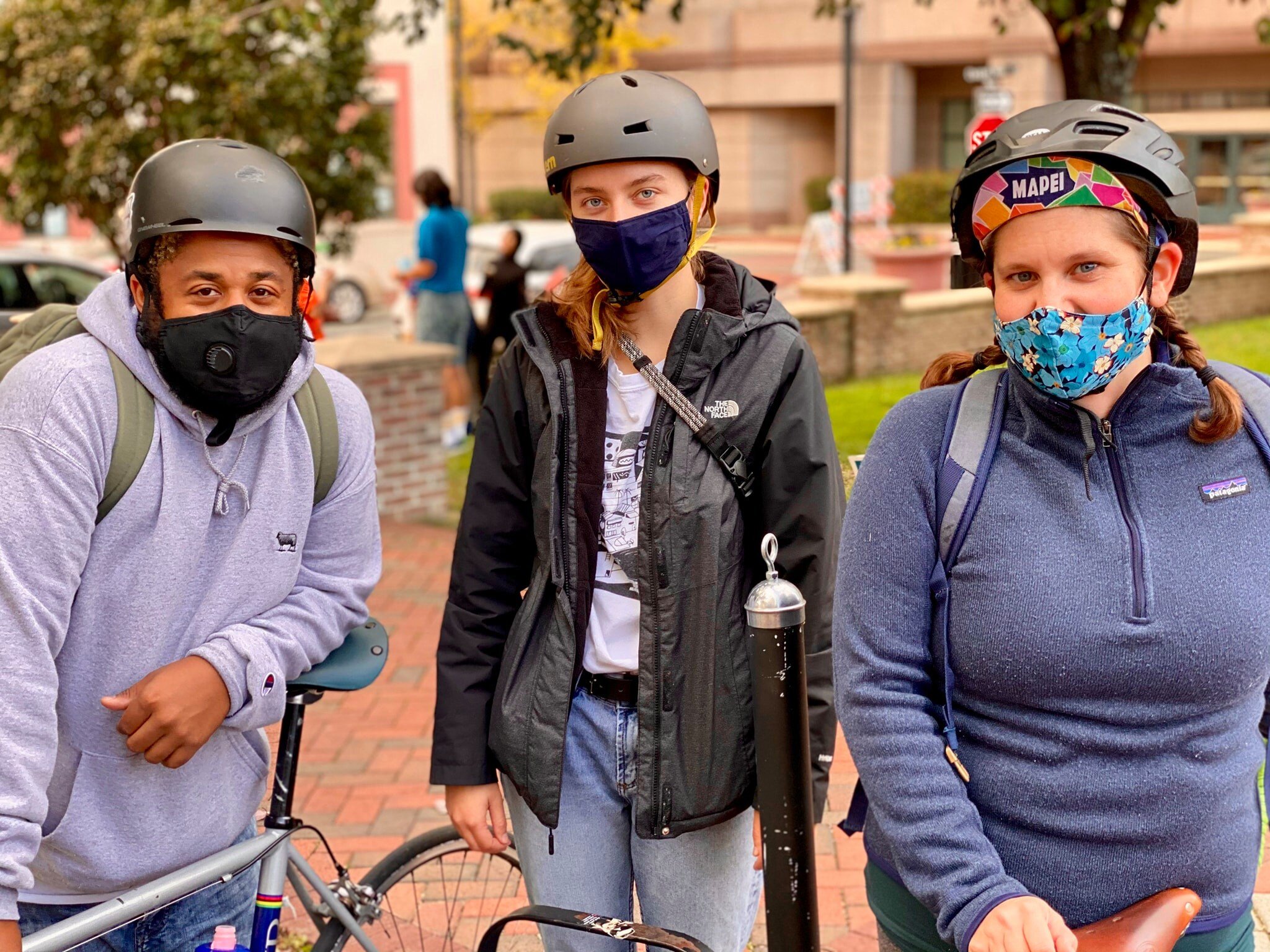
After lengthy conversations about how to make this event as safe as possible in the midst of a pandemic, the event organizers decided to cap each ride at 15 participants and require masks and social distancing while on the ride. Although we were taking precautions, we wondered whether anyone would show up given the legitimate concerns about the spread of covid.


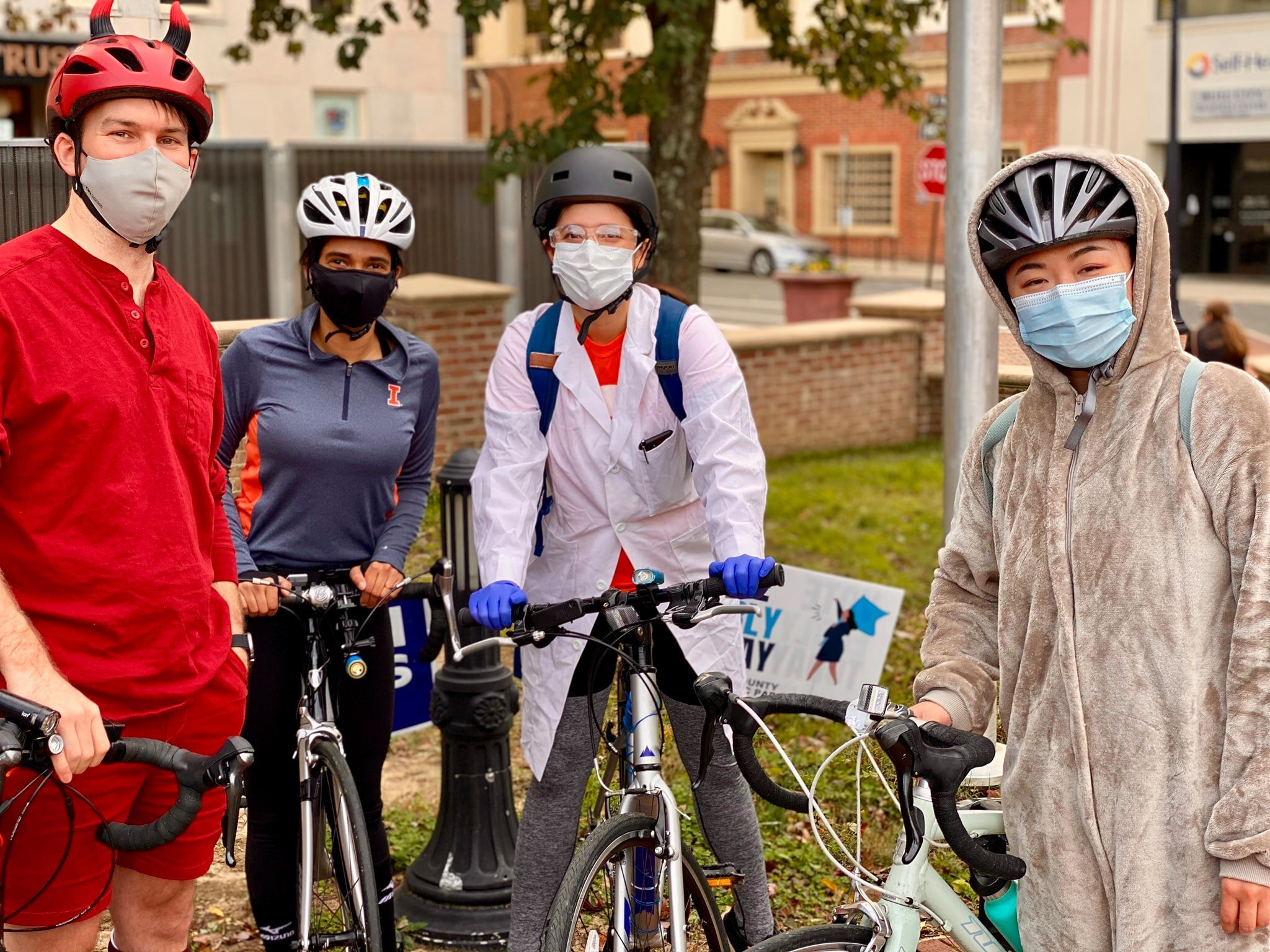
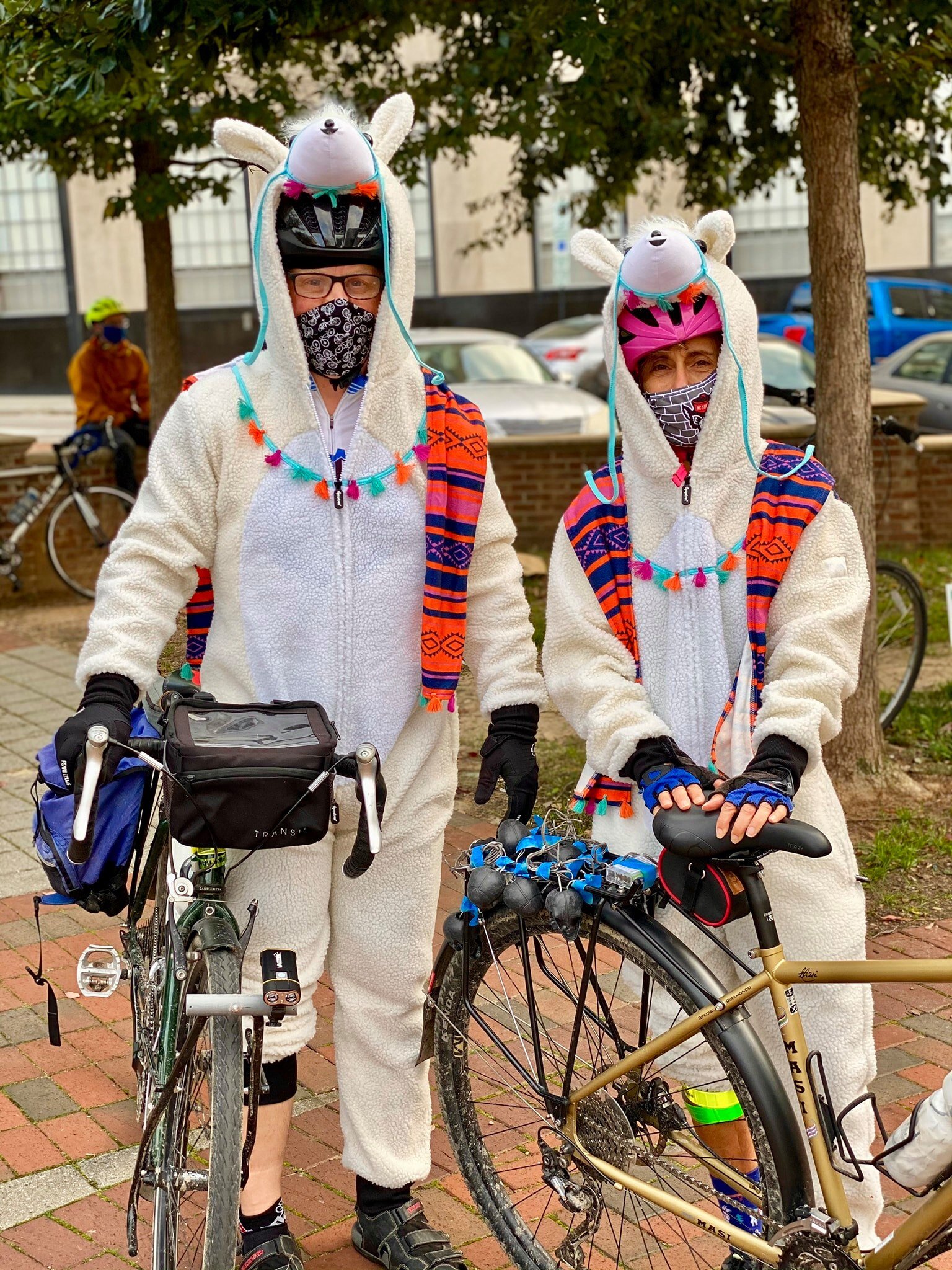
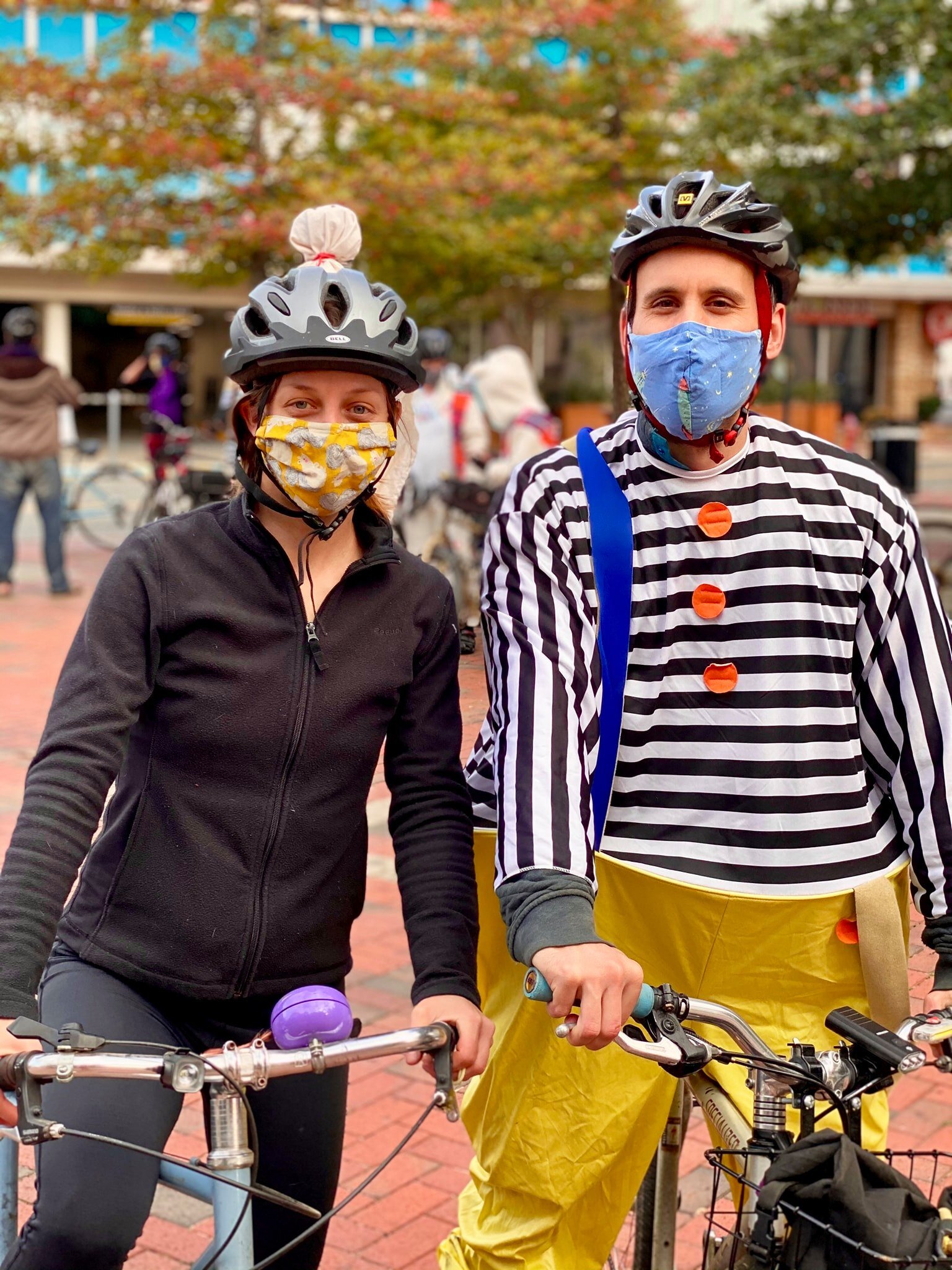
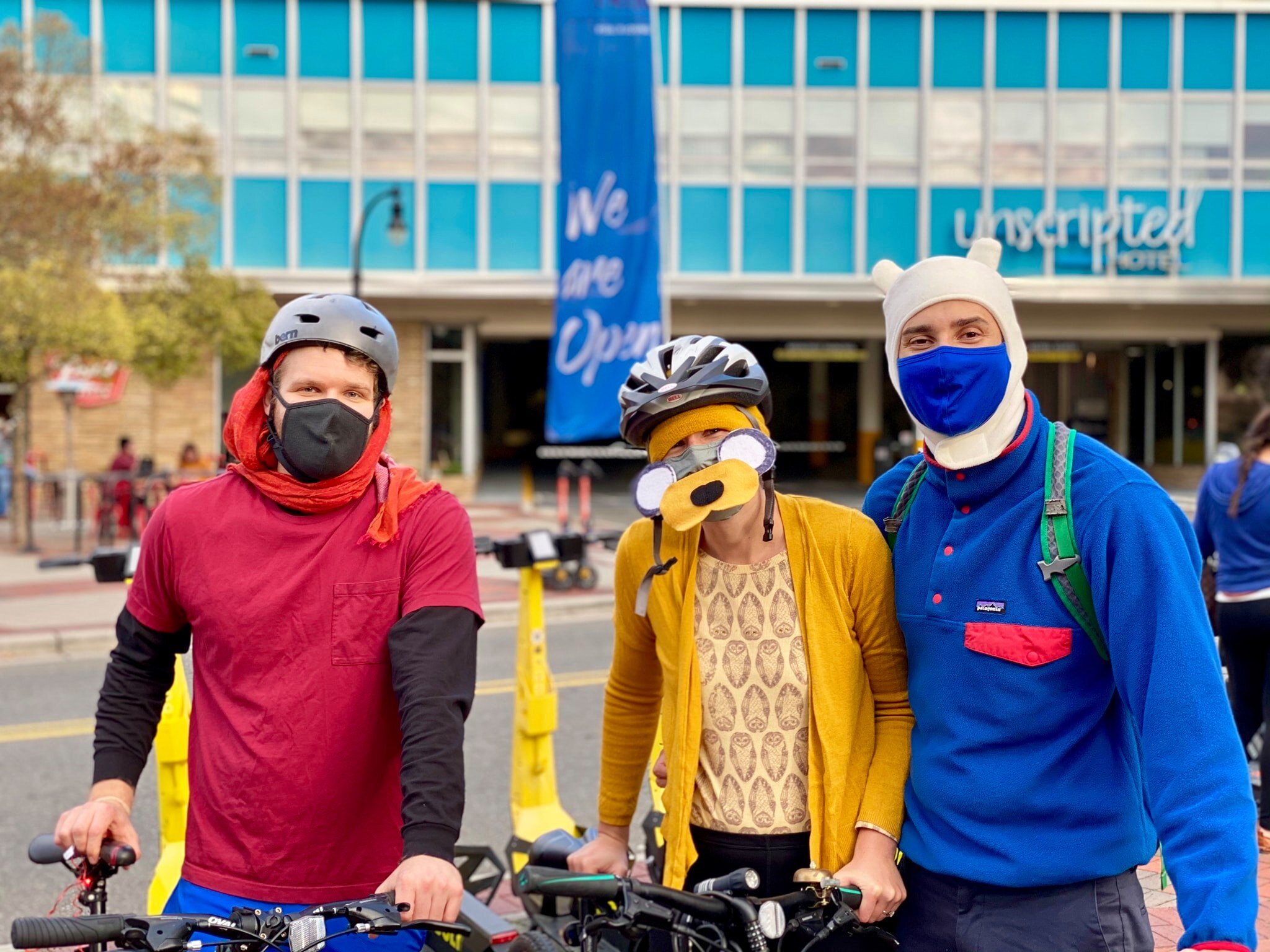
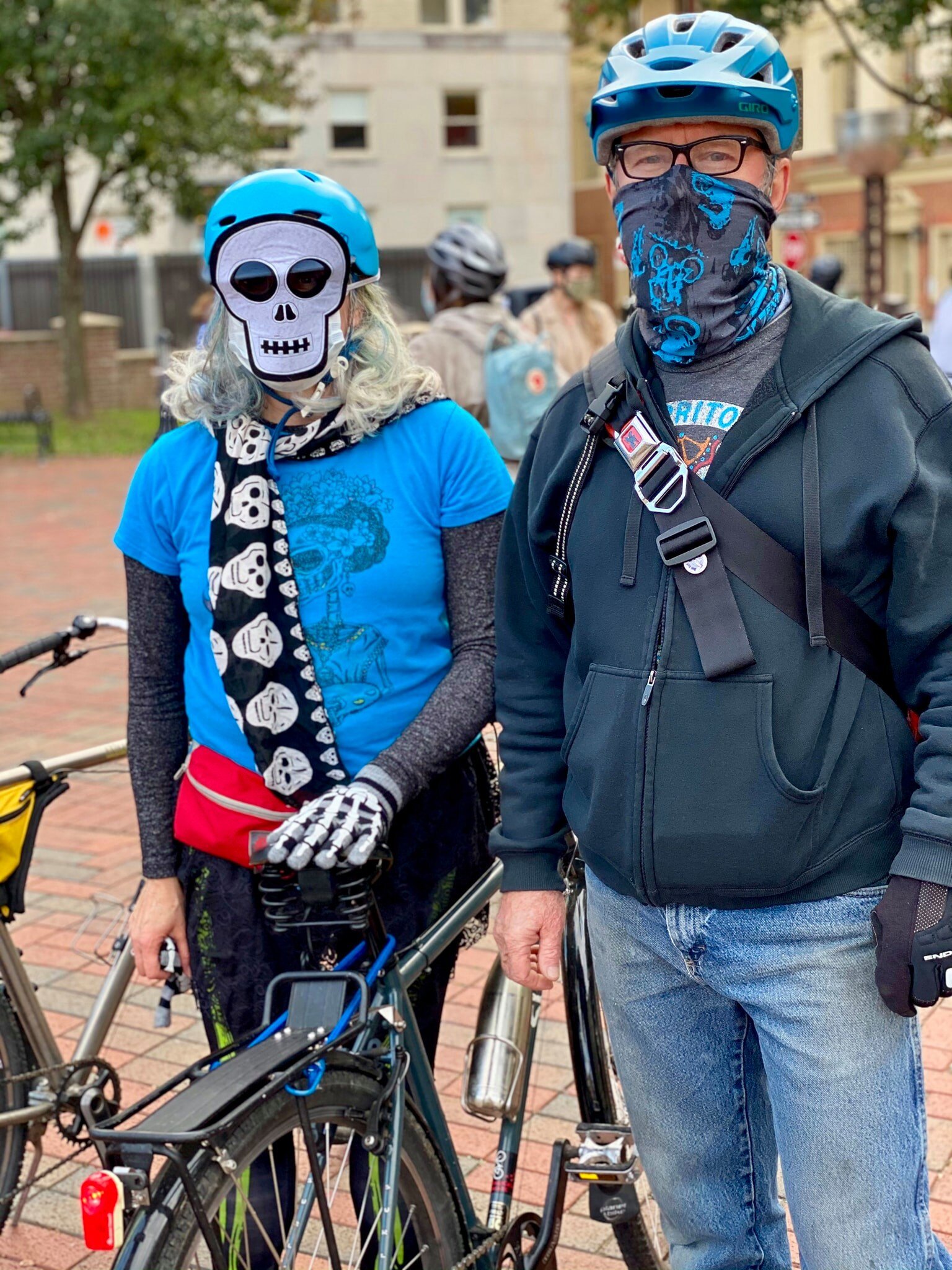
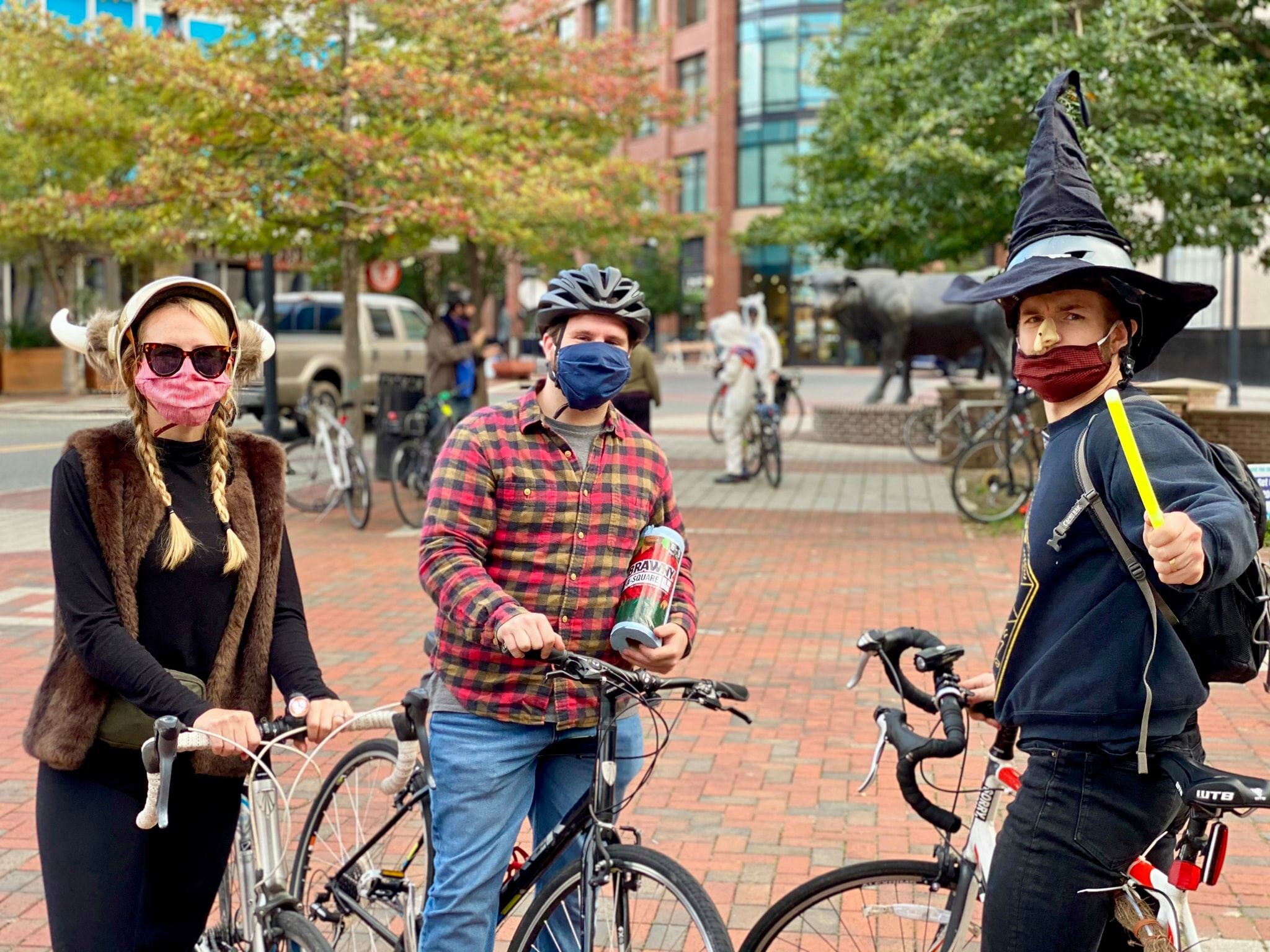
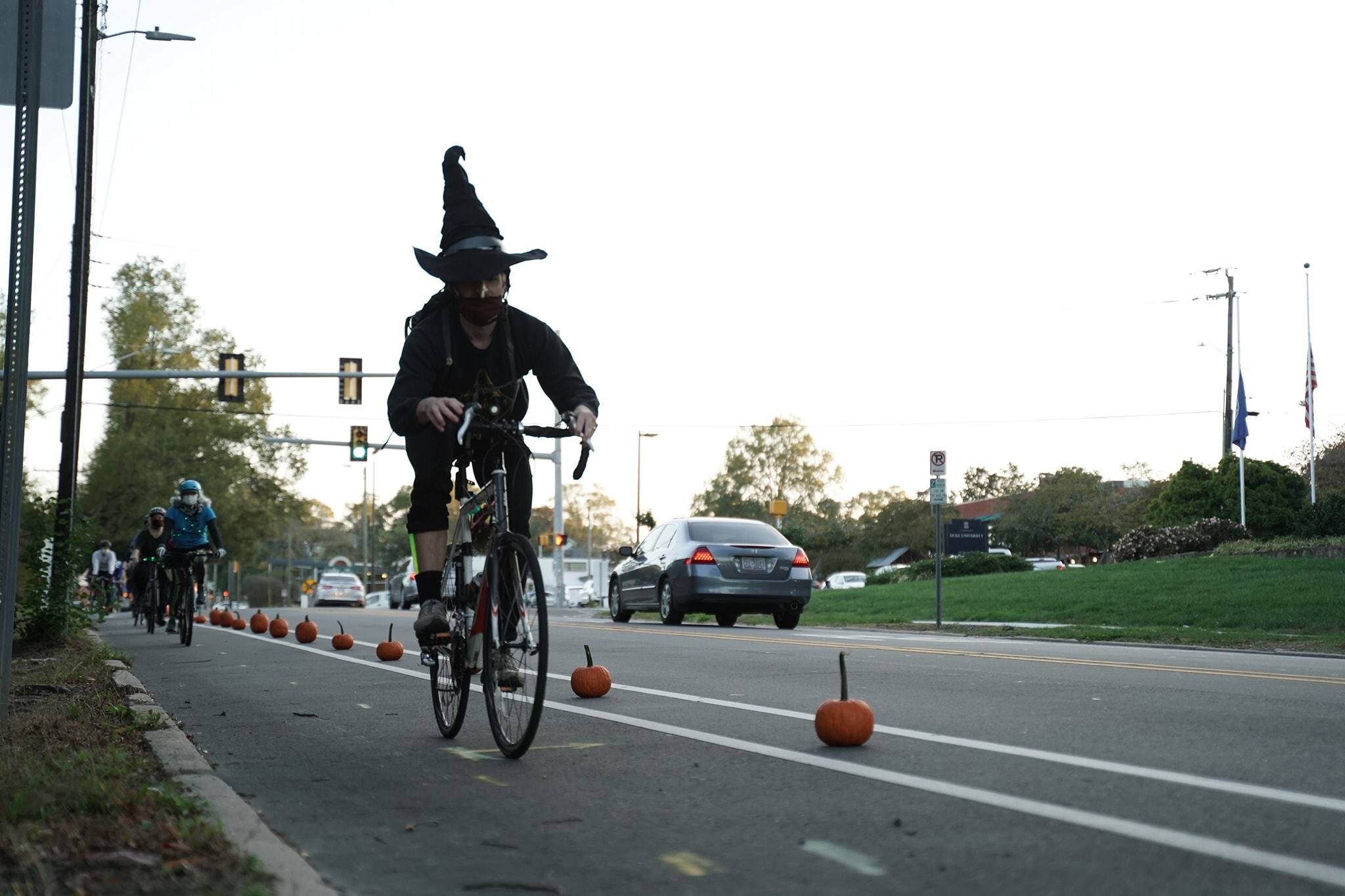
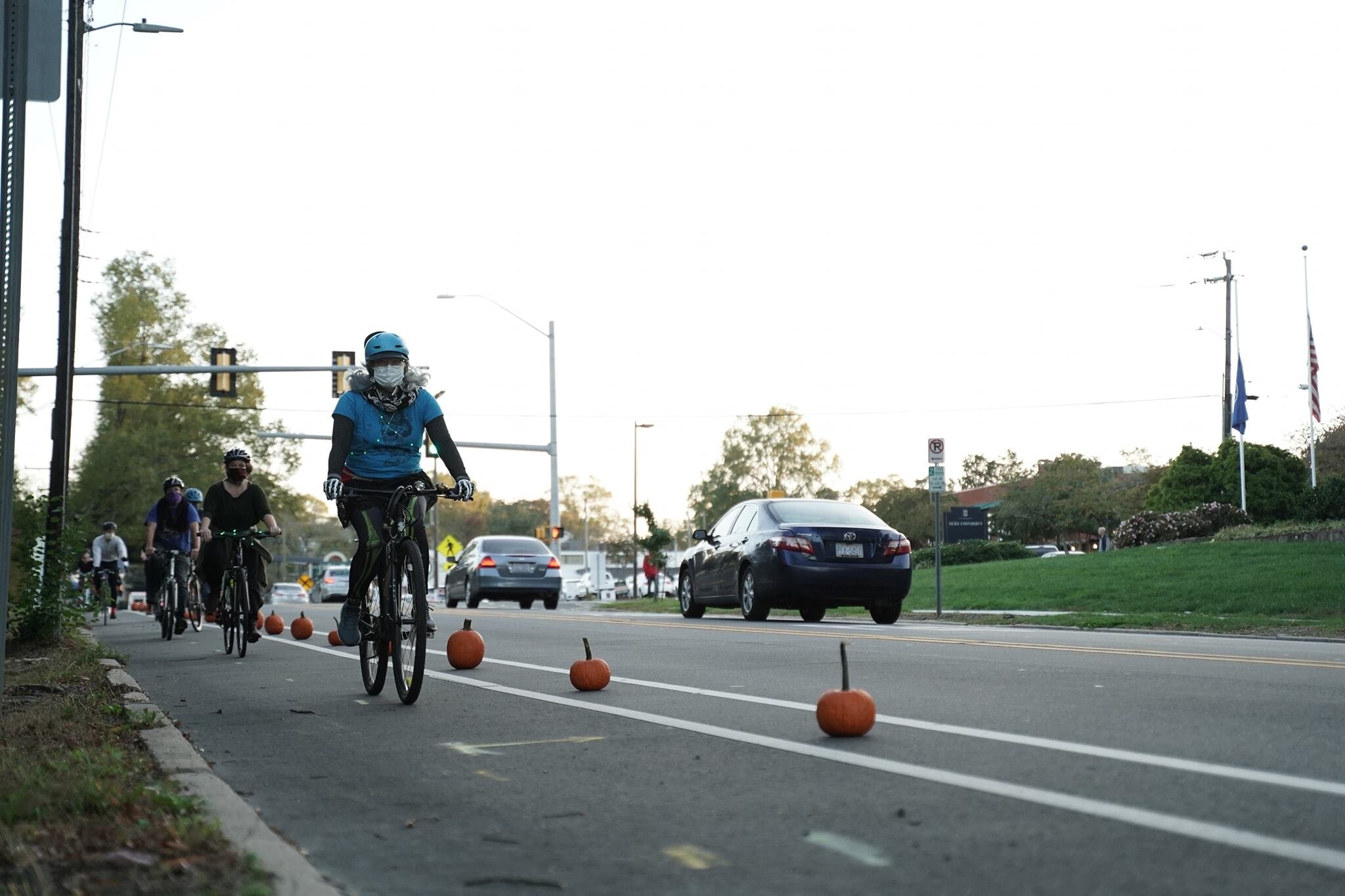
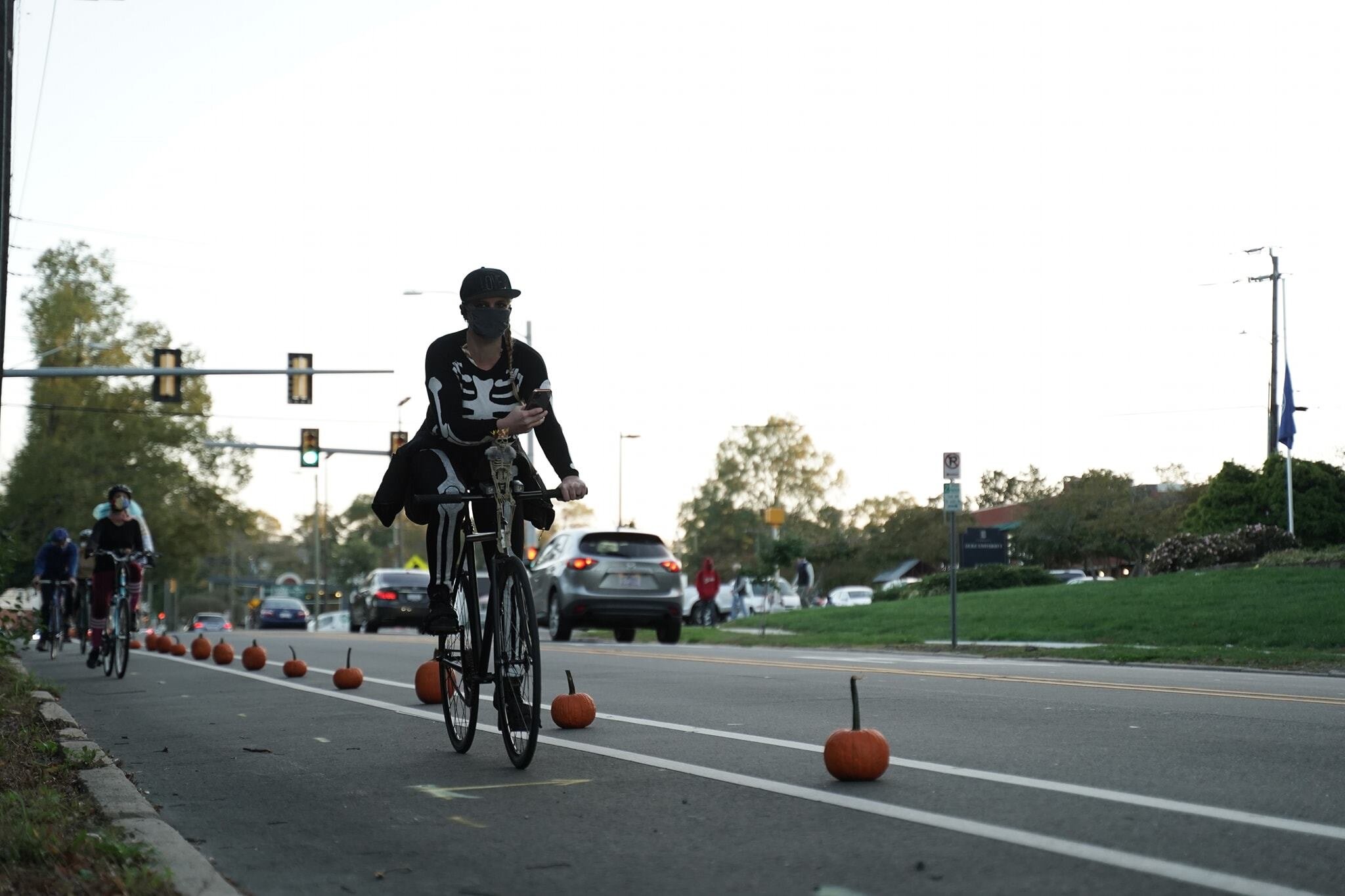
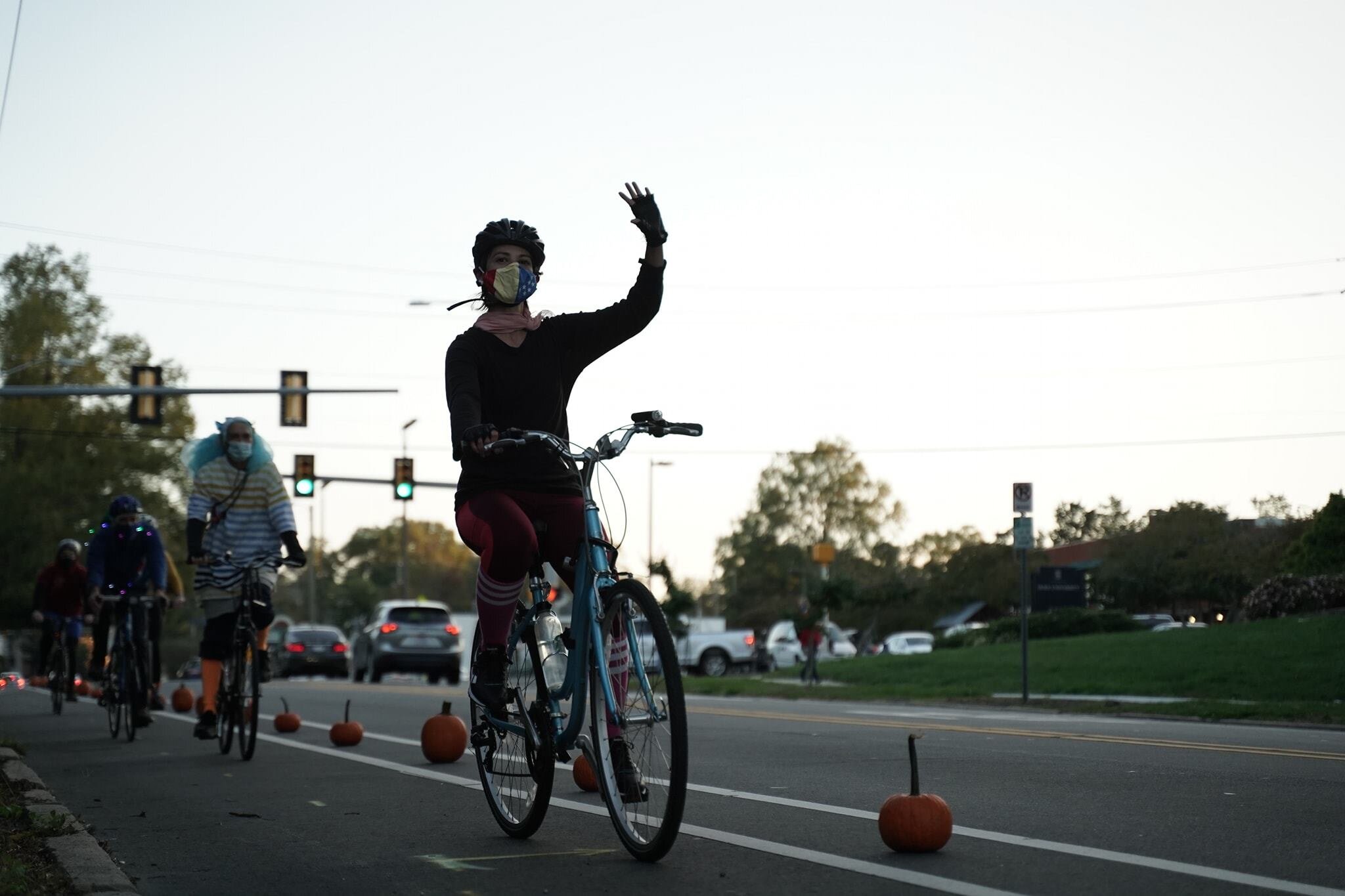
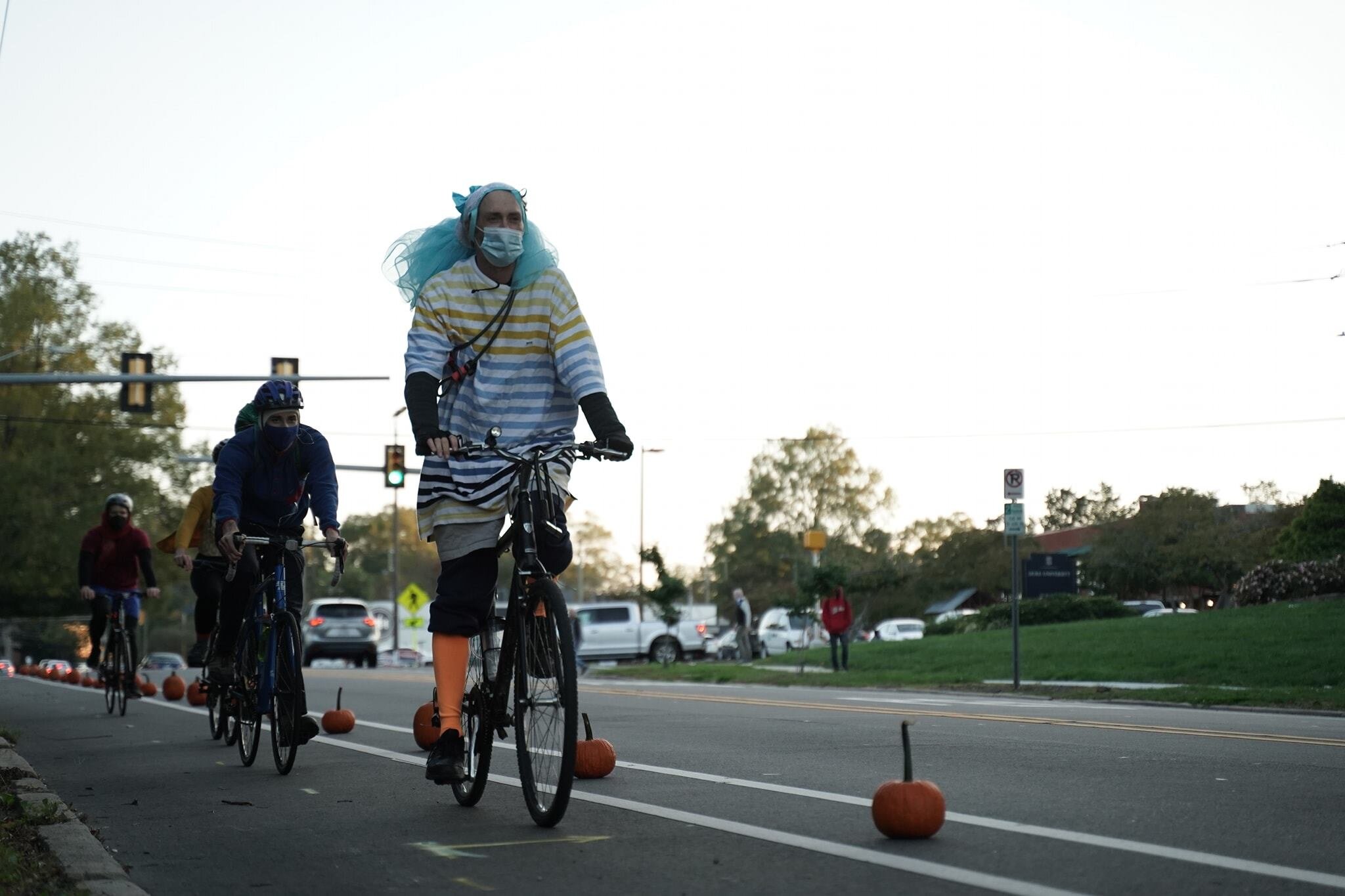
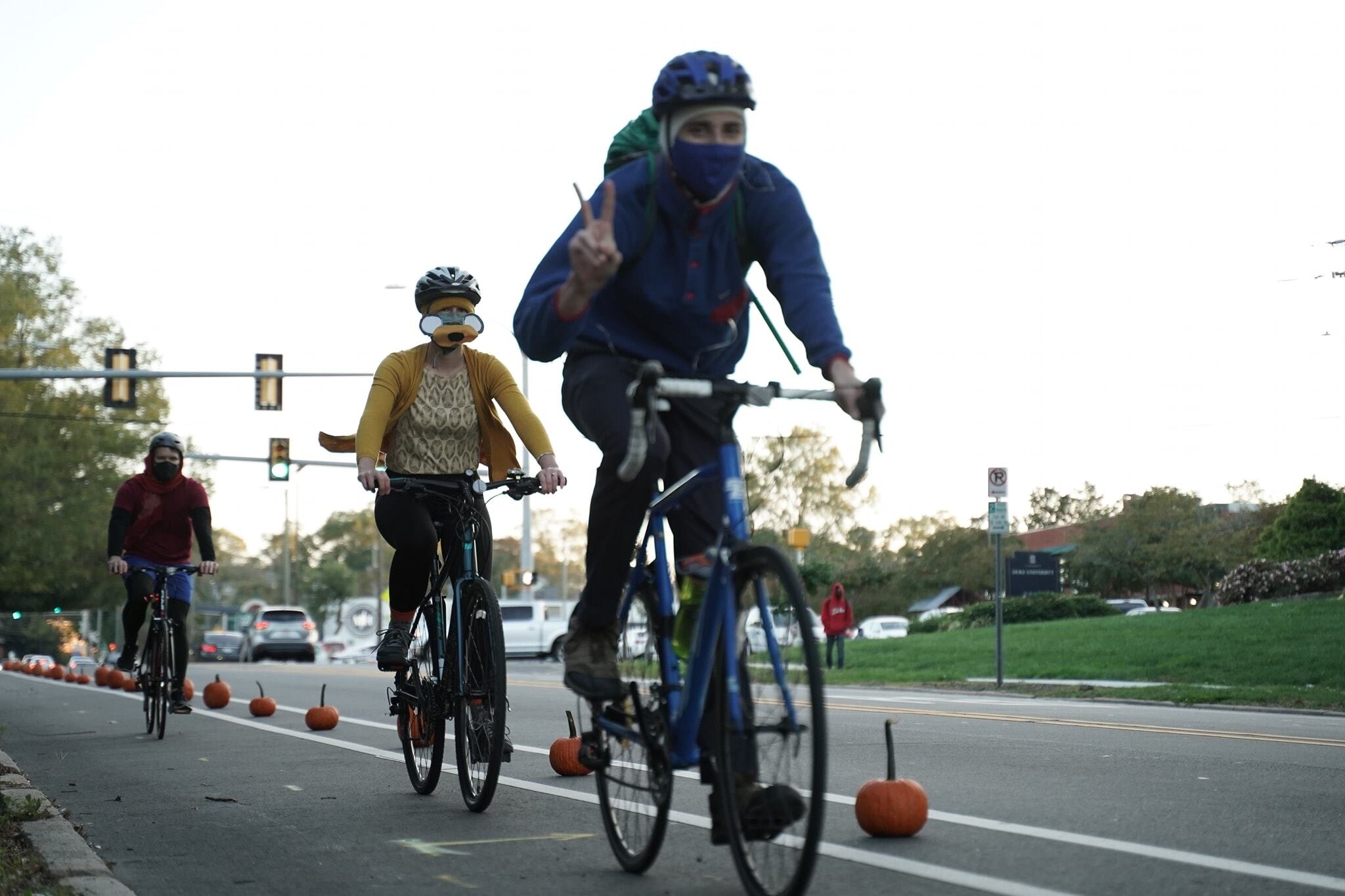
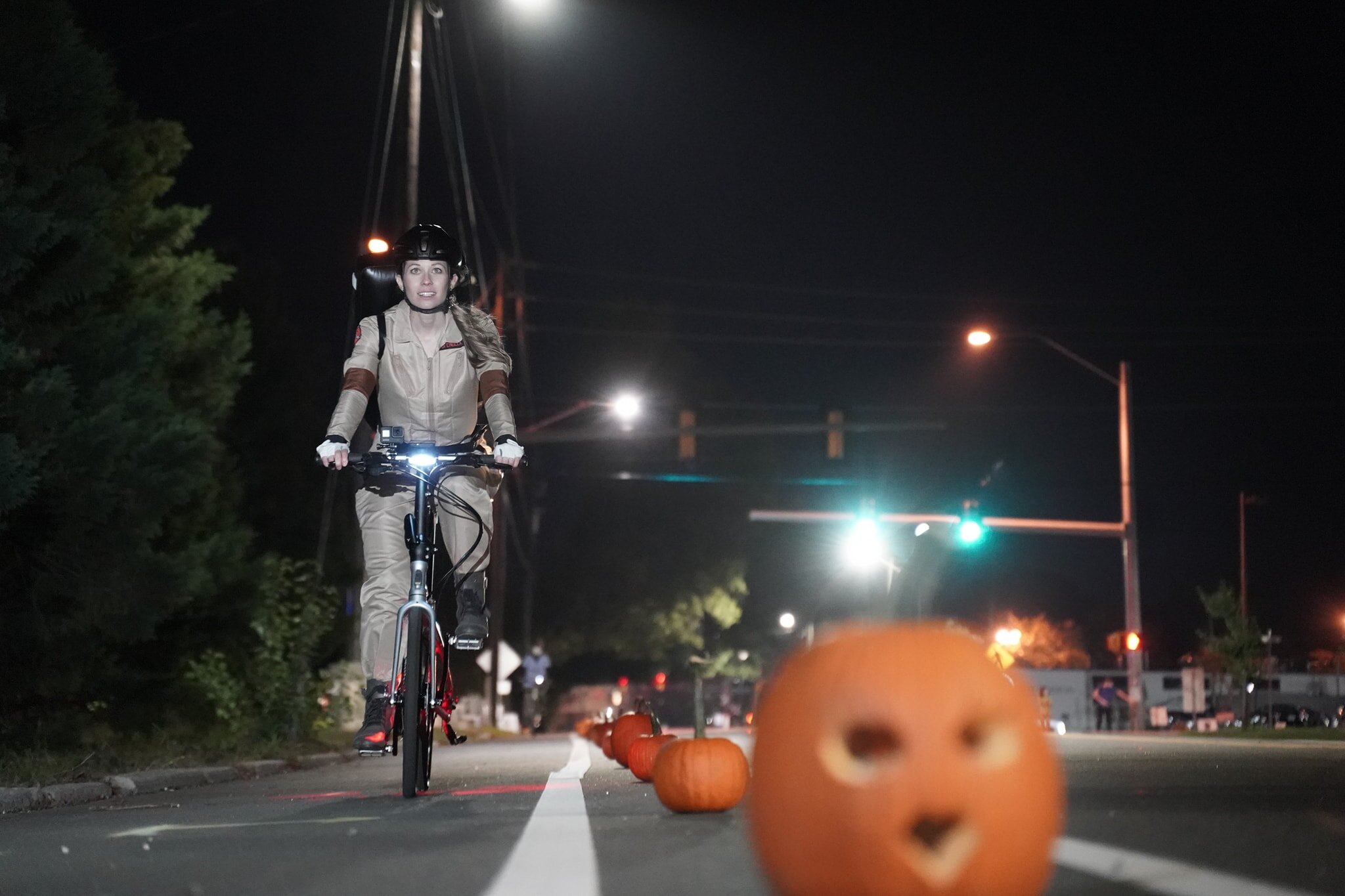
We were thrilled when we discovered that each ride had reached the cap, although we were disappointed that we couldn’t include everyone who wanted to go on the ride. Ride leaders Danielle King, Shaun King, Alison Klein, Seth LeJacq, Marc Maximov, and John Tallmadge led the groups on a 10-mile trip around the city at dusk: one group on Saturday, October 24, and two groups on Saturday, October 31. We gave away candy and lights, and we were delighted at the costumes that bikers wore: a clown and a haunting, two llamas, Amelia Earhart, and a witch, among others.  

125052043_3628105313912744_3830729363506398021_o.jpg


We set up the route in Ride with GPS, a route planning app that allows planners to add stops, information, and even photos (Bike Durham membership comes with a free account on Ride with GPS). We were therefore able to include archival pictures for each stop, as well as additional information about the story of that location, which riders could look at when we reached a stop or browse later at their convenience.

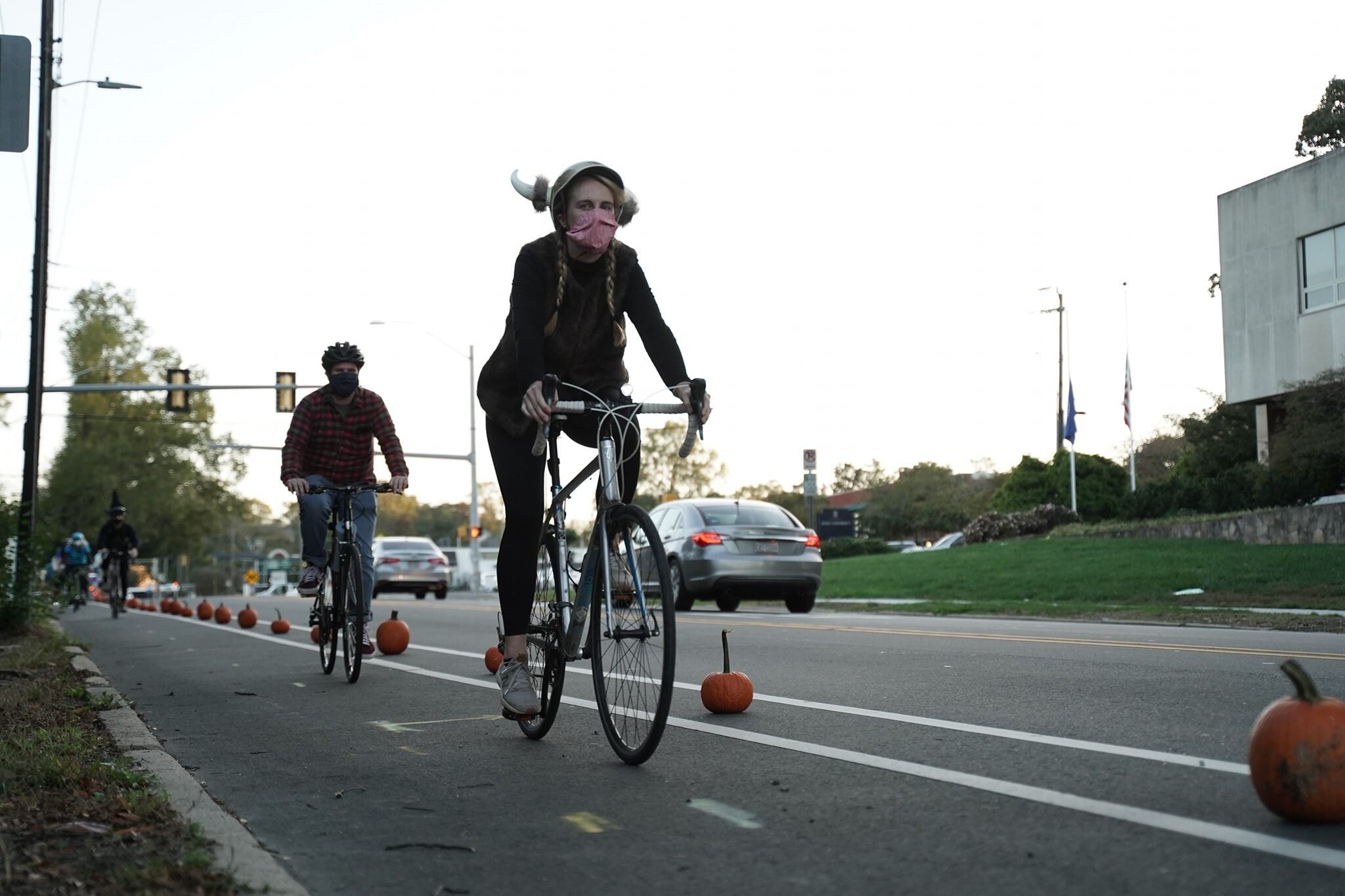
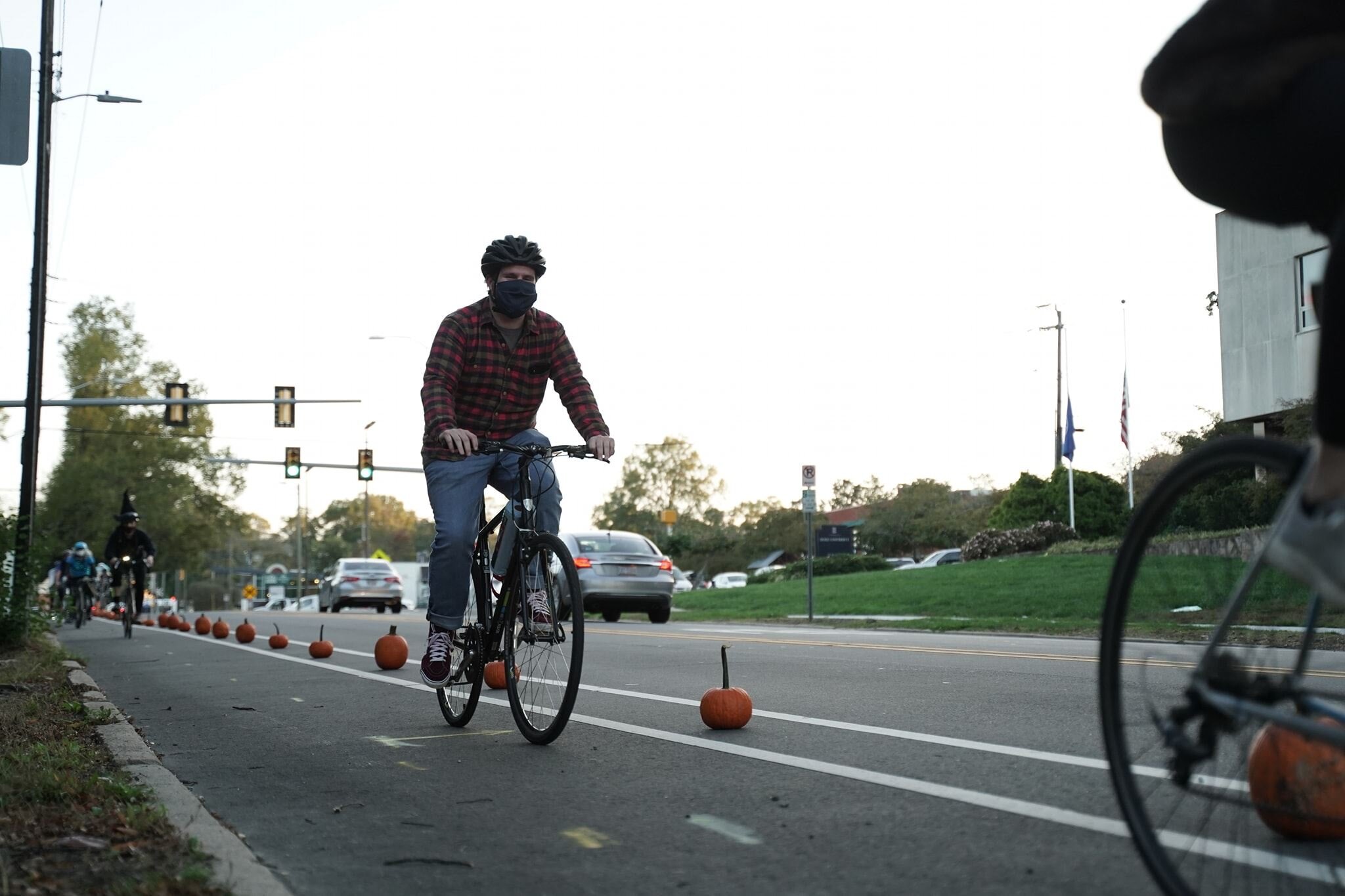
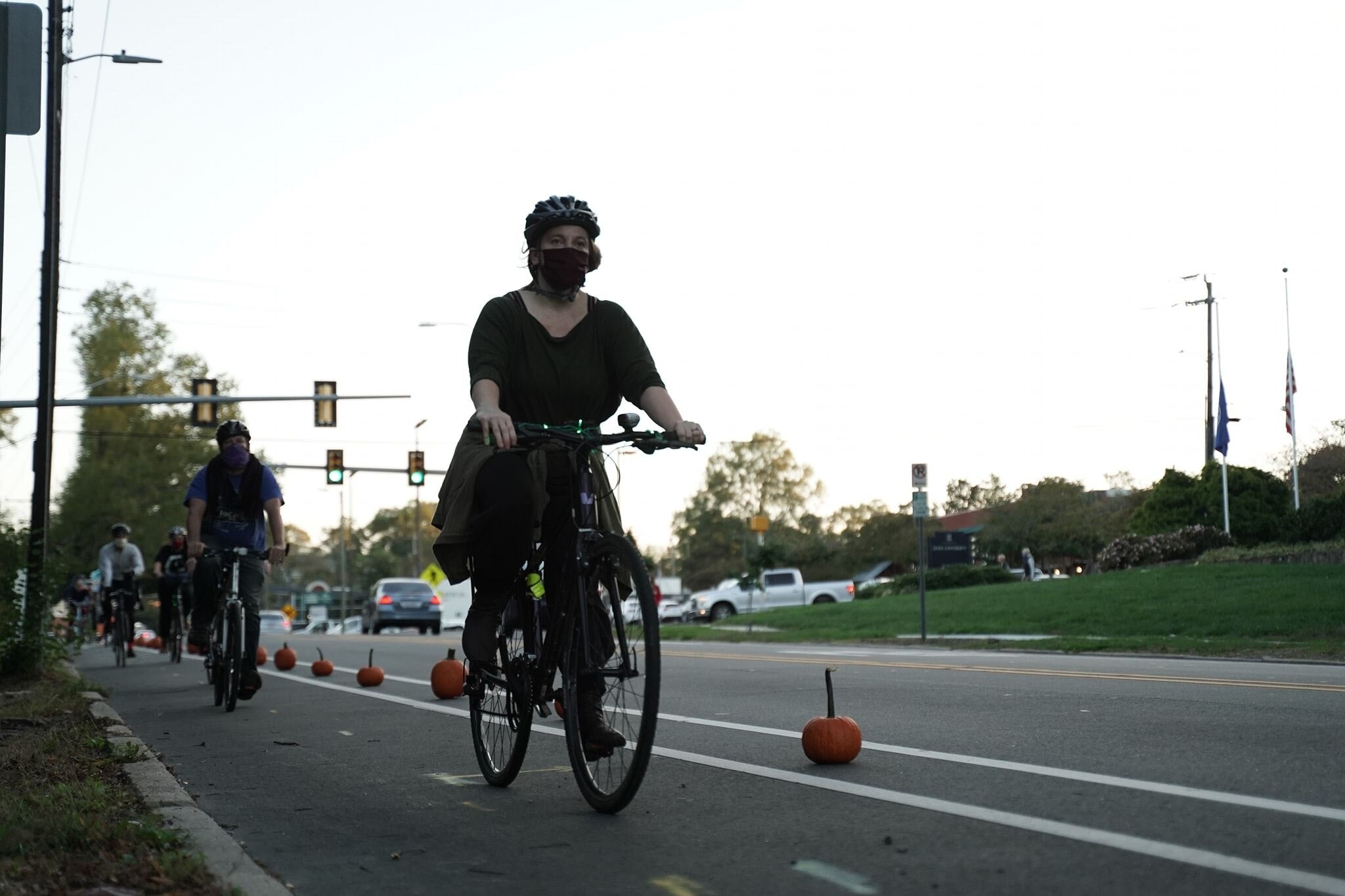
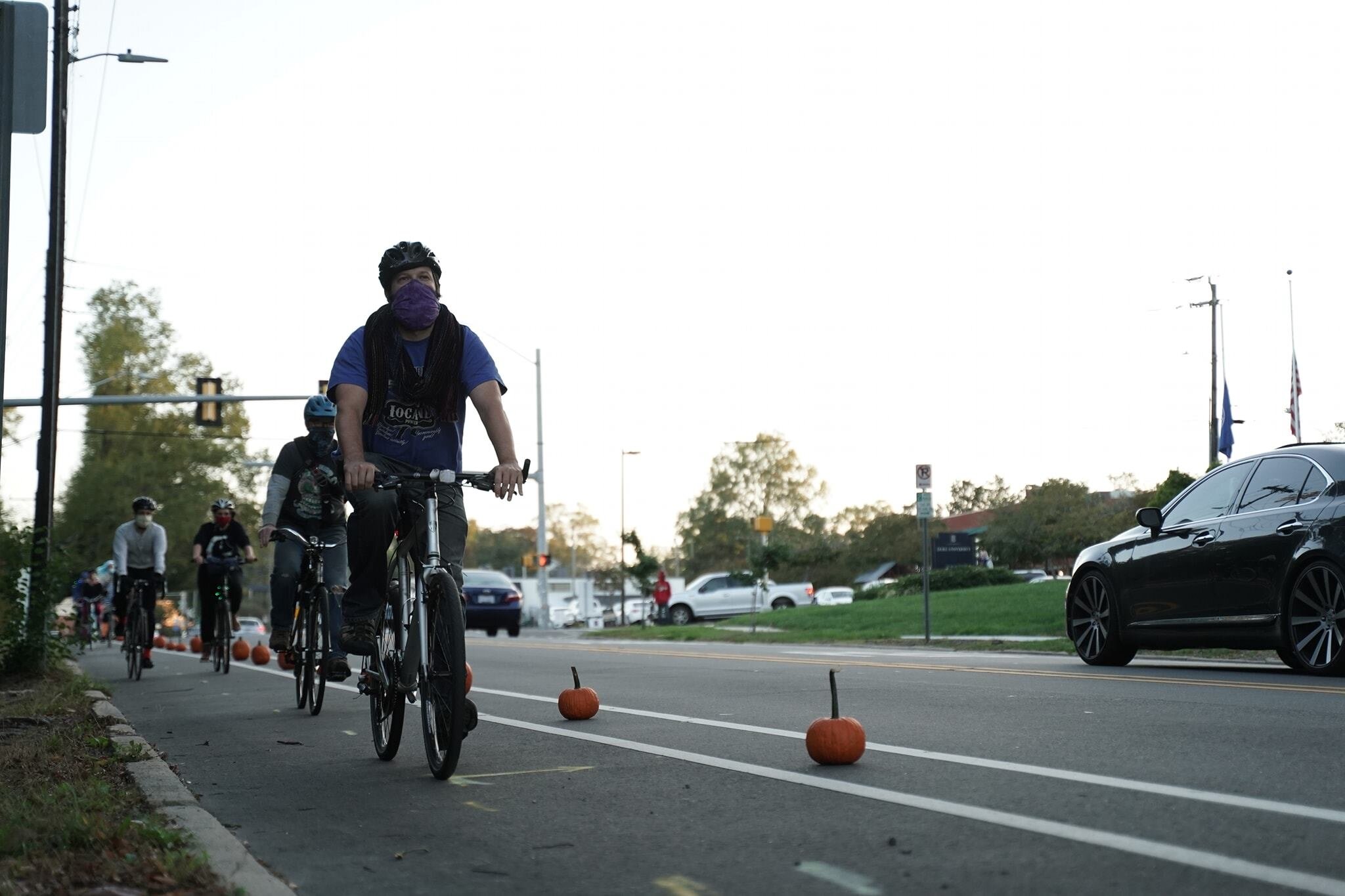
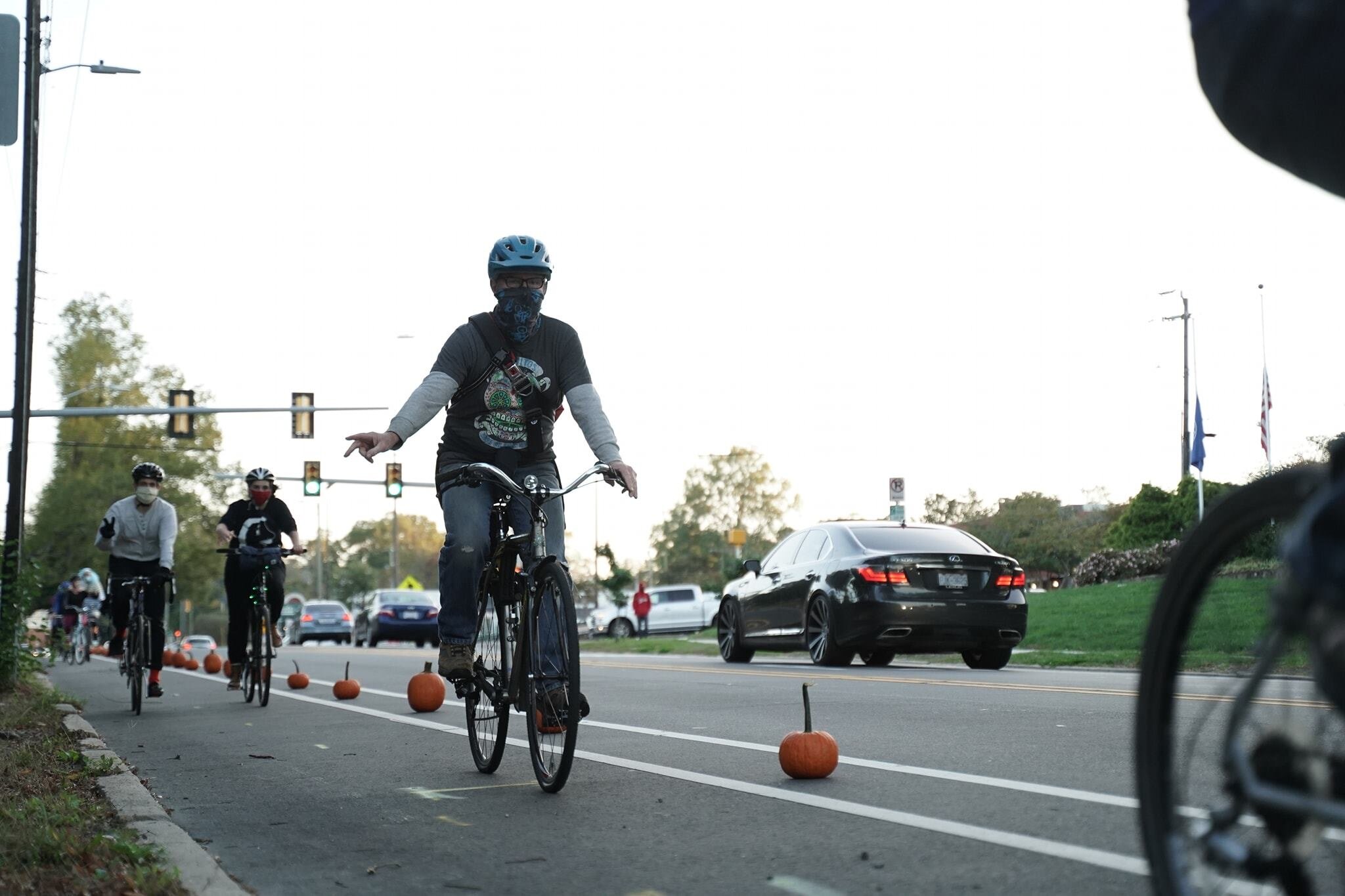
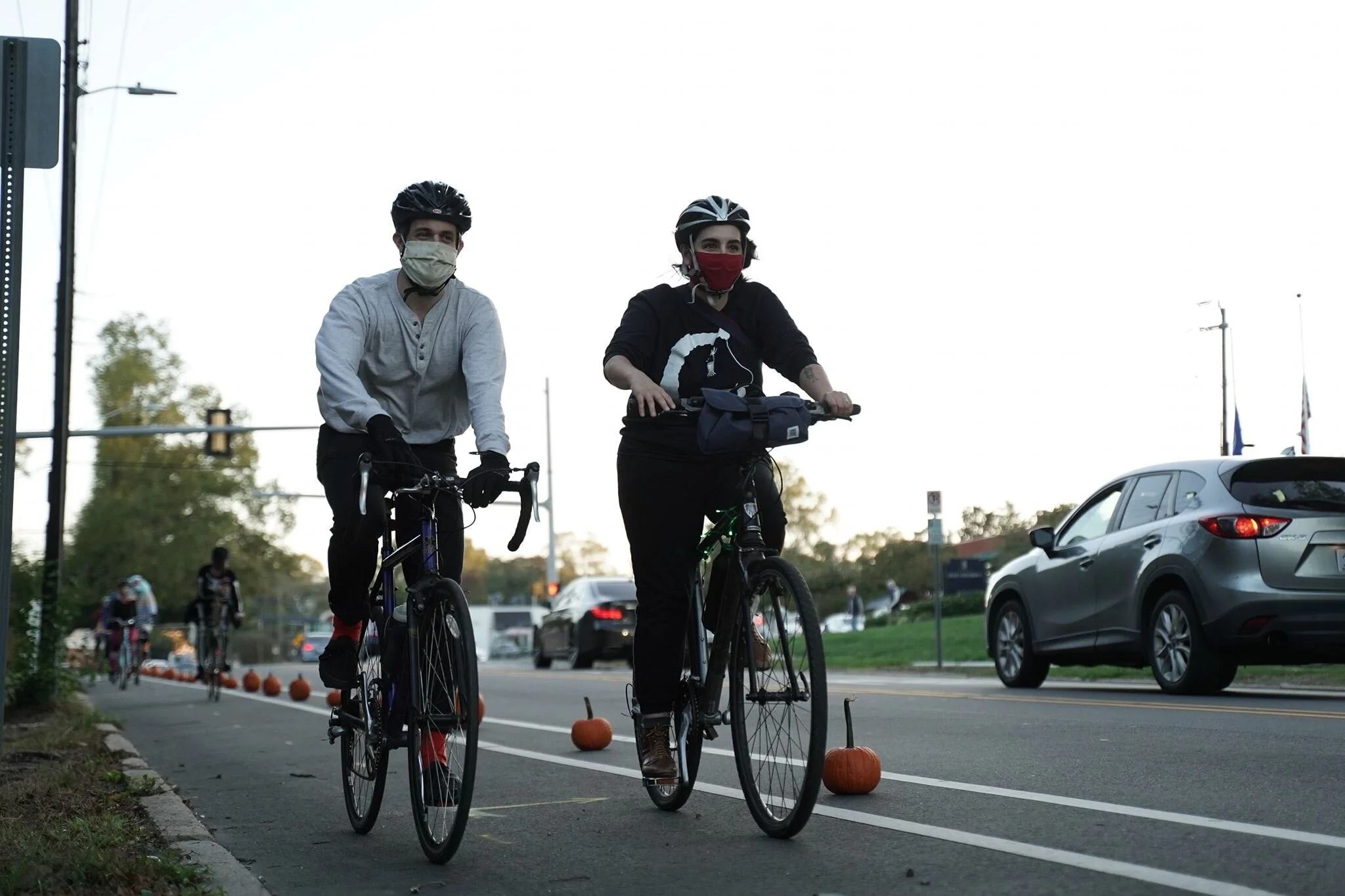
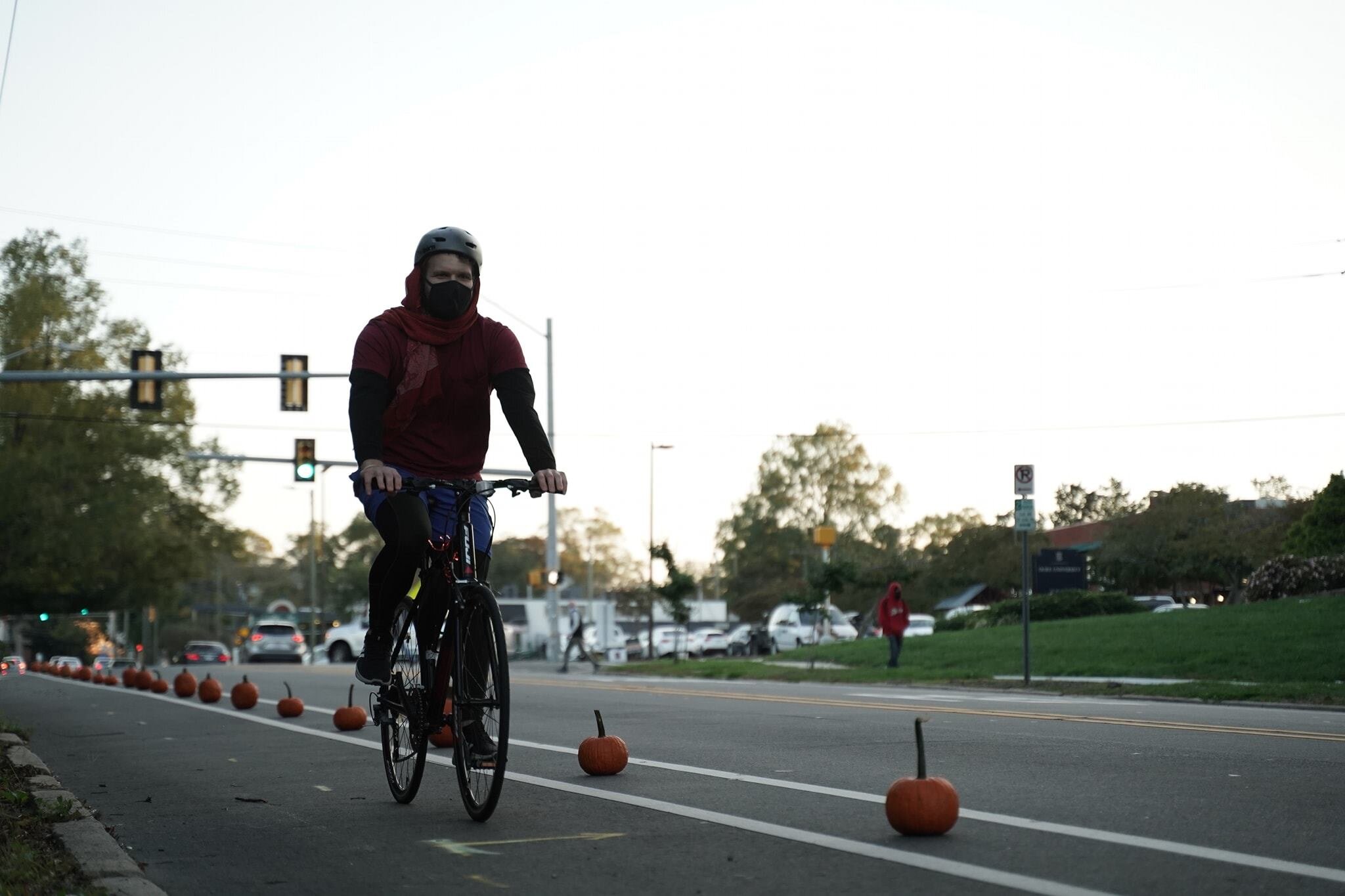
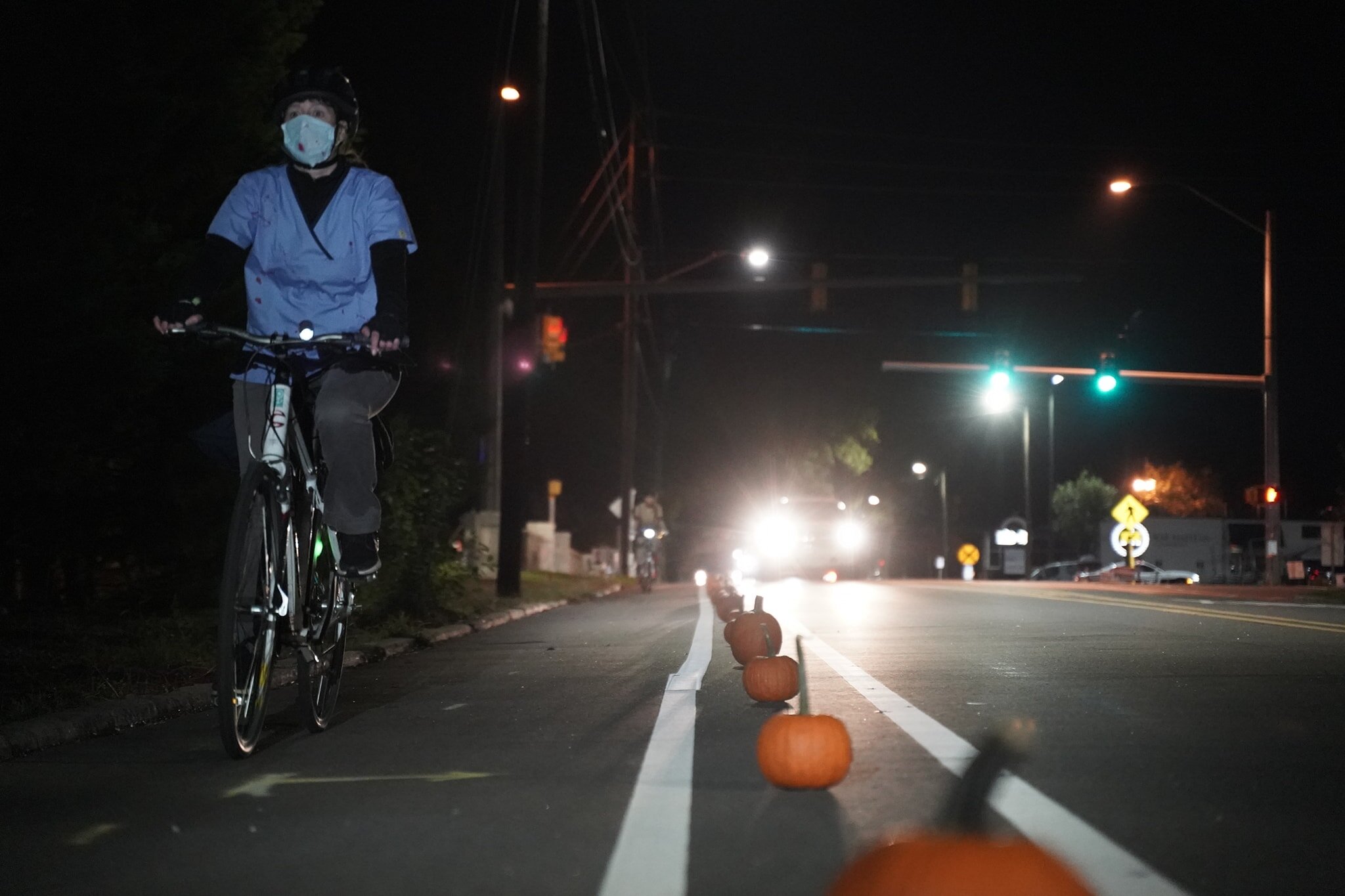
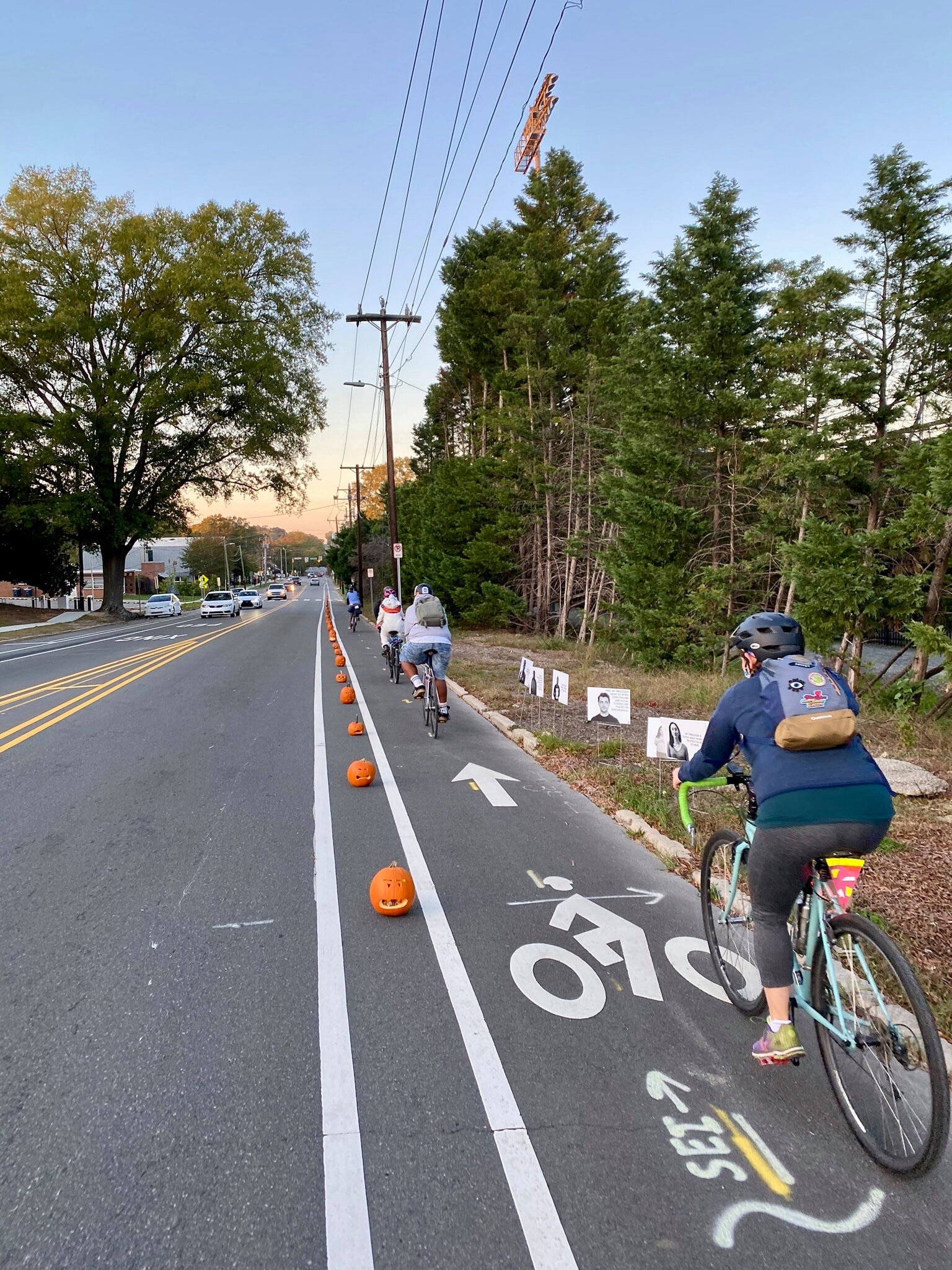
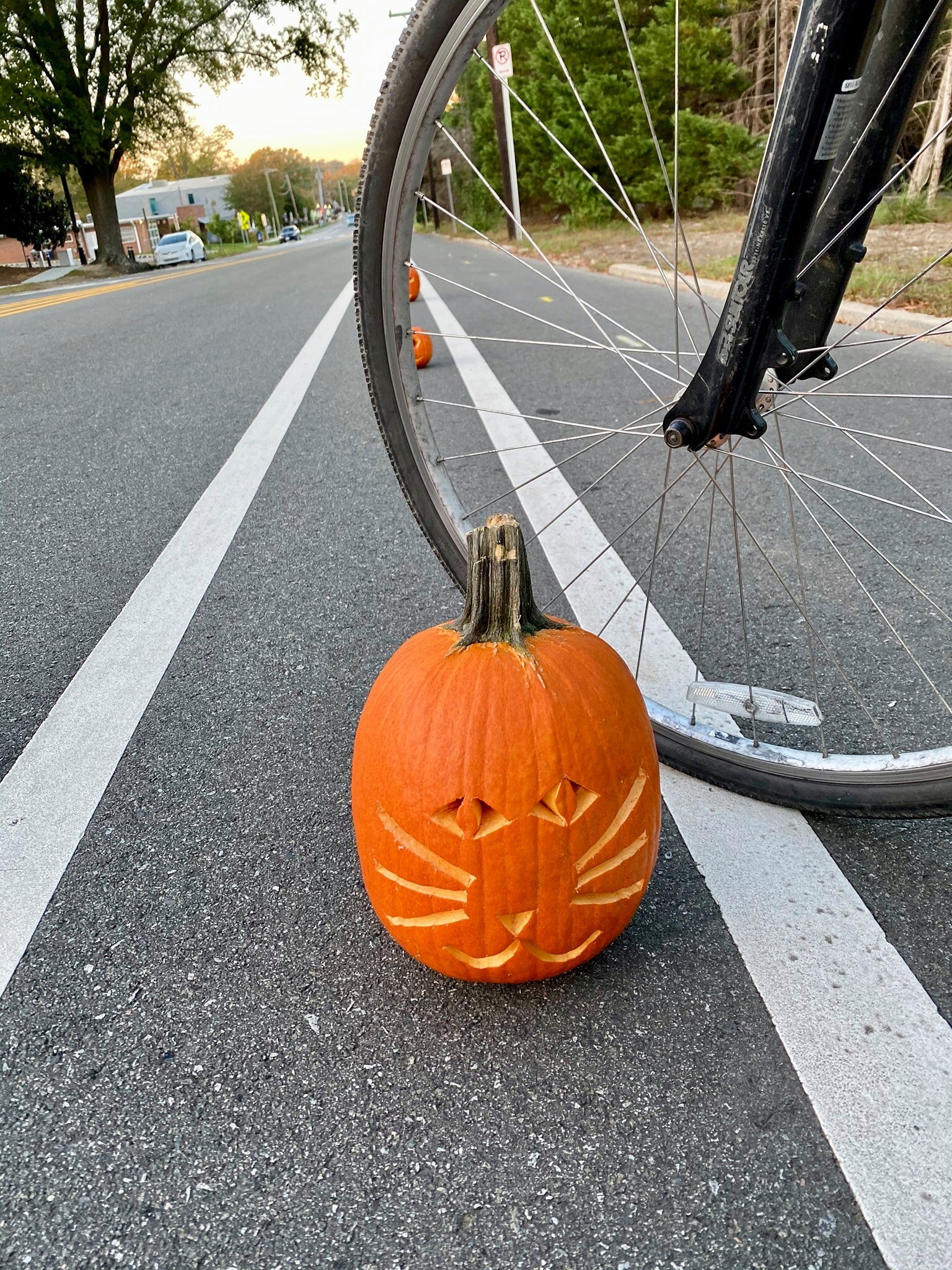
Last year, we created a pumpkin-protected bike lane along one block of the route, Broad Street between Perry and Markham, it was featured in Streetsblog USA and we made a short video about it. We recreated it again for 2020 with dozens of carved pumpkins standing in the gap between riders and vehicles, drawing attention to the need for physical barriers on bike lanes throughout the city in order to protect bikers.


At each stop, we played snippets of horror movie music, and participants guessed which movie the piece came from; winners were rewarded with Reese’s peanut butter cups. Darkness fell as we completed the route, which made the stop at the old railroad tracks on Washington even spookier, and the giant lawn decorations in the shape of Beetlejuice sandworms even more impressive. At the end of the October 31 ride, bikers stood and chatted in CCB Plaza for 20 minutes, and some new friends even went off to an art exhibit together.

We hope to make this ride an annual tradition! We want to thank librarians Valerie Gillespie, Kelley Lawton, and Elizabeth Shulman for their help in uncovering these ghost stories; Open Durham for their excellent archival photographs and historical information; Kyle Sullivan for sharing his professional-level photographs with us; and everyone who participated. We hope you had as much fun on the ride as we had planning it.

 
125239115_3628109833912292_6450808514538263590_o.jpg
 

Switching Gears during COVID-19

Jamaican-Dr-Naima-Stennett-Journey-from-Sports-to-Medicine-and-her-Passion-for-Kids-with-Cancer-2.png


Author Dr. Naima Stennett, Board-Certified Family medicine physician and Sports Medicine Fellow 

We have a saying in medicine, “Exercise is medicine.”  During this pandemic one way we can be healthy is to re-visit an old skill or try something new. After all we know once you learn how to ride a bike you never forget. There are multiple benefits of riding a bike. These can be remembered with the mnemonic C.Y.C.L.E

Naima Stennett-08827.jpg
  • C: Cardiovascular health and other chronic conditions: cardiovascular health include stroke, high blood pressure and heart attack. Regular cycling improves circulation as week as heart and lung function. These benefits your risk of cardiovascular diseases. Regular cycling has the added benefit of glucose control and reducing risk of diabetes. 

  • Y: Your weight – Cycling can help burn fat and paired with a healthy eating plan can boost your metabolism helping you lose weight. 

  • C: Clear mind: Cycling like other aerobic exercise stimulates the release of endorphins,  (the feel good hormones) this results in a feeling of well-being and promotes positive emotions such as happiness.

  • L: Lean muscle and strong bones: Resistance activities such as pedaling up the sloping trails help to build and strengthen muscles as well as increase bone density.

  • E: Easy on your joints: Cycling is a low impact sport. Due to the minimal stress on the joints Individuals who suffer from joint pain can easily participate.

Getting Started with the basics 

  • Helmet: With safety being the priority it is important to purchase a helmet that fits appropriately. 

  • A bike that fits: It is important to connect with a local Bike shop that will help you pick the right bike for your height. They will help match you with a bike for the type of terrain well as customized fitting to make you’re ride enjoyable. 

  • Saddle: It is important to know that this just as important as getting fitted for the right pair of sneakers. One of the main purposes of the saddle is to provide support and prevent increase pressure to the perineum. It is important to have the right saddle as this can reduce numbness and tingling in the legs due to compression of nerves and arteries that supply the lower body.

  • Cycling gear: Bike shorts are engineered to have thick padding to reduce chafing and cushioning while you ride. Various cycle jersey exist that help both in warm and cool temperature. They also have reflective designs so that both motorist and another cyclist can see you.

  • Water bottle rack: It is important to stay hydrated during activities especially If you plan to do more than 1 hours of cycling. Hydrated before, during, and after your ride.

  • Other tips: Find a local bike club that can help you stay motivated to keep pedaling. There are many bike lanes and trails in the Raleigh-Durham area including the American Tobacco Trail. New riders should avoid riding on the street especially if they do not have bike lanes. Lastly, do not forget your sunscreen and sunglasses

Happy Cycling

 No content in this article should be used as a substitute for direct medical advice from your doctor or other qualified clinician.


Bike Durham Webinar: Working with State and Local DOTs for Safe & Healthy Streets

On Wednesday, September 24, 2020, Bike Durham held a two-part webinar on the challenging conditions of many Durham streets, and on how design firms are working with state and local Departments of Transportation to make streets more accessible to all users. The webinar, sponsored by HDR, Inc, was moderated by Bike Durham director John Tallmadge.

It began with a discussion by Bonita Green, president of the Merrick-Moore community club, about unsafe road conditions in that neighborhood. Next, Oxford Manor community leader Tammy Ferrell spoke on the streets in her area.

Then Patrick McDonough, AICP; Rick Plenge, PE, PTOE; and Michelle Podeszwa, PE, all of HDR, Inc., shared their experiences working with state and local transportation departments to develop street designs that are safer for people walking and biking.

The webinar ended with a brief Q&A. Text from the chat is as follows:

From Charlie Reece: Hi everybody, this is Charlie Reece from the Durham City Council. Great to see y’all, looking forward to this webinar.

From Zack Hawkins: I appreciate this webinar, as well. Zack Hawkins, NC House District 31. Look forward to getting the recording to share out on my page, if permissible.

From SpiritHouse NC: I love this kind of background.

From Erik Landfried (he/him), Bike Durham: It's frightening to even drive on Cheek Road.

From SpiritHouse NC: It is frightening.

From SpiritHouse NC: There is a city process for speed bumps but it is a very difficult process.

From Bonita Green: Merrick Moore has worked with DPD and DSO to do speed traps. This works for a while but eventually the speeding starts again.

From Kevin Young: Yeah, I've tried to ride on Old Oxford. It's nuts.

From Kevin Young: Thank you Tammy.

From Molly De Marco (she/her): Thanks Tammy!

From Zack Hawkins: Thanks for sharing.

From Constance: There are huge traffic issues on Belvin Ave at Danube. Potholes, narrow streets. Also at East Club to Glenbrook Dr.

From Kevin Young: Agreed Constance, no space on East Club, it's hairy.

From Kevin Young: May I ask please, are there any DOT people in this meeting/presentation?

From Mary-Jo Gellenbeck: Thank you promoting low-cost implementations to generate faster improvements.

From John Tallmadge, he/him, Bike Durham: I don’t think so, Kevin. Richard Hancock from Division 5 had registered, but it doesn’t appear that he has been able to join.

From Kevin Young: Thanks John.

From John Tallmadge, he/him, Bike Durham: North Roxboro Street is a 4 lane road like that.

From Kevin Young: John, it is, but it's not nearly as wide as this image.

From Kevin Young: This is cool, looks cool in the illustrations. John, let's do this on Roxboro. And Tammy, on old Oxford.

From Matthew Clark (he/him): My question is for John or folks with the City. Durham’s transit tax brings in millions of dollars every year. Could that revenue be used to purchase streets from NCDOT if the purchase is part of a larger plan for a safe, reliable, and sustainable transit and mobility system in Durham? And what are the pros and cons of doing something like that?

From Bonita Green: What low cost suggestions do you have for two-lane rural roads with no shoulder?

From Constance: How did these projects affect neighborhoods as far as destruction, especially lower-income and neighborhoods with limited investments?

From Charlie Reece: Mr. Clark, thanks for that question. That’s certainly possible, but there are lots of competing needs that need to be addressed by the Durham transit tax (including robust funding for our bus system). But I’d also point out that the transit tax is collected by Durham County, not the city of Durham, and our friends at the county commission determine the spending priorities for those funds.

From Charlie Reece: I need to step away but I will watch this Q&A section later once the recording is posted. Many thanks to everyone for a great event!

From Bonita Green: The lanes are very narrow. Resurfacing is the only improvement that has been done.

From Zack Hawkins: Thanks everyone. Look forward to being in touch. Good job Bike Durham and HDR.

Bike Durham Launches Transit Equity Campaign

On September 1, 2020, Bike Durham launched the Transit Equity Campaign in partnership with four other Durham nonprofit organizations: the Coalition for Affordable Housing and Transit, the Durham Committee on the Affairs of Black People, Durham Congregations in Action, and the People’s Alliance. The following press release lays out the campaign’s vision and the urgency of its mission. For more information about the campaign, including how to get involved, visit bikedurham.org/transit.

Our Comments on the 2050 MTP Draft Goals and Objectives

CALL TO ACTION

The Durham-Chapel Hill-Carrboro Metropolitan Planning Organization (DCHC-MPO) is responsible for transportation planning for Durham and the western part of the Research Triangle area. On August 12, they held a public meeting to discuss their 2050 Metropolitan Transportation Plan (MTP) Goals and Objectives. This long-range transportation plan is updated every four years and guides transportation investments in the region.

While we agree with the inclusion of goals and objectives that go beyond the traditional measures of traffic speed and congestion delay we don’t believe that they are responsive to the values of our community. By 2050, we want to see zero disparity of access based on race and income, zero carbon emissions, and zero deaths and serious injuries on our streets and highways.

Please contact your elected officials on the MPO Board this week and ask them to direct staff to rewrite the goals to more clearly communicate the direction we want to go, and to rewrite the objectives to establish measurable outcomes for 2050 and interim years that will get us to zero disparity, zero emissions, and zero deaths. Ask them to vote against these goals and objectives unless they are changed.

You can view Bike Durham’s full recommendations on each of the Goals and their objectives below:

Goal: Protect the Human and Natural Environment and Minimize Climate Change

Objectives: Reduce mobile source emissions, GHG, and energy consumption; Reduce negative impacts on natural and cultural environment; Connect transportation and land use

We agree that this is a very important goal, and appreciate that the staff has included it. We believe the first objective should be net-zero carbon emissions from the transportation sector by 2050. The second and third objectives are directionally fine, but they do not specify the conditions we aim to achieve by 2050.

Goal: Connect People and Places

Objectives: Connect people to jobs, education and other important destinations using all modes; Ensure transportation needs are met for all populations (especially the aging and youth, economically disadvantaged, mobility impaired, and minorities)

We agree that this is an important goal, but we do not believe the language is adequate. We urge rewriting the goal as “Connect all people and places without disparity.” We urge the objective to be “Achieve zero disparity of access to jobs, education, and other important destinations by race, income, or belonging to a marginalized group.”

Goal: Promote and Expand Multi-modal & Affordable Choices 

Objectives: Enhance transit services, amenities and facilities; Improve bicycle and pedestrian facilities; Increase utilization of affordable non-auto travel modes 

While we support these strategies and tactics in achieving the goals of zero carbon emissions, zero disparity of access, and zero deaths on our streets and highways, the only goal defined here is affordability. We urge rewriting the goal as “Ensure that all have affordable access to the transportation system.” We ask that the objectives include: “No one should pay more than 40% of their income for housing plus transportation by 2050.” It may be valuable to establish objectives around the percentage of trips that use sustainable modes of transportation, but we would recommend that be established under the first goal, supporting the objective of zero carbon emissions, paired with an objective regarding the percentages of the motorized fleets that are electric.

Goal: Manage Congestion & System Reliability

Objectives: Allow people and goods to move with greater reliability; Promote Travel Demand Management (TDM, such as carpool, vanpool, telecommuting and park-and-ride); Enhance Intelligent Transportation Systems (ITS, such as ramp metering, dynamic signal phasing and vehicle detection systems)

We agree that system reliability is an important goal. By that, we mean that connections are available when people need them, and that travel times are predictable. Measures of congestion are not as important as measures of travel time predictability, and travel times should be comparable for all system users. "Objectives 2 and 3" are strategies, not objectives.

Goal: Improve Infrastructure Condition and Resilience

Objectives: Increase proportion of highways and highway assets in 'Good' condition; Maintain transit vehicles, facilities and amenities in the best operating condition; Improve the condition of bicycle and pedestrian facilities and amenities; Promote resilience planning and practices; Support autonomous, connected, and electric vehicles

This is a well-defined goal and set of objectives—except for the last one. ​The last objective seems to be a strategy, and doesn’t have a clear connection to the goal. Also, “improving conditions” should not be equated with expanding capacity. There is a long tradition defining any transportation project as an “improvement” (i.e., Transportation Improvement Program).

Goal: Ensure Equity and Participation

Objectives: Ensure that transportation investments do not disrupt communities; Promote equitable public participation among all communities

We agree with the goal; however, the first objective does not acknowledge that the existing transportation system has placed disproportionate burdens on low-income communities, especially Black communities, and on individuals without regular access to a car. One objective should be a transportation system with zero disparities of access based on race, wealth, income, gender identity, age, or ability. We urge rewriting the second objective to read, “Ensure equitable public participation among all communities: geographic, racial, age, income, gender, and ability.”

Goal: Promote Safety and Health

Objectives: Increase safety of travelers and residents; Promote public health through transportation choices

This is an essential goal. Objective 1 should be stated as zero deaths or serious injuries on our streets and highways by 2050. Objective 2 should be measurable, such as “All residents will have safe access to active transportation choices by 2050.” Interim targets should also be established.

Goal: Stimulate Economic Vitality

Objectives: Improve freight movement; Coordinate land use and transportation; Target funding to the most cost-effective solutions; Improve project delivery for all modes

While the goal seems laudable, it does not indicate for whom. When we don't indicate for whom we are stimulating economic vitality, there is usually a group left behind, and that group is usually those who are Black or brown, and at the lowest end of our income and wealth scales. If our transportation system is to become equitable, it needs to stimulate economic vitality for all socio-economic groups, with objectives, and ways to measure progress, set toward that goal. We recommend a replacement goal of “Enhance inclusive local and regional economic opportunity.”

Second, "improve freight movement" is ambiguous. Does this mean shorter freight travel times? Or greater predictability of travel times? If a goal suggests the direction we're going, an objective should communicate where we want to end up. Improving freight movement doesn't do that. Neither does the fourth objective. The third objective is important, but it isn’t specific to this goal. We want cost-effective solutions that achieve multiple goals.

We recommend the following objectives: Maximize local-hire opportunities in construction, operation, and maintenance projects; prioritize pedestrian and bicycle access to local businesses over automobile access and parking; promote transportation-related businesses in ways that help ownership reflect the demographics of the regional population by race and gender; and ensure projects that benefit the local community without displacing residents.

Bike Durham's Letter to the City on the Move Durham Transportation Study

In late June 2020, the City solicited feedback on its Move Durham Transportation Study. The public was invited to post comments on the pdf in the above link through July 24.

While the study contains many admirable improvements to the downtown Durham streetscape, we feel it doesn’t go far enough in envisioning a more walkable, bikeable, transit-friendly city. On July 28, Bike Durham sent a letter to the Transportation Department summarizing our response. The text of the letter is below.

Bike Durham's Statement on Recent Events

Bike Durham has been considering how to respond to both the unjust murders of George Floyd, Ahmaud Arbery, Breonna Taylor, and the many others before them as well as to the violent use of force from police departments across the nation to silence the protesters. We support the protests calling for justice. We are fortunate in Durham to have peaceful protests, and acknowledge it took years of work from the Black community to reform our departments and elect Black leaders into positions of power to enable that peace. But the work is not over, and all of us need to participate. 

As a transportation advocacy organization, we are answering the call by looking within ourselves and our own organization, as well as the transportation system and decision-making processes within Durham—not just to undo the harms caused by historical racist decisions, but also to actively acknowledge the ways in which our current system upholds these racist outcomes. We also know that we need to go beyond words, and take actions to support leaders of color working for justice and to develop and strengthen our own relationships with communities of color.  

We are using this time to recommit ourselves to our mission statement: We believe everyone should have access to safe, affordable, and sustainable transportation regardless of race, wealth, gender identity, ability, or where they live. Bike Durham empowers people of all ages to walk, bike, and ride transit more often by promoting policy, infrastructure, education, and community events.

We encourage you to also engage in the work of dismantling racism. If you are looking for resources, there are many available online. You may find this one helpful. To deepen your understanding of the concepts of mobility justice, we urge you to read the work of the Untokening collective. We invite you to share resources that you have found informative and helpful via social media or email to director@bikedurham.org.

We have a lot of work to do. Bike Durham is committed to doing the work to dismantle white supremacy culture in local transportation processes and within our own organization. 

Sincerely,
John Tallmadge, Executive Director
Allison Shauger, Board Chair

Bike Month Webinar: City Update on Biking and Walking Projects

The final Bike Month webinar on May 27th featured City of Durham Transportation Planning Manager Ellen Beckmann. She laid out the timeline of the City’s upcoming pedestrian- and bicycling-focused projects, and talked about the various challenges to getting them implemented.

At the midpoint and at the end, attendees had the chance to ask Beckmann questions. Text from the meeting’s chat window is reproduced below the video.

Andrew Black: Apologies if this is being addressed, but I’m hoping for an answer on our safe/open streets.

John Tallmadge: Thank you, Andrew. That will be part of Ellen’s presentation.

Andrew Black: What about narrowing streets and adding bike lanes?

Craig Young: YEAH!!!

Lauren Dirgo: That’s great news

Cynthia Bland: Yes, it seems like a road-diet to add a bike lane would be a more cost-effective project, right?

Andrew Black: That’s a lot of progress, nice work!

John Tallmadge: FYI: The Neighborhood Bike Routes are an iteration on the Bike Boulevards concept.

Andrew Black: What is timing for belt line?

Carlye Gates: Question about the neighborhood bike routes project: At least one of the streets included on the map (Gray Avenue) does not currently have any sidewalks, unfortunately. Would sidewalks, in addition to bike lanes, be added to these streets? If not, it would seem concerning to have bike lanes without a safe place for pedestrians to walk, as it would not be safe (for cyclists or pedestrians) to have pedestrians walking in the bike lanes.

Dave + Renee: Would that BUILD grant help expedite the Belt Line?

Craig Young: Is the City updating their Comprehensive Transportation Plan to include the future NCDOT projects that you mentioned, so that the updated Complete Streets Policy will apply and the City will not be responsible for any cost sharing for bike & ped accommodations on these projects?

Jim Svara: How is the City examining how to preserve and expand affordable housing around trail projects, in particular the Duke Beltline?

Nate: On the planning commission, we regularly recommend approval for hundreds of acres of sprawl development. No connectivity. No street trees. What can your department do to help change that precedence?

Andrew Black: Can you provide more detail on slow streets plan? It’s embarrassing and frustrating that nearly every city in the developed world has something except us.

Lauren Dirgo: Does the cost difference between the independent and opportunistic projects have anything to do with the prohibition on using state funding for bike/ped infrastructure?

Steve Hinkle: Without sidewalks, the neighborhood bike routes might exacerbate bike/pedestrian danger.

Carlye Gates: Agreed, Steve. I'm not sure why a street without sidewalks would be included as a street in the neighborhood bike route.

John Tallmadge: The transit tax brings in $30-35 million per year and less than $10 million per year has been committed to ongoing services.

Cynthia Bland: Wow!

James Nishimuta: Is there a reason that the Transit Plan, and funding for it, only considers buses, rather than also biking and walking as forms of transit?

Andrew Black: Seems like the loop could be cut down by one lane and used for walking and biking.

Lauren Dirgo: Any chance of BRT being a part of the transit plan?

Dave + Renee: Triangle Bikeway!

Matthew Clark (he/him): Everyone that buys a candy bar pays that transit tax. As an outsider, I would love to see organizations like Bike Durham focus on what it means to spend the revenue equitably.

Alex M: Why does NCDOT (state gov?) manage city roads? Sounds like a horrible idea.

Nate: Do you think Durham is open to municipally-sanctioned pop-up urbanism projects for short term demonstration of non-automotive facilities?

James Nishimuta: I encourage everyone here also check out BikeWalkNC, an advocacy organization that focuses more on the state level. Seems like a lot of challenges here are related to NCDOT

Cynthia Bland: If biking/walking is such a high priority among residents, why is it so hard to get those funded and built? What can we do to make this happen?

Andrew Black: Love that idea!

Robert Bush: The State ownership of roadways dates back to the Great Depression. Generally the State owns major roadways and cities own the rest.

Cynthia Bland: Good stuff!

Andrew Black: Feel like Foster was closed for a year and it was fine—why not now?

Carlye Gates: Isn't there a two-bike limitation on buses though? Perhaps this is why there are fewer cyclists compared to pedestrians, going to bus stops?

Robert Bush: It’s more related to how many people walk vs bike over the short distance to access buses.

Steve Hinkle: Some buses have room for three. But other options are to bike to the bus and ride bus to destination, leaving bike locked at the stop for when you return. Some bike racks at high use stops might encourage this.

Katherine O'Brien: Bike racks are also very rare at bus stops.

Carlye Gates: Understood. Thanks, all.

Cynthia Bland: Thanks, Ellen! Great presentation!

Steve Hinkle: Thanks Ellen!

Graham Watkins: Thank you very much!

Bike Month Webinar: How Travel is Changing in Time of COVID-19

On May 20, Bike Durham held a panel discussion on how the coronavirus is changing the streetscape in cities across the country. It featured Durham community organizer and BPAC officer Aidil Ortiz; UNC-Chapel Hill professor Tabitha Combs; and special guest Warren Logan, who directs policy on mobility and interagency relations for the mayor’s office of Oakland, CA. The discussion was moderated by Bike Durham member Erik Landfried.

Bike Durham's Letter to the City, May 11, 2020

The City’s vitally important stay-at-home measures have changed the way Durhamites are using our streets. In a letter to transportation director Sean Egan, Bike Durham called upon City staff to address these changing circumstances with concrete action.

Here are the main points of the letter, in brief:

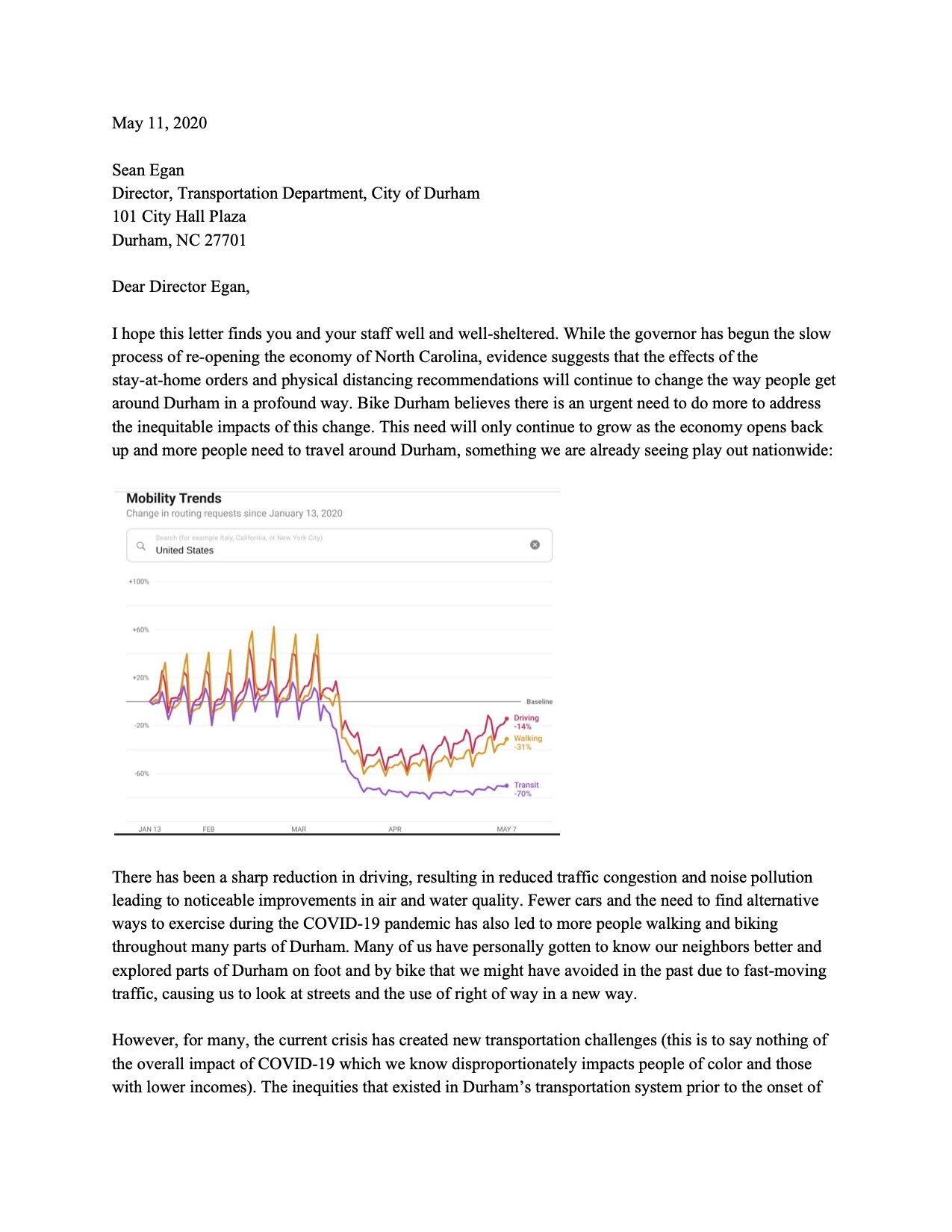
While the governor has begun the slow process of re-opening the economy of North Carolina, evidence suggests that the effects of the stay-at-home orders and physical distancing recommendations will continue to change the way people get around Durham in a profound way. Bike Durham believes there is an urgent need to do more to address the inequitable impacts of this change. This need will only continue to grow as the economy opens back up and more people need to travel around Durham.

For many Durhamites, the current crisis has created new transportation challenges (this is to say nothing of the overall impact of COVID-19 which we know disproportionately impacts people of color and those with lower incomes). The inequities that existed in Durham’s transportation system prior to the onset of the pandemic have only been further exacerbated. Bus operator availability led to the recent decisions to reduce GoDurham to Sunday-level service and physical distancing recommendations (essential to protect bus operators) now limit the number of people on board buses to 16. This has left people behind and created additional delays for those who rely on the service.

To address these inequities and facilitate safe physical distancing on Durham's streets, Bike Durham has requested that the City, with assistance from Bike Durham members and volunteers, do the following things:

  • For the protection of riders and drivers, provide face masks free-of-charge to all fixed-route and paratransit customers who need them until the need for them ends.

  • Develop strategies to ensure that Durham’s most vulnerable residents are still able to travel to essential jobs or services without extra delays or unreliability due to the new capacity limits on GoDurham buses.

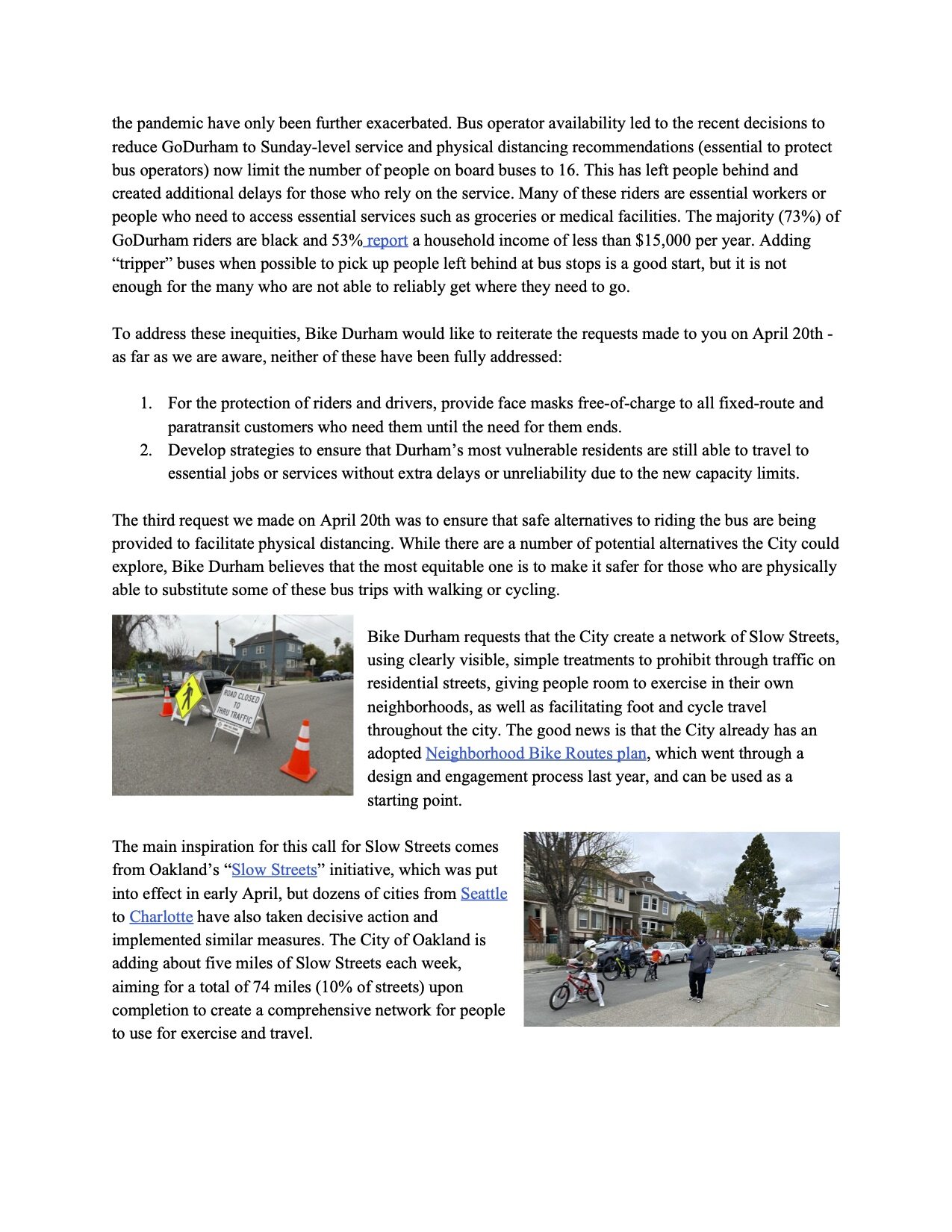
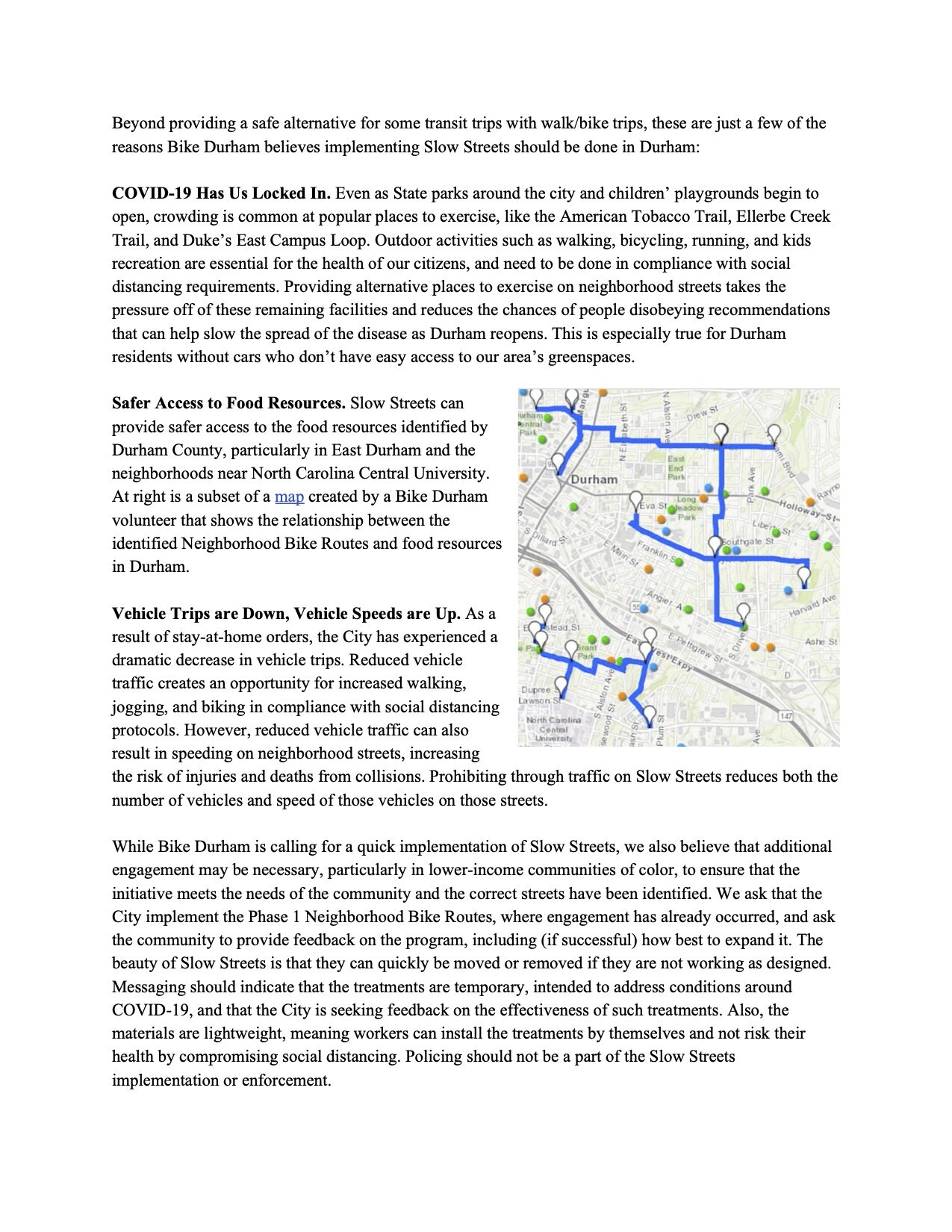
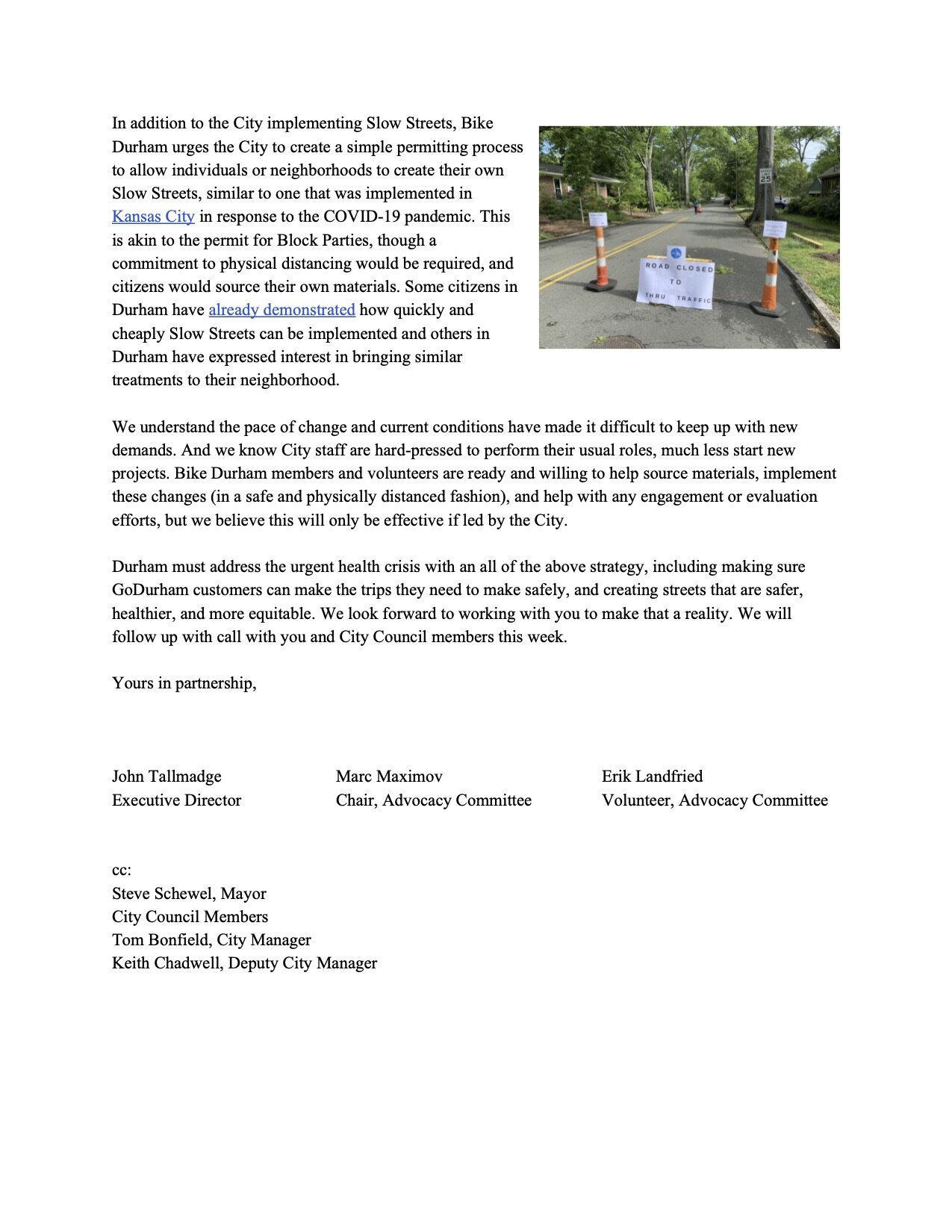
  • Create a network of Slow Streets, using clearly visible, simple treatments to prohibit through traffic on residential streets, giving people room to exercise in their own neighborhoods, as well as facilitating foot and cycle travel throughout the city based on the City's adopted Neighborhood Bike Routes plan. The main inspiration for this call for comes from Oakland’s “Slow Streets” initiative.

  • Create a simple permitting process to allow individuals or neighborhoods to create their own Slow Streets, similar to one that was implemented in Kansas City in response to the COVID-19 pandemic.

The full text of the letter is below.