Why We Need Safe Streets: A Perspective From Someone Who Is Blind

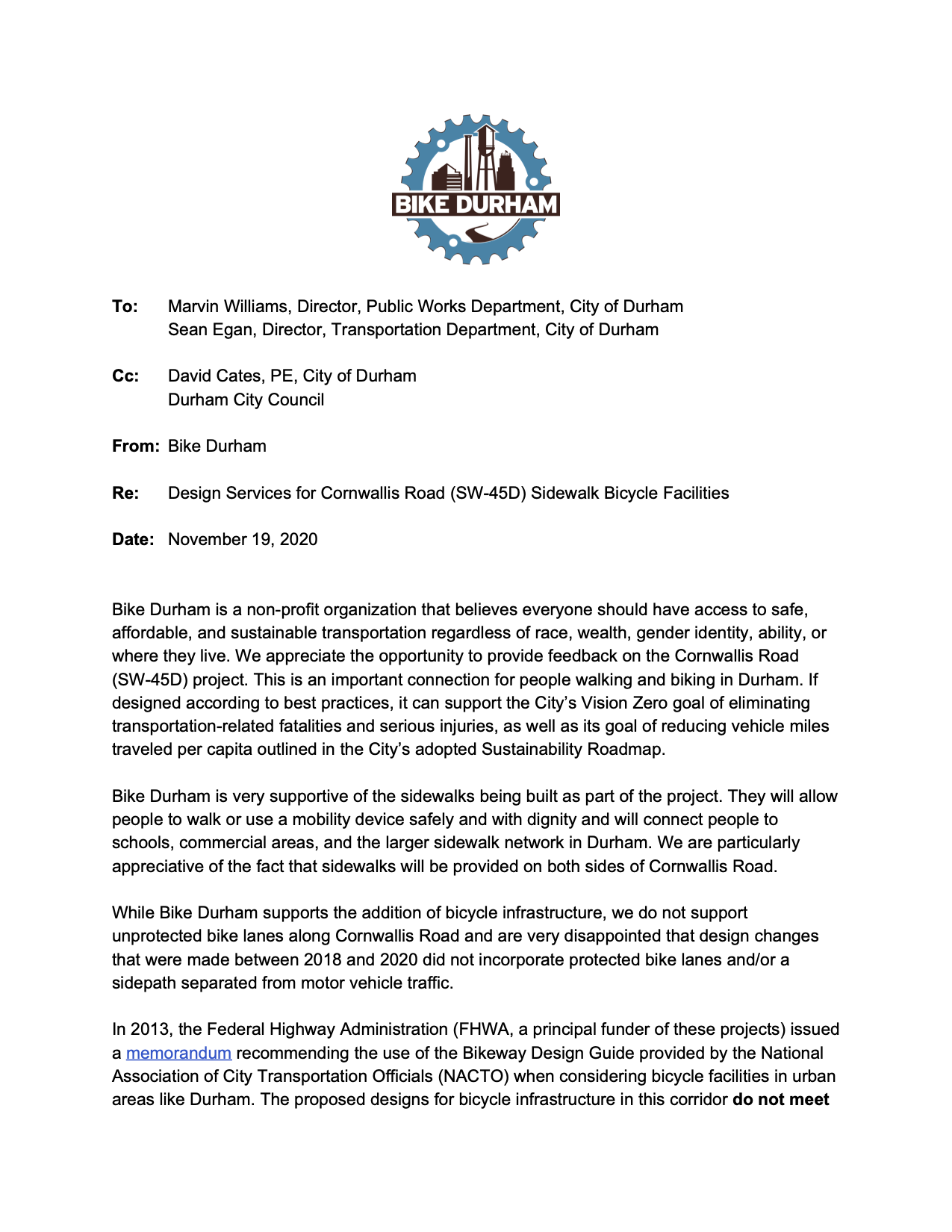
Donna Permar is a resident of Durham, NC and a long-time local advocate for safe places to walk and improved transit service. 

I recently joined the Bike Durham Advocacy Committee because I strongly support its mission of empowering all people to walk,  bike, and ride transit more often. Therefore, I wish to do whatever I can to help shape policies that promote safe pedestrian travel, enjoyable bike trails, and a public transportation system that meets the needs of current riders and attracts others who are not yet on board.

Due to my vision loss, my guide dog and I travel to work, appointments, shopping, et cetera via GoDurham, and we log hundreds of miles walking to many destinations. I have fought for sidewalks where there weren’t any and have promoted the installation of audible pedestrian signals (APS), which enable those of us who are blind and low-vision to cross streets more safely. My advocacy led to an APS installation at Hillandale Road and Croasdaile Commons where there are medical clinics, an urgent care center, Walgreens and several restaurants. Most recently, my efforts helped to get an APS installed at the very dangerous intersection of Fayetteville Road and Renaissance Parkway, which would make travel much safer for cyclists and pedestrians. 

I am also eager to provide input on improving transit service in Durham. I participated in the Transit Equity Campaign videos as a small way to advocate for improved transit in Durham. My ability to travel independently relies in large part on Durham’s transit system. Changes to transit routes present unique challenges for people with disabilities, and while changes can be inconvenient overall, the adjustment period to navigate a new routine and other changes can be longer and more frustrating for people with disabilities.

I do this work because I want to increase public awareness surrounding the idea that people with disabilities also bike and hike and would greatly benefit from improved trails, sidewalks and a transit system that is more reliable, efficient and serves more of the places where people need to go. I’ve been riding tandem bicycles with Bridge II Sports, and I enjoy it as a way to show others that people with disabilities are fully capable of athletic activities, such as biking. 

Back-seat biking provides impromptu opportunities to explain how I live my life, and it gives others a space where they can grow more comfortable when interacting with those of us who have disabilities. I enjoy riding tandem bikes with my guides as they describe the scenery to me along our route. We also discuss topics of mutual interest ranging from work, vacations and gardening, to sports and cooking. Most times, I find back seat pedaling on a tandem bike so pleasant that I wish my guide dog could be my captain. Alas, that skill was not included in his training. 

I firmly believe that achieving an excellent public transit system is crucial if the City of Durham truly wants to include all of its diverse populations in employment, education, recreation and health care opportunities. Transportation to such facilities is a huge barrier to participation for those who cannot afford to drive vehicles, have a disability which prohibits driving, or the senior-citizen population who once drove cars but are no longer able to do so. My hope is that some day Durham’s public transportation system will be second to none!
Bike Month DIY Rides

Bike Month DIY Rides

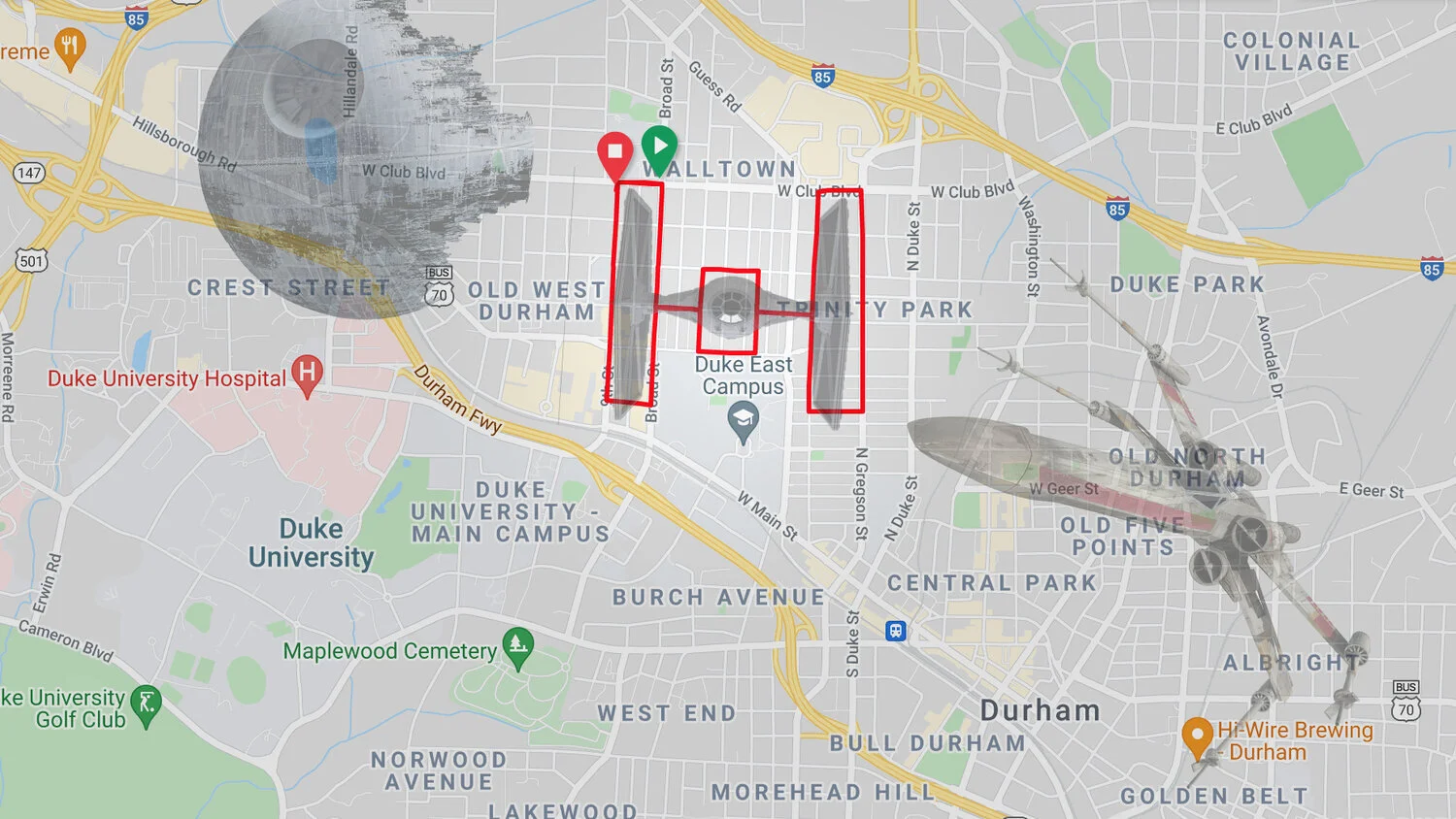
May was a busy month for Bike Durham, hosting several DIY rides in honor of Bike Month, including a scavenger hunt, a Star Wars inspired ride, and encouraged cyclists and other community members to ride their bikes to work.

Bike Durham Bull Ride

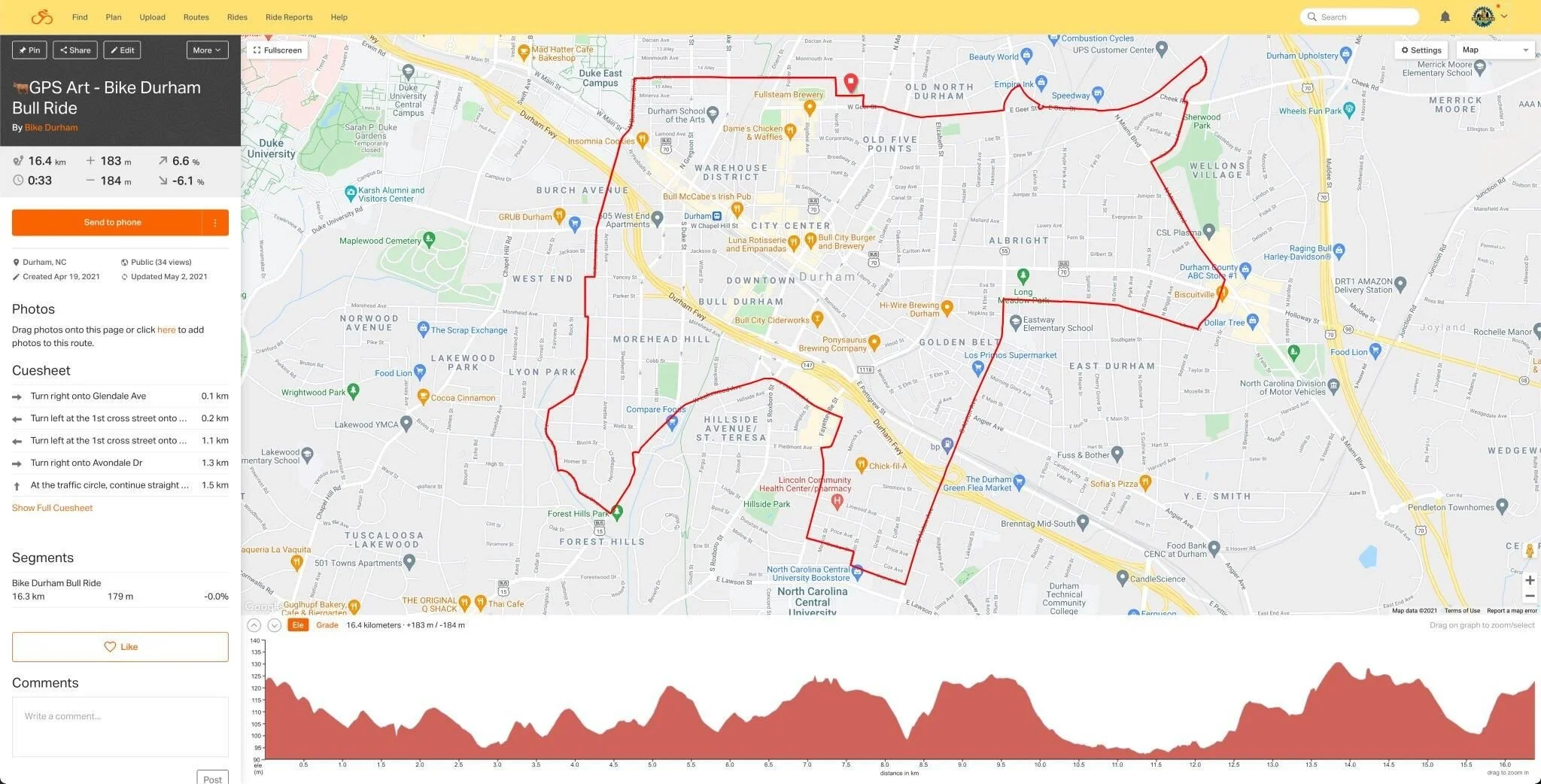
We were on the hunt for the perfect city bike ride to represent Durham for over a year. We couldn't find it, so we had to go to Alaska and partner up with Aurora Hablett aka Stravzilla, who creates the rarest forms of GPS visualizations.

Planning the Bull Ride Screenshot.png

The goal was to find "Major the Bull," over the city's center mass, in a closed-loop ride that stays on relatively safe streets, highlights neighborhood diversity, and cruises past NCCU and Duke.

RWGPS Bull Ride.jpeg

The ride needed to be long enough to be an experience but short enough to be accessible.

Bike Durham Bull Ride_group pic.jpeg

The big reveal is that Aurora worked with us to create a commemorative art piece that has the city inside of the shape of the bull. Now, we can show our Bull City Pride as we literally draw the bull with our bikes and then celebrate our city with this new street portrait of Major.

BIKE DURHAM BULL RIDE duality.jpeg

There are a lot of different drawings and sketches of Major the Bull, but this one is in the blueprint of our streets! And it's going to take over!
 
Bull Ride Poster.jpeg
 

A special thanks to our Sponsors for helping us bring creative events to Durham!

Victims Fair Treatment Act

Think of all the times in your life you have pressed the walk button, waited for the lights to change to red, got the “all clear” signal, and then proceeded to cross the street. If a driver ran the red light and hit you while you were in the crosswalk while you had the right of way, they would be at fault and you would be compensated for your injuries, right? Not so fast.

Even if the sequence of events happened as mentioned above, you may not collect anything for damages in North Carolina due to “contributory negligence.” Under the obscure doctrine of “contributory negligence,” people who negligently harm others and are 99% at fault are legally not required to compensate their victims. In our thought experiment above, the driver who ran the red light could argue that you had headphones and couldn’t hear, or that you didn’t look both ways. If a jury agreed that you contributed just 1% to the blame for the crash, you would not be able to recover anything. Stated plainly, contributory negligence means that you cannot recover money for any injuries caused by a negligent person if you are deemed even 1% at fault. The person who hit you would not be accountable for their actions. Not at all.

For those of us who advocate for better walking, biking, rolling, and transit, contributory negligence can be especially unjust and harmful.

As we know all too well, many people consider walking and biking to be inherently risky activities and are all too ready to blame the person walking or riding. Most news coverage tends to subtly shift blame to the victim (“car hits cyclist”, or similar, is the usual passive construction). People are more used to navigating our streets by car than by bike, foot, or bus. This bias is found in police reports, courtrooms, and jury boxes. If most people on a jury think riding a bike is inherently risky, they will be more likely to find that 1% fault regardless of facts. That 1% is all it takes to lose all hopes of recovering even just a small amount of compensation for damages or injury. Check out BikeLawNC to learn more about how the current law negatively impacts people on bikes.

What about insurance? That’s why drivers are required to have it, right? No. With contributory negligence, it is just as difficult, if not more difficult, to recover money from insurance companies as it is in court because insurance companies know that the law plays in their favor. Our friends at BikeLawNC have stories of insurance claims rejected on the basis of contributory negligence. Contributory negligence makes it harder to recover damages in court and harder to receive compensation through insurance companies. This is true even if the person who hits you is negligent and 99% at fault. They can walk away with zero consequence. 

There is an opportunity to change this zero sum game for those of us who navigate our streets exposed to negligent drivers. A bill was recently introduced in the NC Senate—Senate Bill 477 The Victims’ Fair Treatment Act— to move away from contributory negligence and use comparative negligence like 45 other states. Comparative negligence essentially eliminates the “all-or-nothing” framework and increases the likelihood of compensation for victims. 

Our friends at BikeLawNC have written more extensively about putting an end to contributory negligence. Bike Durham has asked our state lawmakers to support the Victim’s Fair Treatment Act. To support The Victims’ Fair Treatment Act yourself, take a moment to join the movement and contact your lawmaker

Tyler J. Dewey (he/him) is a Bike Durham volunteer and full-time bike commuter. Prior to transitioning to Durham, he worked as the executive director of a bicycle non-profit organization in Athens, GA where he facilitated bicycle education programs, headed up bicycle advocacy, and co-ran a bike recycling program.


Ellerbee Creek Clean Up

Ellerbee Creek Clean Up

Bike Durham starts off Bike Month with a community clean up at Ellerbee Creek Trail, and Charlie Reece, Durham City Council Member At-Large, makes an appearance.

Bike and Walk to School Day at Merrick-Moore Elementary

Fourth grade students walking around Merrick-Moore Elementary on Bike and Walk AT School Day

Fourth grade students walking around Merrick-Moore Elementary on Bike and Walk AT School Day

Tuesday morning I biked from Sherwood Park in east Durham to Merrick-Moore Elementary School at 2325 Cheek Road in east Durham where students were getting outside to walk around the school campus as part of national Walk and Bike to School Day.*  It was good to see the kids outside, and they clearly enjoyed the break from the classroom, but this was certainly not walking and biking TO school.  The reason this was a walk AT school event was clear when Dr. Vannessa Alford, principal at the school, asked the Kindergarten students why none of them walk to school.  One of them called out “No sidewalks!”

Where the sidewalk ends at Merrick-Moore Elementary

Where the sidewalk ends at Merrick-Moore Elementary

Merrick-Moore Elementary is located on Cheek Road, a two-lane road with no shoulder and incomplete sidewalks.  The school is a key institution in the Merrick-Moore neighborhood, a historically Black neighborhood that has a history of advocating for more walkable streets. “My community has lobbied for many years for safer streets. Sidewalks are needed more than ever,” Bonita Green, neighbor and President of Merrick-Moore Community Development Corporation told me in an email.

This isn’t just an issue at Merrick-Moore Elementary.  Bike Durham’s Safe Routes to School Program Manager Jen McDuffie identified fifteen Durham Public Schools’ elementary schools that don't have safe streets for walking or biking around them.  That’s more than half of the 29 DPS elementary schools.  We know that parents aren’t going to allow their kids to walk or bike to school unless they feel that it’s safe.  Investing in these connections to schools, and addressing other safety concerns that parents and children feel, have to be priorities before every child can experience the joy and independence of walking or biking to school. 

Events like these are one way to raise awareness of the benefits that biking and walking to school can bring to the kids and also the parents.  Two of our daughters attended E.K. Powe Elementary, right around the corner from our house, connected with sidewalks.  When they were in fourth and fifth grades, they would walk independently to and from school.  It was a great feeling of independence for them, and it freed my wife and me from having to race home from work to pick them up each day. 

These events are also an opportunity to identify the obstacles, like poor or missing infrastructure.  This event at Merrick-Moore was organized by Stephen Mullaney, an accelerated teacher at the school, and supported by Bike Durham’s Safe Routes to School Program Manager Jen McDuffie.  It was attended by School Board member Natalie Beyer, City Council members Jillian Johnson and Pierce Freelon, and Durham Transportation department staff Bill Judge and Dale McKeel.  Along with Dr. Alford, we had good conversations about the need to connect Merrick-Moore and the surrounding neighborhoods with sidewalks, and other strategies to advance the outdoor education at the school.

tempImage6MUbzN.gif

As I left the school, I was thankful for a lot of things:  that Bike Durham has this new partnership with the City and DPS to provide Safe Routes to School programming; that there are teachers like Stephen Mullaney and principals like Dr. Alford who are leaders in getting kids outdoors and active; that we have elected leadership that supports investing in sidewalks and bicycle facilities; and that all the pick up trucks were giving me wide berth as they passed me along Cheek Road.  

 *May 5th is actually the national Walk and Bike to School Day.  However, there wasn’t any biking or walking to public schools in Durham today because Wednesdays are Wellness Days for Durham Public Schools, meaning that students don’t have class in-person or remote.   

Challenges to Equitable Transit - A Durham Documentary


“People use transportation just like they use their own car. And if their car wasn’t reliable, let’s say, their car could only crank up every hour, they would be so frustrated! So they have to look at it like that, like this is our car and we need it to be more reliable.”

- Holly McCoy, Transit Rider


In “Challenges to Equitable Transit - A Durham Documentary”, we see and hear the voices of transit riders and transit workers as they describe the main challenges they face using the bus in Durham. These challenges echo ones we’ve heard from other riders, transit workers, and people who live in low-wealth communities of color and that were captured in the first round of public engagement for the Durham Transit Plan update.

Riders are demanding:

  • More frequent service

  • More reliable service

  • More direct service with shorter travel times to jobs and other destinations in Durham and the region

  • Safer walks to bus stops

  • Accessible and comfortable bus stops

  • Expanded paratransit and other curb-to-curb service

A core strategy of the Transit Equity Campaign is to identify and communicate the transportation needs of current transit riders and low-wealth communities of color in Durham to decision-makers and the general public. The Transit Equity Campaign has relayed many of the needs we have heard to those in charge of updating the Durham Transit Plan, but there is no substitute to those officials hearing these needs directly from the riders in their own voices. This is particularly critical as already limited opportunities to listen to riders, such as bi-monthly public meetings at Durham Station, have been discontinued during the pandemic.

The Transit Equity Campaign commissioned two local videographers, John Laww and Saleem Reshamwala, to produce videos that describe the benefits and challenges of Durham’s current transit system through transit rider and worker interviews and showing the rider experience directly.

In addition to “Challenges to Equitable Transit - A Durham Documentary,” we created three shorter video vignettes to capture individual stories and topics. The first of these, “Supporting Transit for Persons With Disabilities,” spotlights Marie Hill Faison, a paratransit operator for GoDurham ACCESS and a Transit Equity Campaign partner. Paratransit is a federally mandated curb-to-curb service for persons with disabilities and is complemented by a county-wide system that fills in gaps in the fixed-route bus system in Durham. The Durham Transit Plan should reduce wait times and expand service levels on local and regional bus and paratransit services to improve the lives of those who cannot drive due to a disability. This would also increase transportation options for people who live or work in parts of Durham County where bus service does not run.

Transit service is only useful if people can safely get to and from bus stops and feel safe and comfortable at the stops themselves. The second vignette, “Walking To and Waiting At the Bus Stop,” focuses on the lack of sidewalks and safe street crossings for people walking to and from bus stops and the poor condition of many of the bus stops in Durham. These issues were identified by every rider we interviewed for these videos. The Durham Transit Plan should ensure that bus stops in Durham have safe sidewalk connections and consistent, dignified waiting conditions at the stop.

The final vignette focuses on a transit journey George A. Long, a longtime GoDurham rider, takes to accompany his friend, Lisa Raiford, to get her COVID-19 vaccination. What could be a better demonstration of how essential transit is in Durham?! George has benefited from a doubling of frequency on the route that serves his apartment, GoDurham Route 12, and newer buses, both of which have been funded through the Durham Transit Plan. The Durham Transit Plan should ensure more frequent service and better buses are provided to more people in Durham to improve access to jobs and services, particularly for low-wealth communities of color.

If you support these priorities, please click the link below to sign on to the Transit Equity Campaign.

Click Here to Join the Transit equity campaign

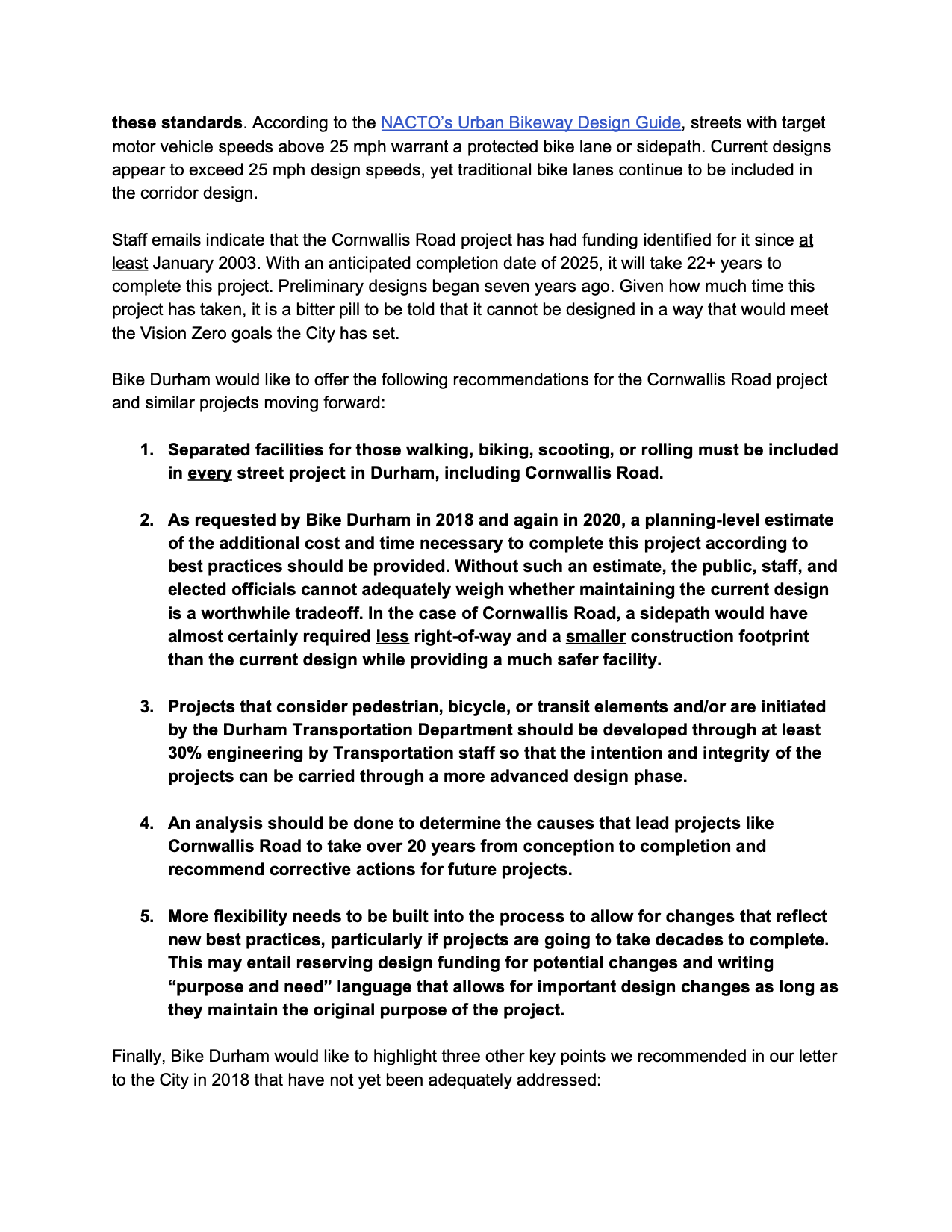
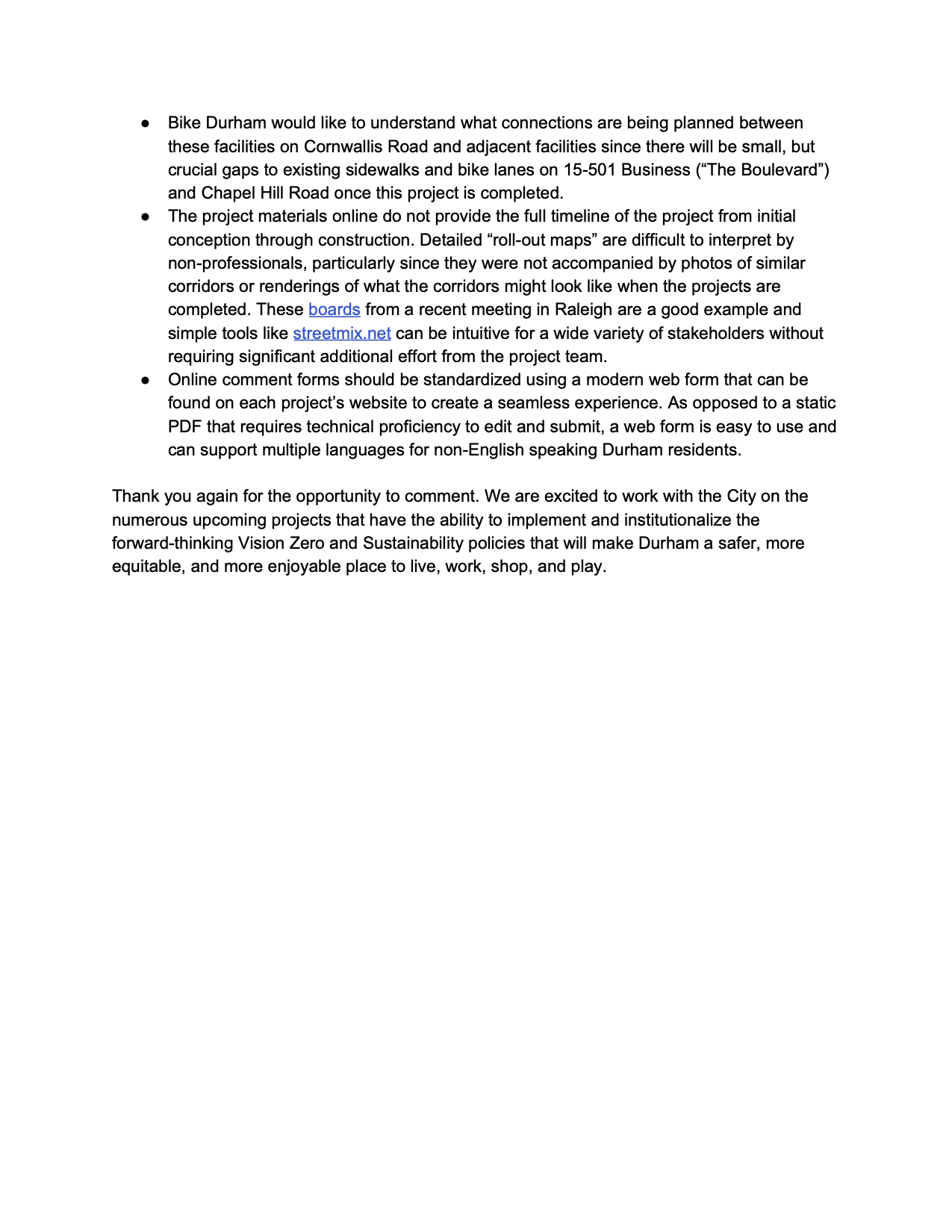
Bike Durham's Letter to the City on Cornwallis Road Project

Cornwallis Project.png

After a long delay, the City is going forward with plans to reconfigure Cornwallis Road from Chapel Hill Road to South Roxboro Street, to be completed in 2025. While we commend the City for improving bicycle and pedestrian facilities, design standards have evolved in the 20 years that have gone by since the plan was initially conceived.

Before the Thanksgiving break, Bike Durham sent a letter to City staff with our feedback on the project. The letter is reproduced in full below. Here are our key recommendations:

  • Separated facilities for those walking, biking, scooting, or rolling must be included in every street project in Durham, including Cornwallis Road.

  • A planning-level estimate of the additional cost and time necessary to complete this project according to best practices should be provided. Without such an estimate, the public, staff, and elected officials cannot adequately weigh whether maintaining the current design is a worthwhile tradeoff.

  • Projects that consider pedestrian, bicycle, or transit elements and/or are initiated by the Durham Transportation Department should be developed through at least 30% engineering by Transportation staff so that the intention and integrity of the projects can be carried through a more advanced design phase.

  • An analysis should be done to determine the causes that lead projects like Cornwallis Road to take over 20 years from conception to completion and recommend corrective actions for future projects.

  • More flexibility needs to be built into the process to allow for changes that reflect new best practices, particularly if projects are going to take decades to complete.

Halloween with Bike Durham

 
125062873_3628106797245929_5407822221440118402_o.jpg
 

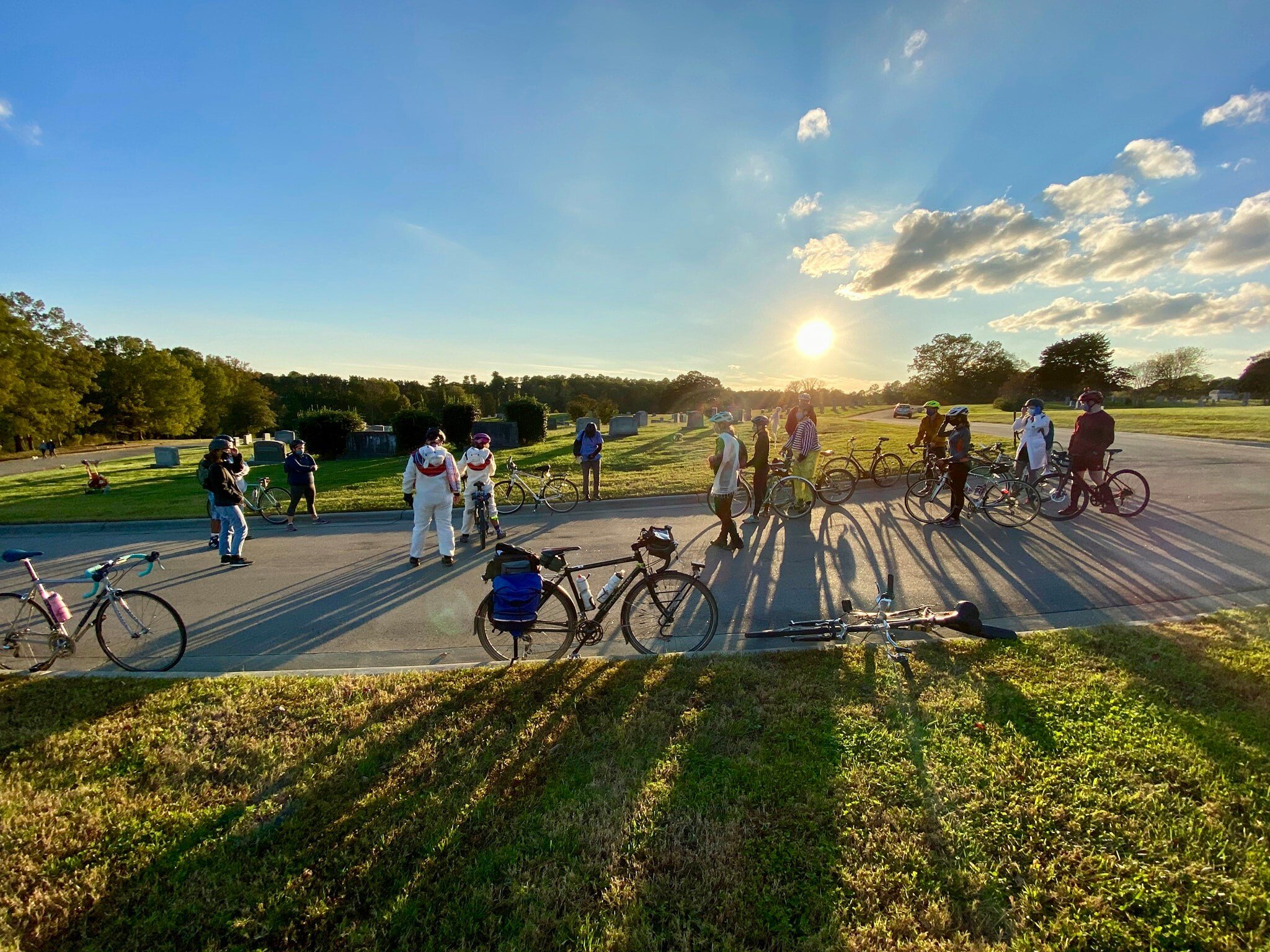
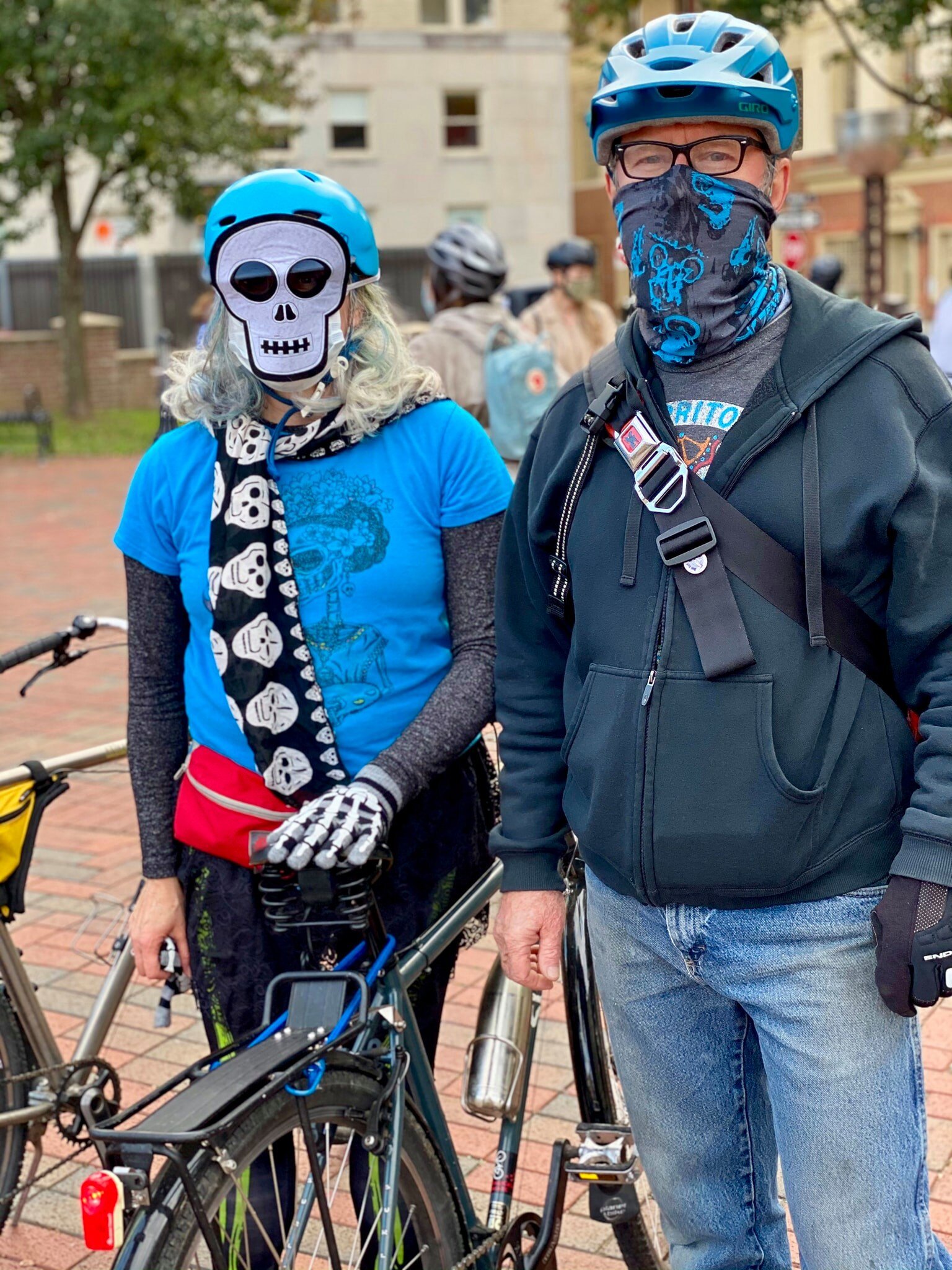
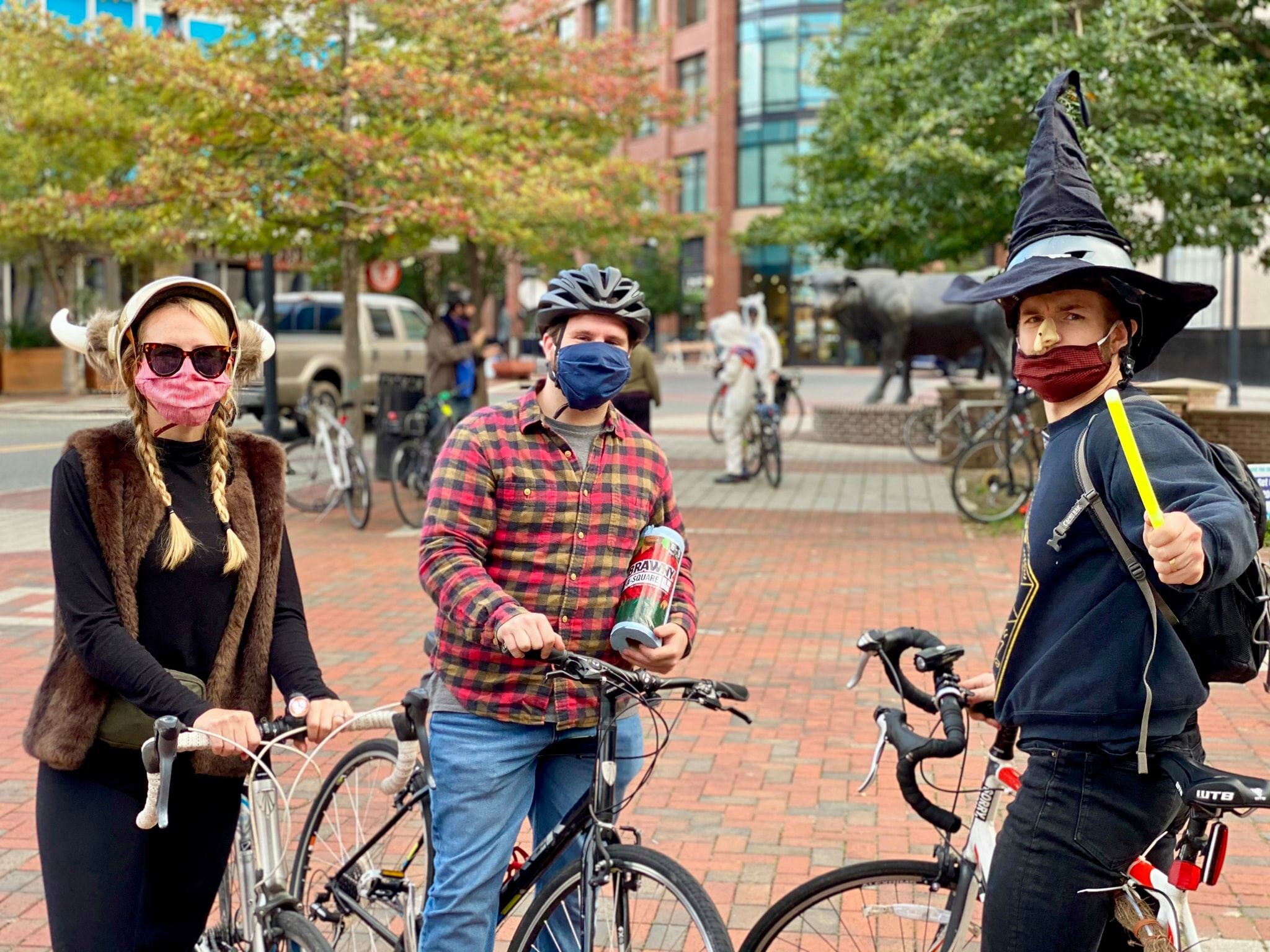
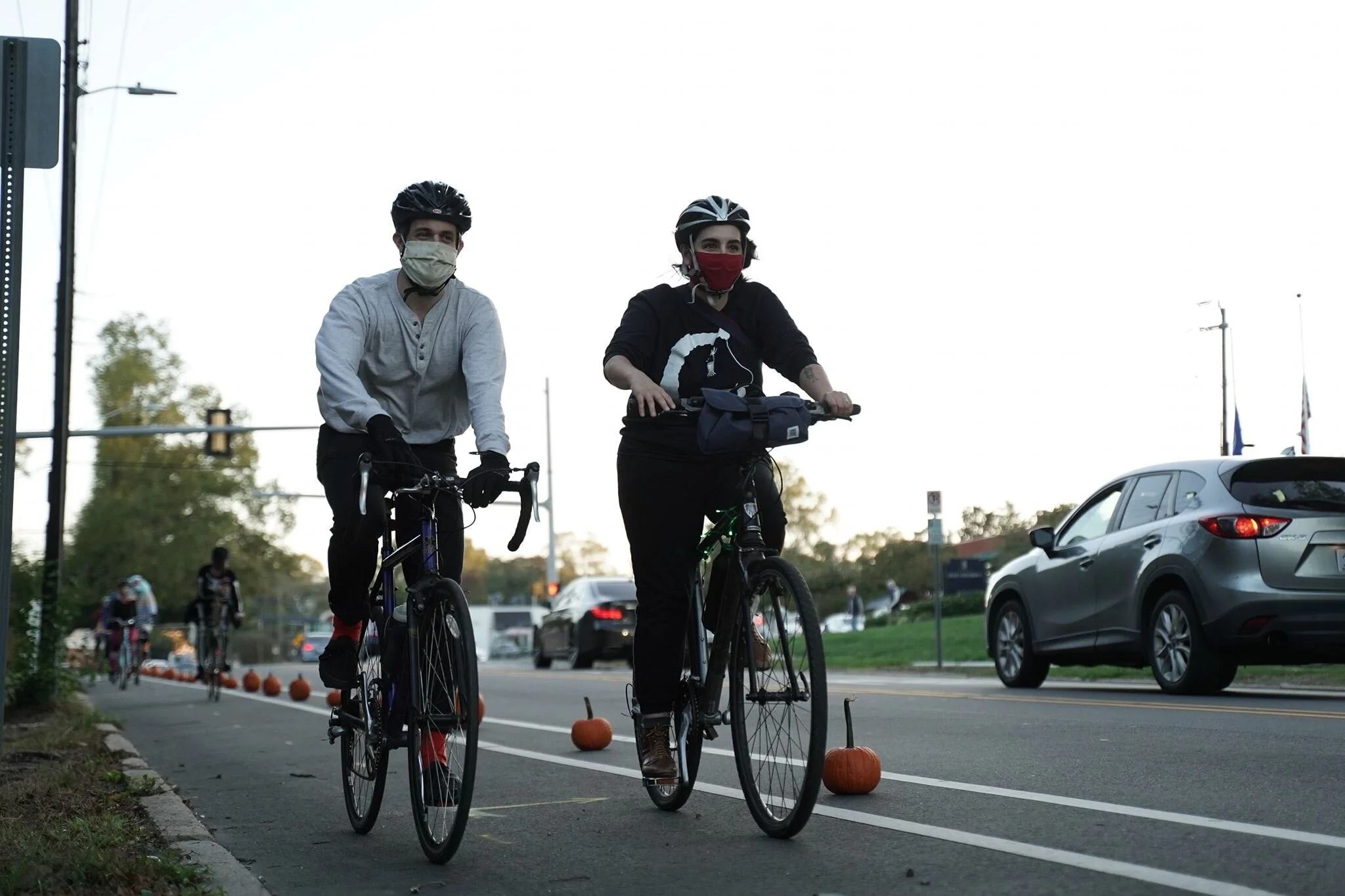
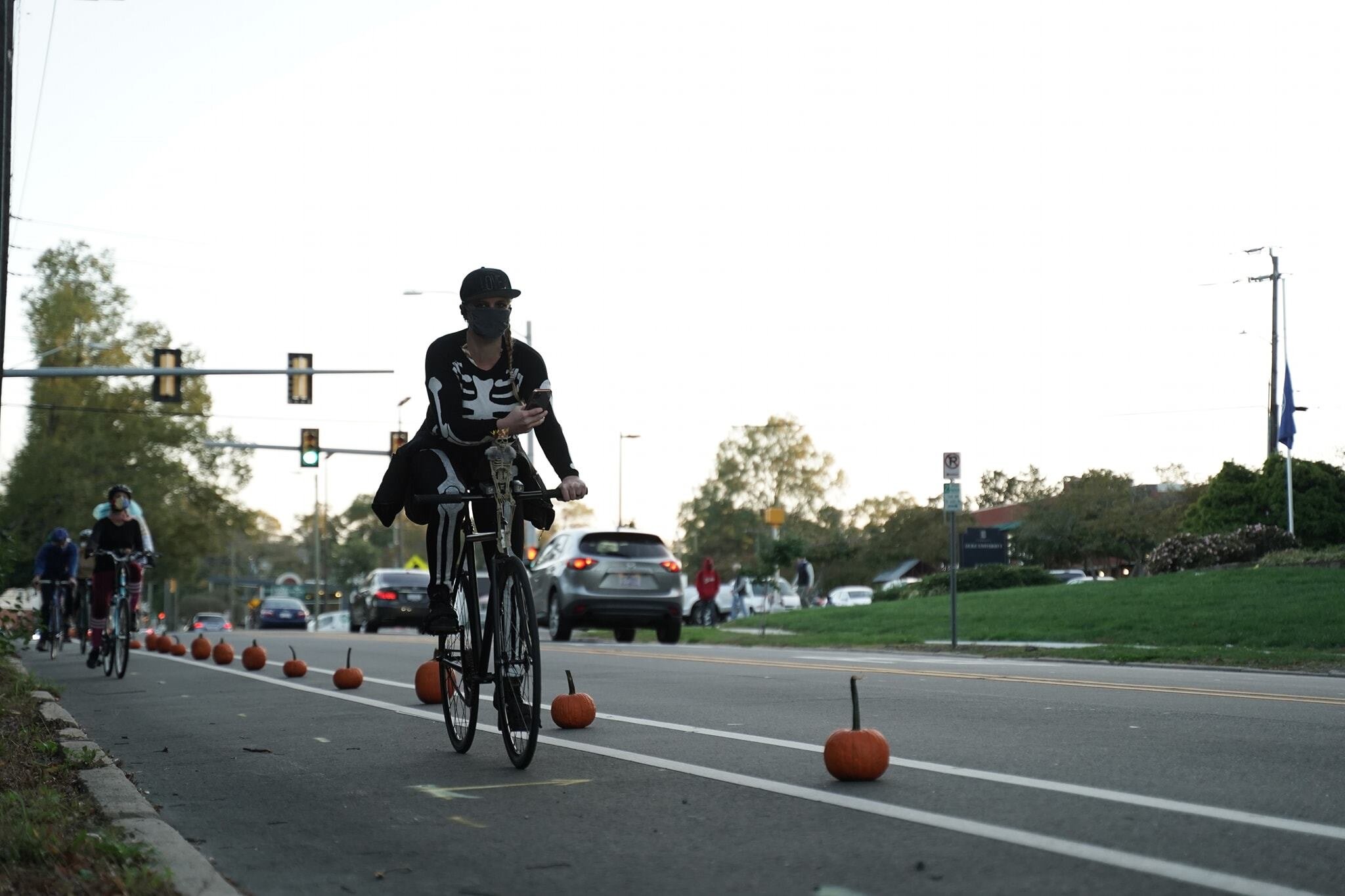
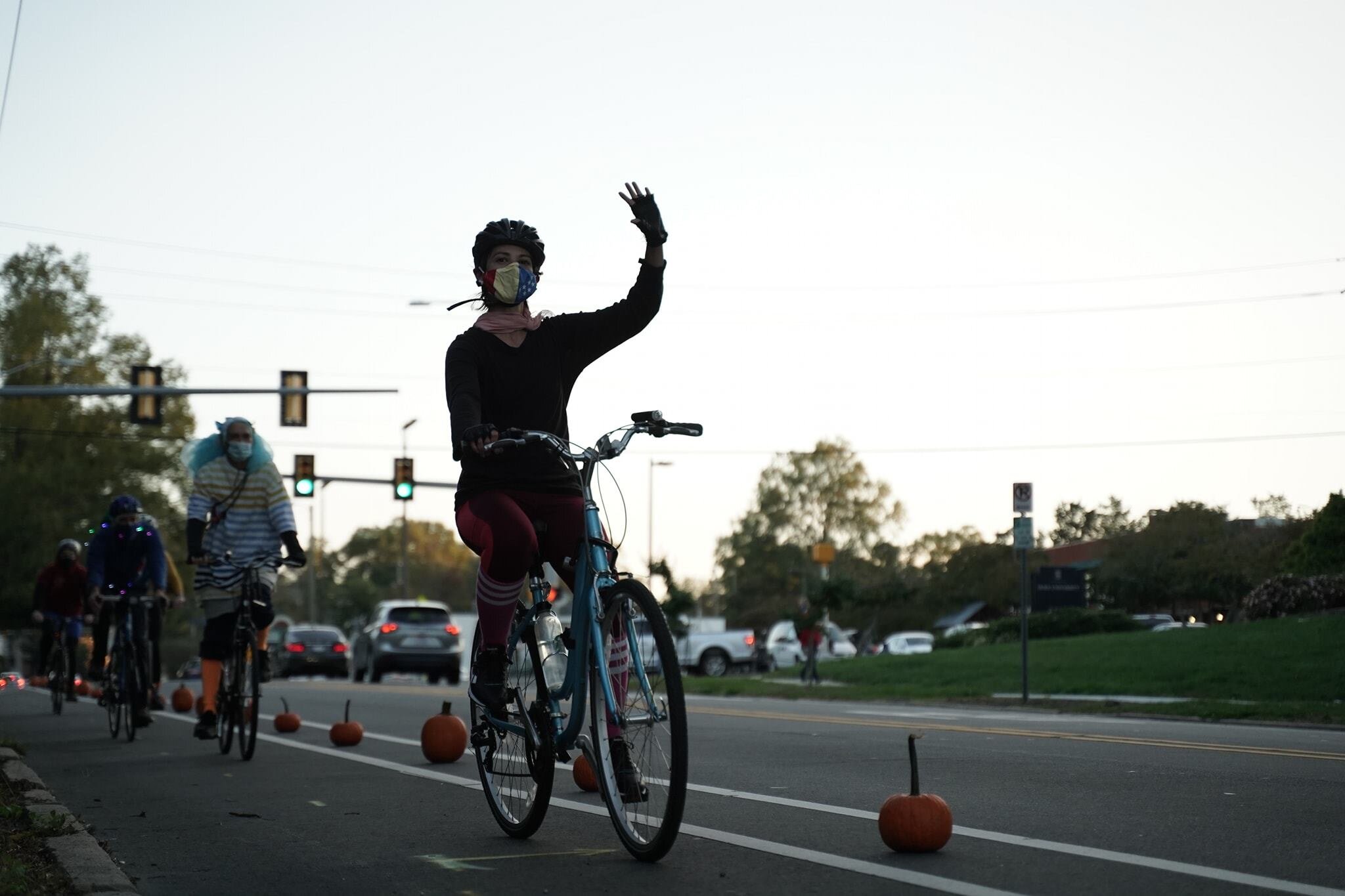
This Halloween, Bike Durham organized the first-ever Ghost Stories Tour, a group ride in which we visited seven haunted locations around Durham. These included Duke’s Parapsychology Lab, where we learned of the poltergeist that haunted Carl Jung, the old Durham County Jail, where the ghost of a drowned boy lingers, and the North Carolina School of Science and Math (formerly Watts Hospital), where a security guard spotted the ghost of a murdered nurse one rainy evening. This ride was special in many ways, not the least of which is that it was our first group ride since the pandemic began.

20201031_171606.jpg
 

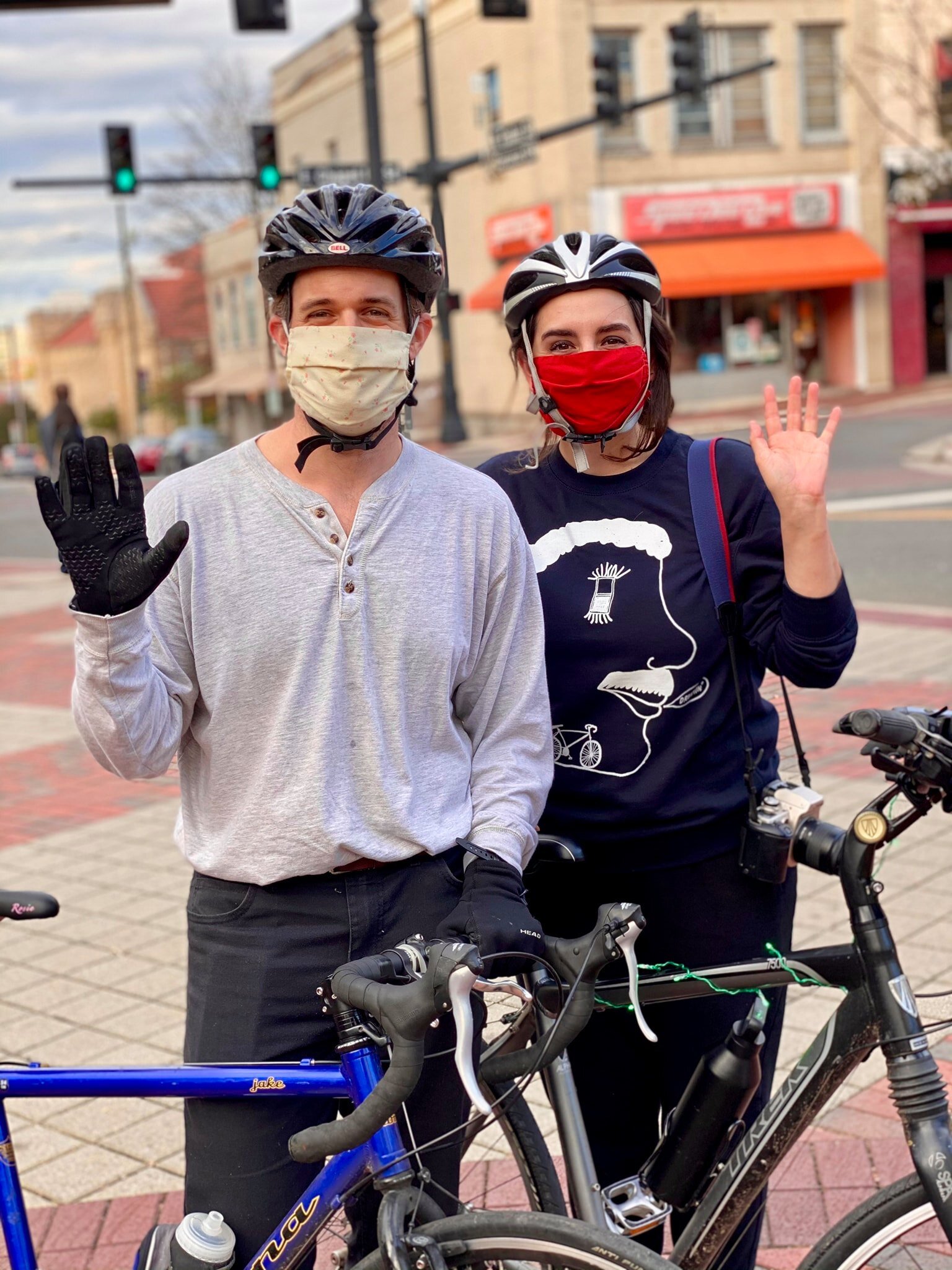
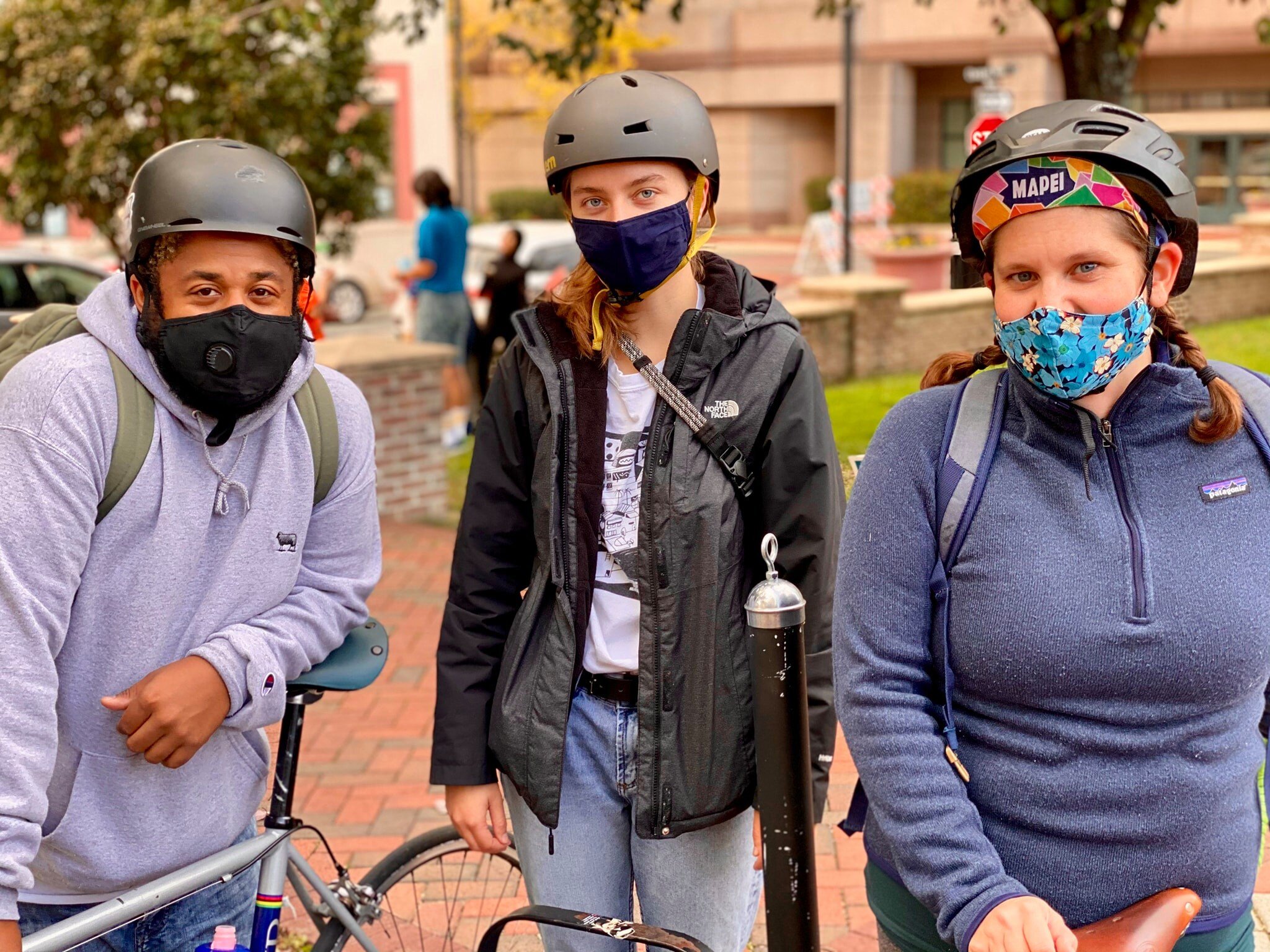
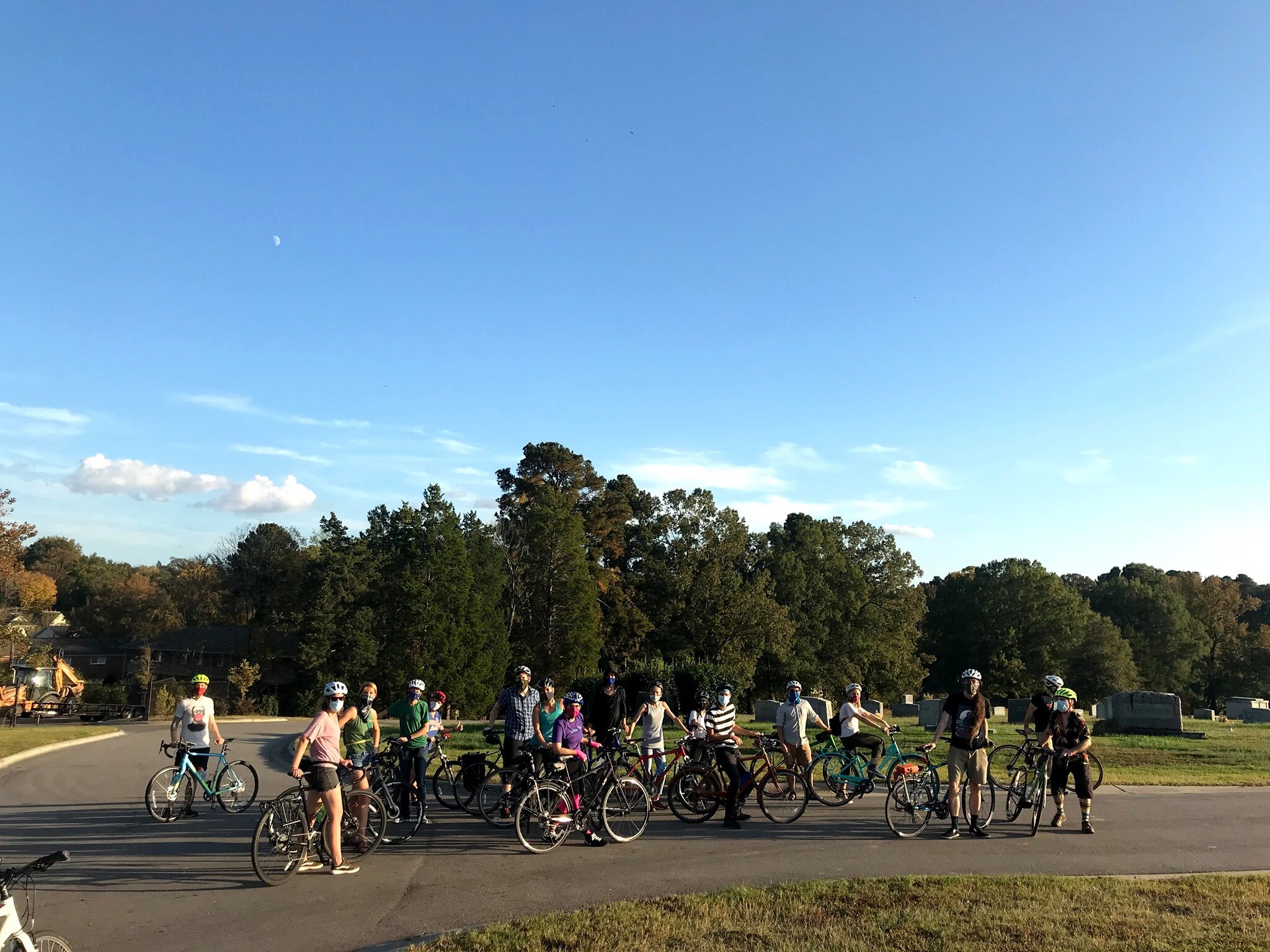
After lengthy conversations about how to make this event as safe as possible in the midst of a pandemic, the event organizers decided to cap each ride at 15 participants and require masks and social distancing while on the ride. Although we were taking precautions, we wondered whether anyone would show up given the legitimate concerns about the spread of covid.


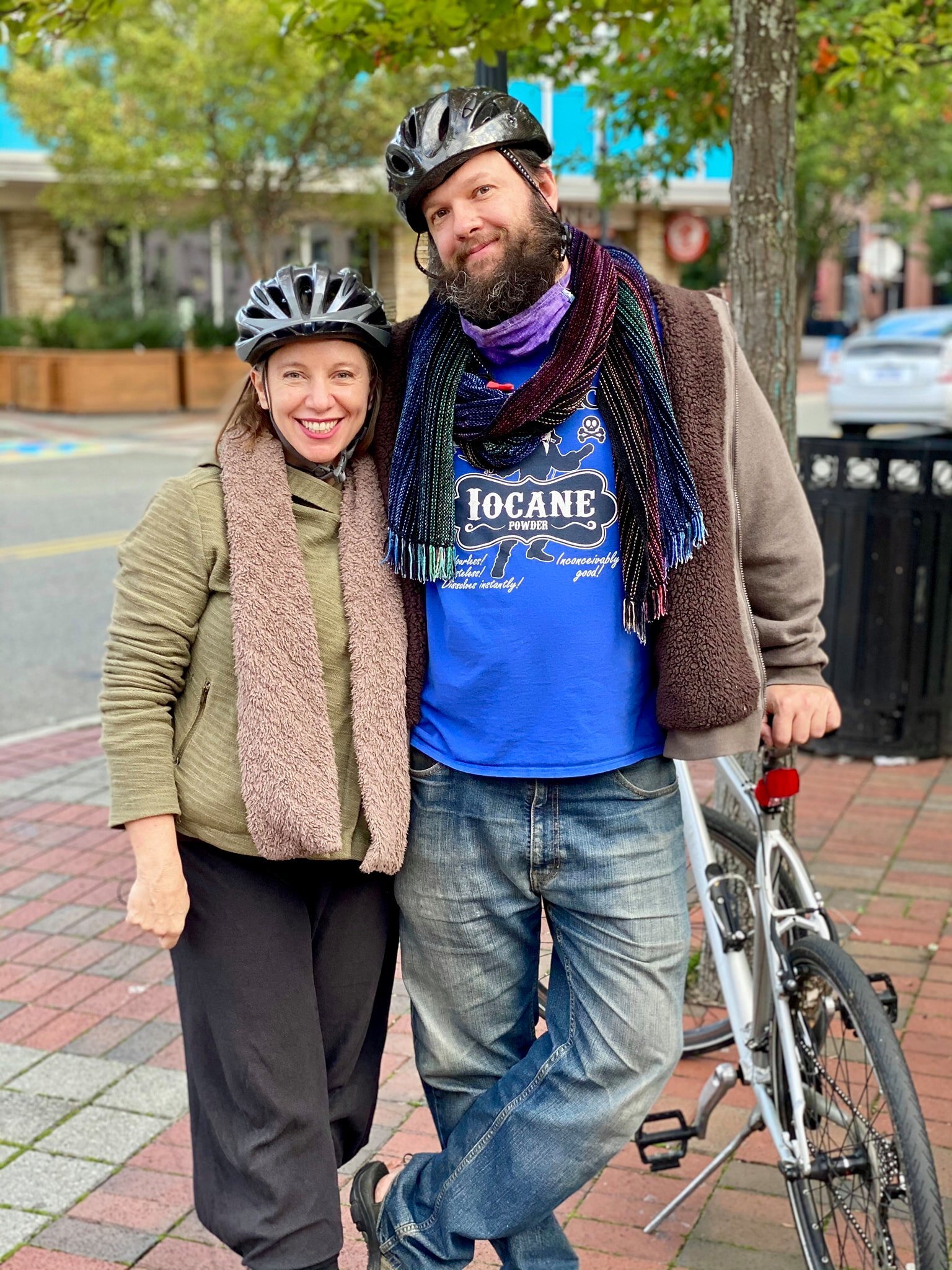
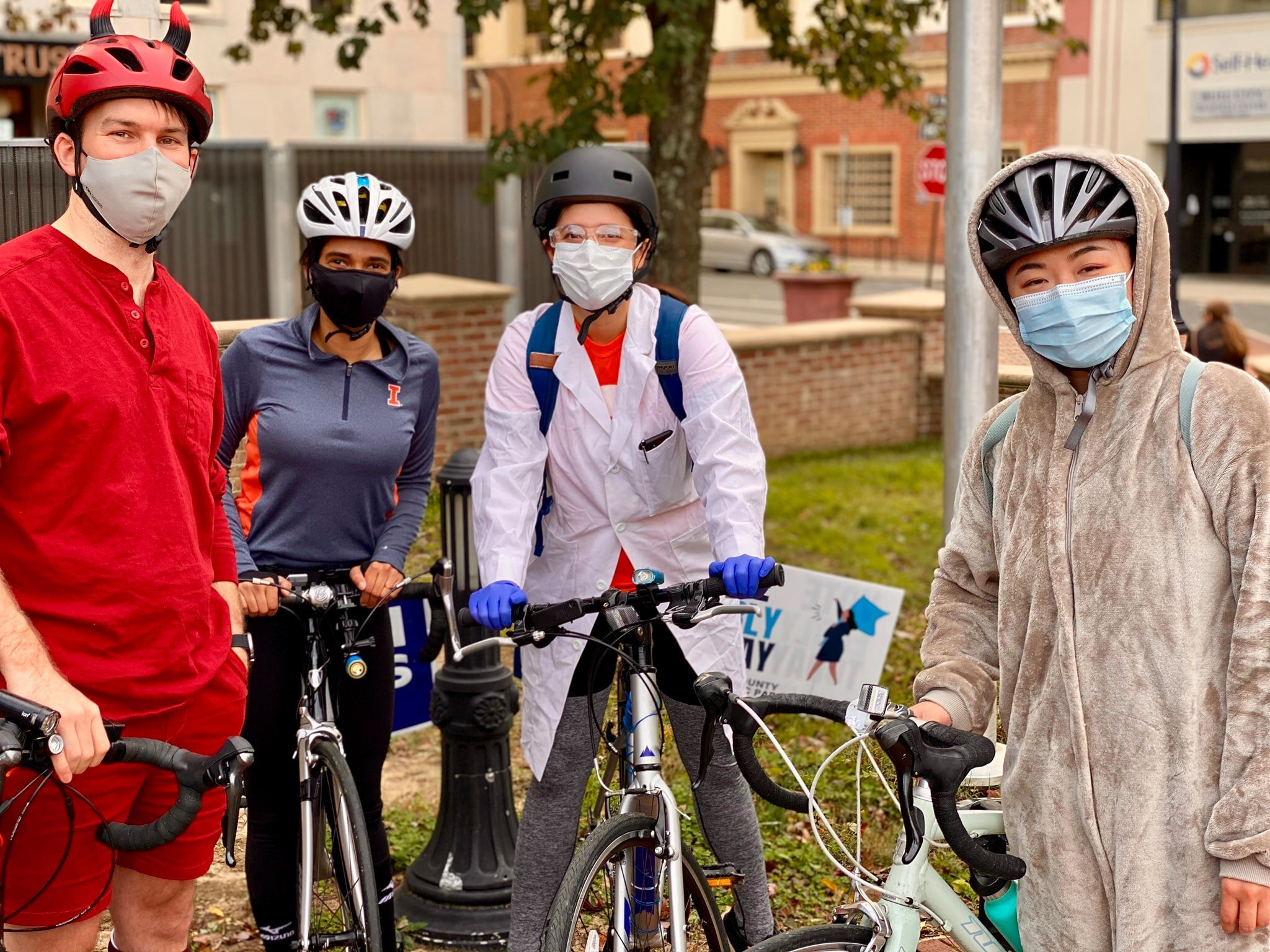
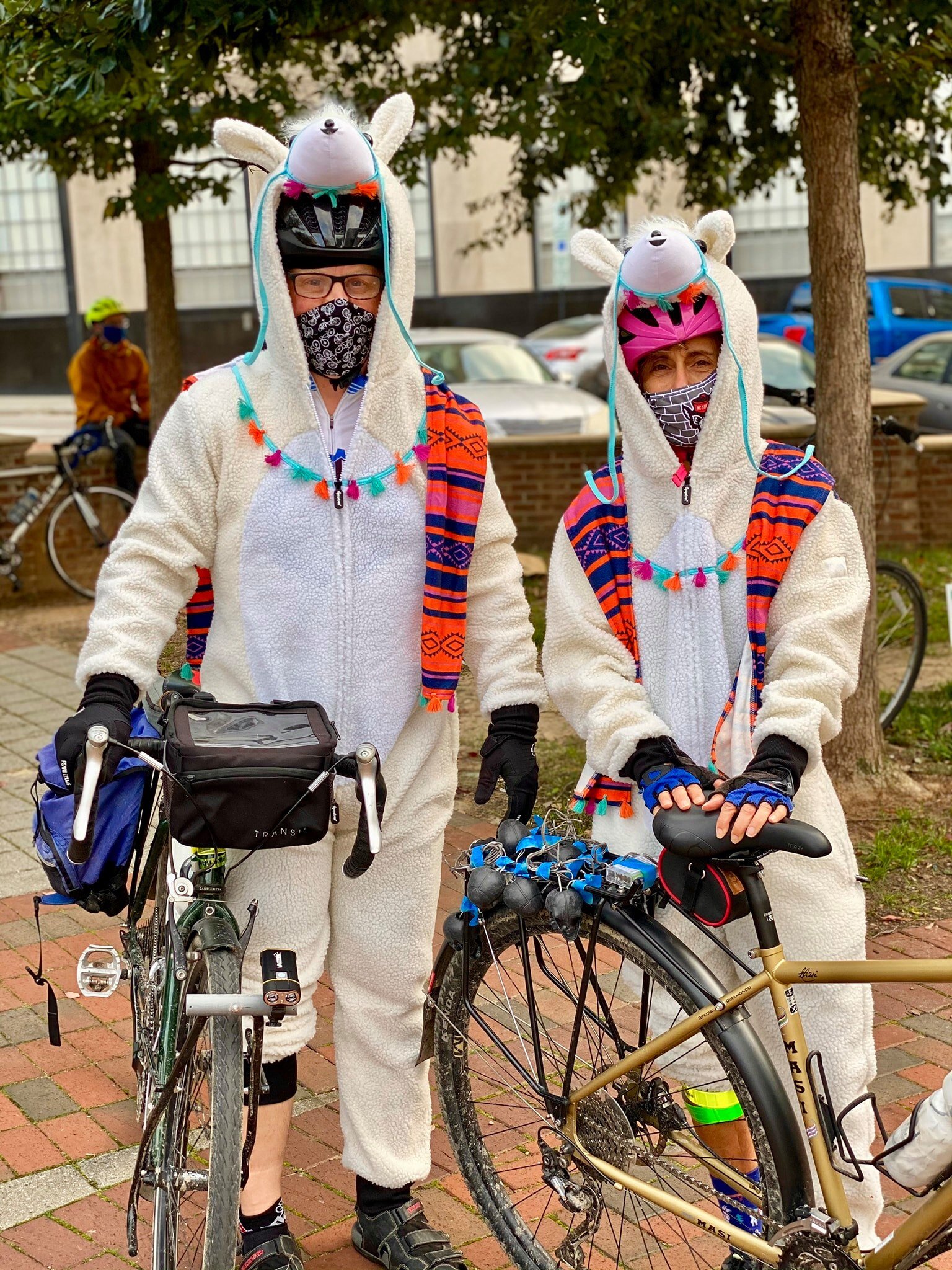
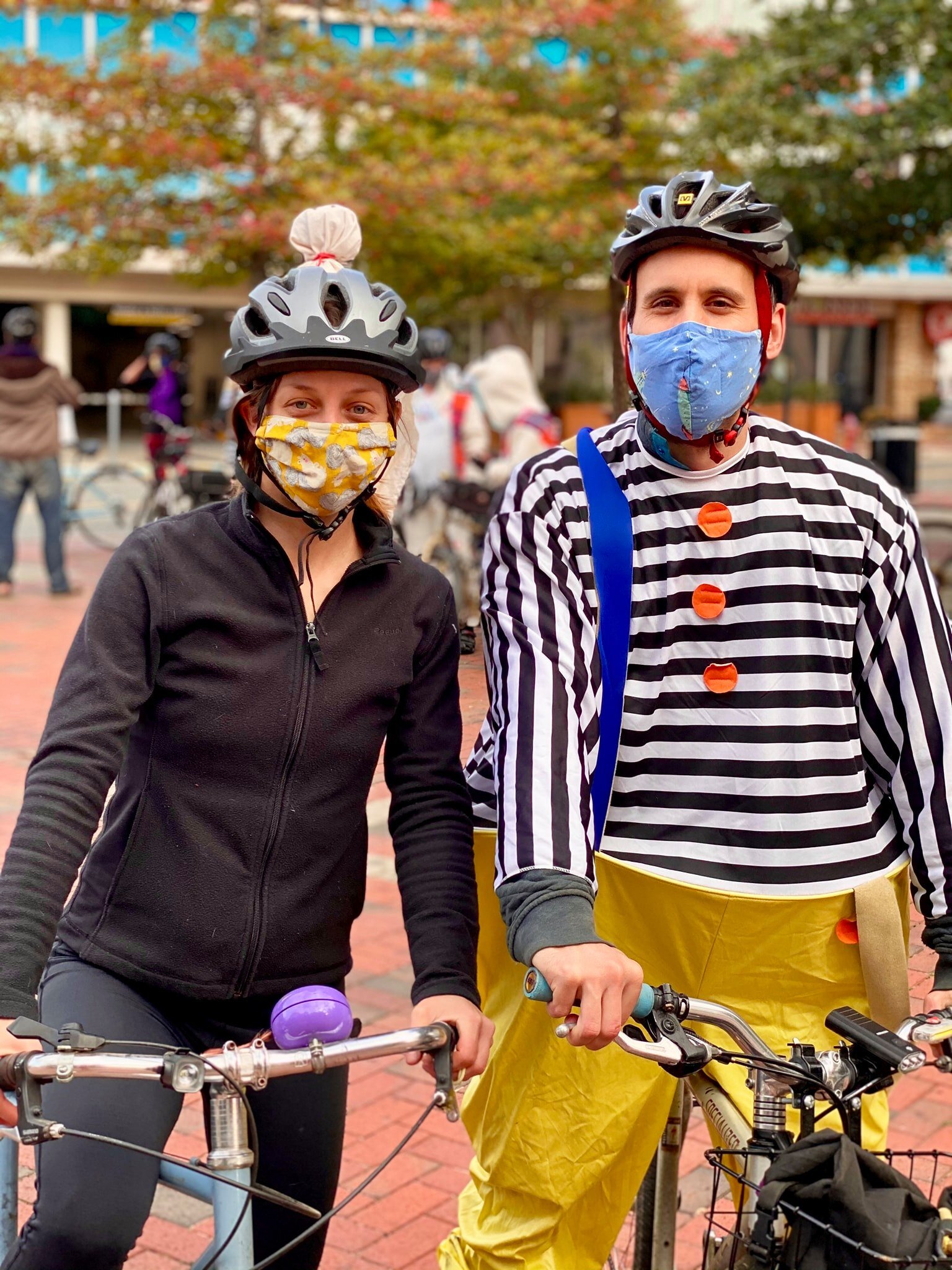
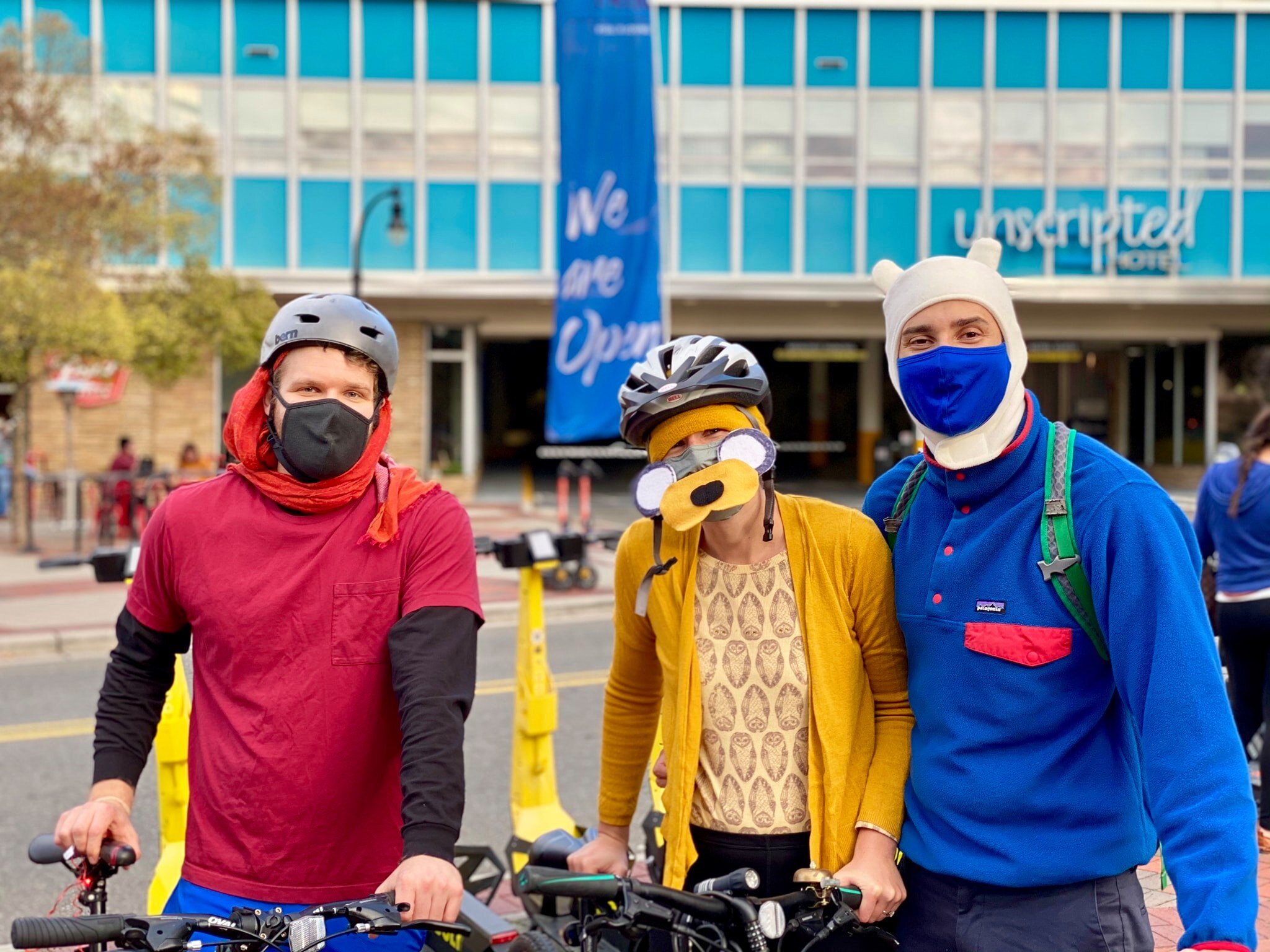
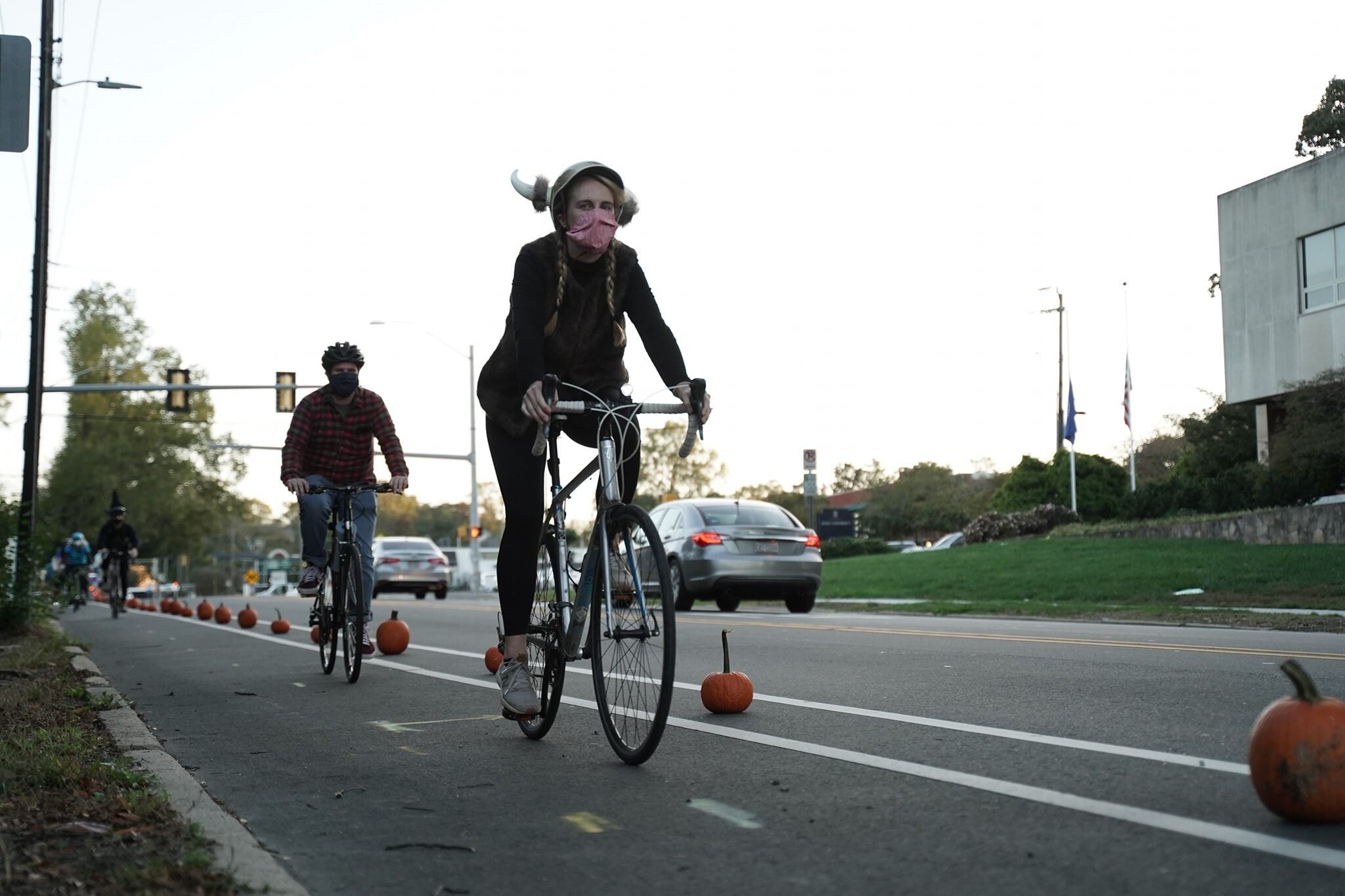
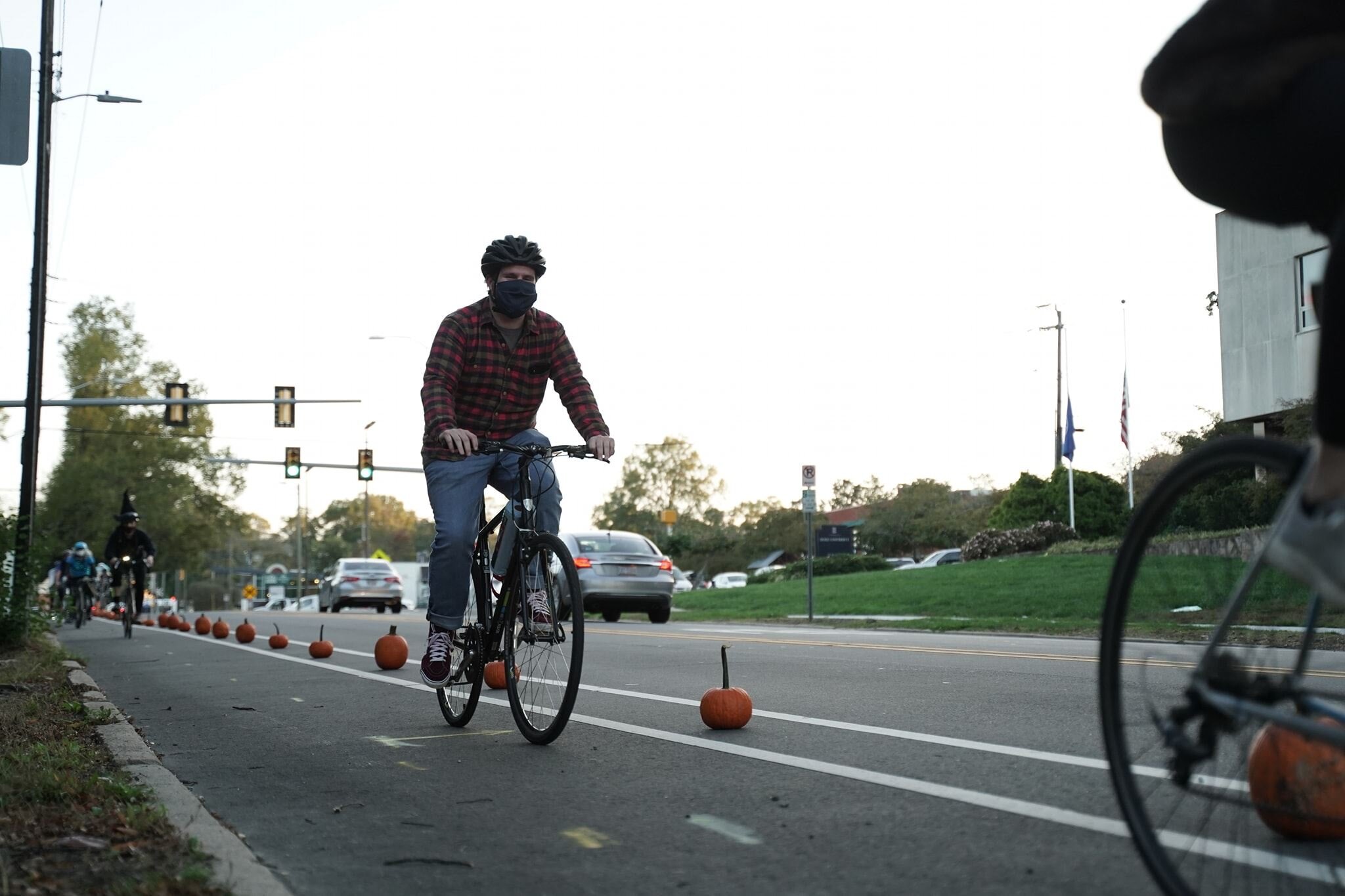
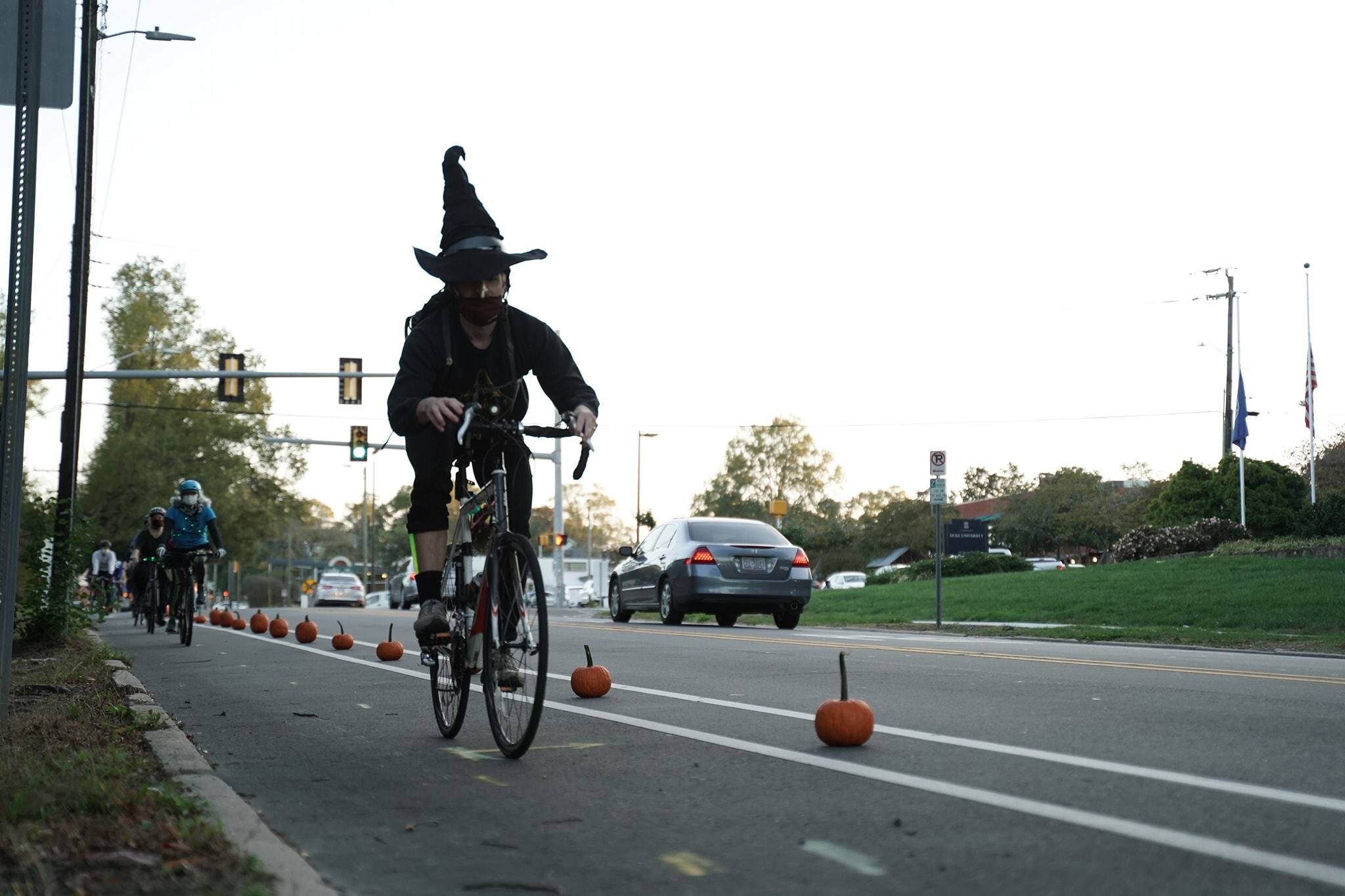
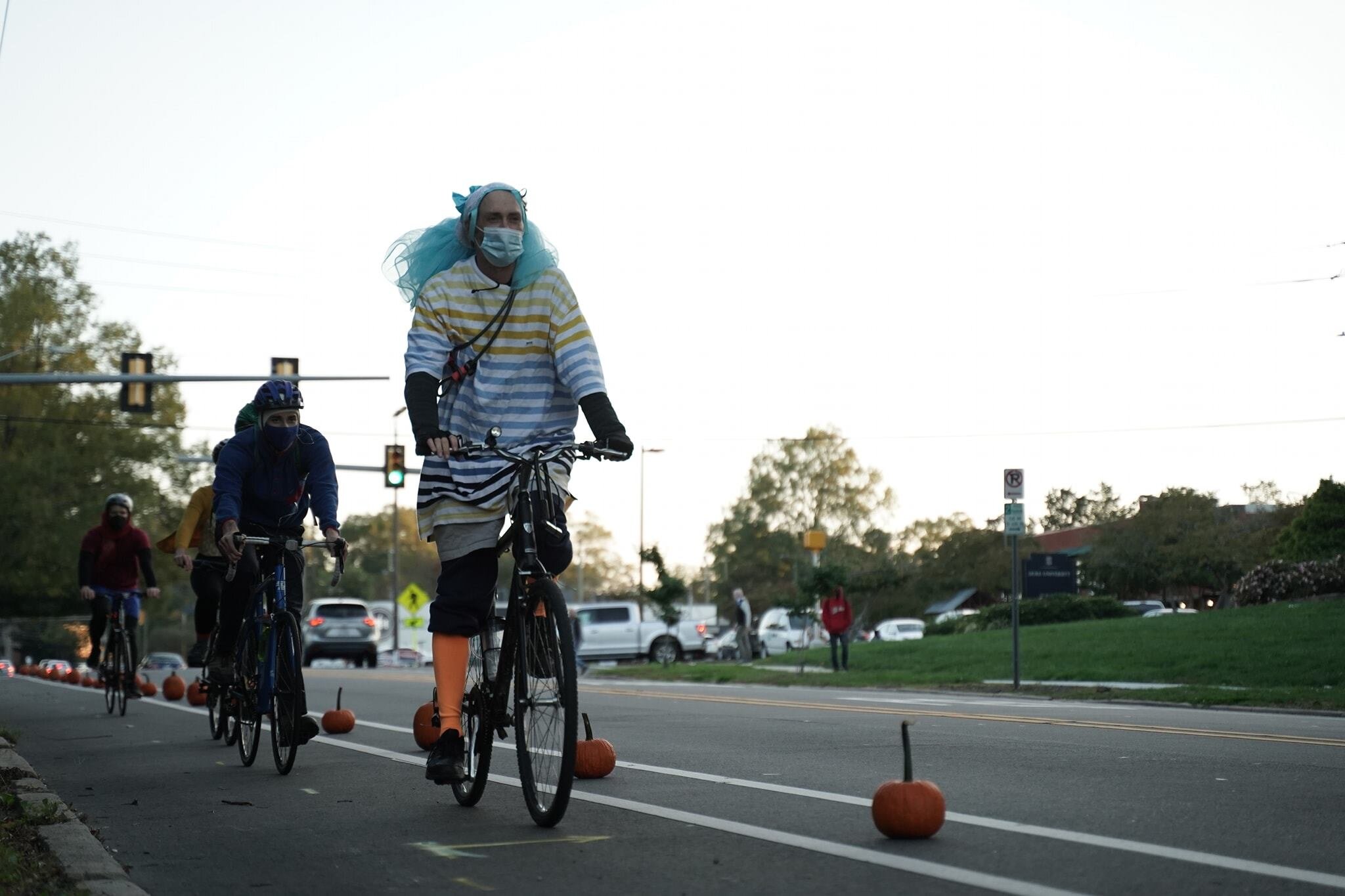
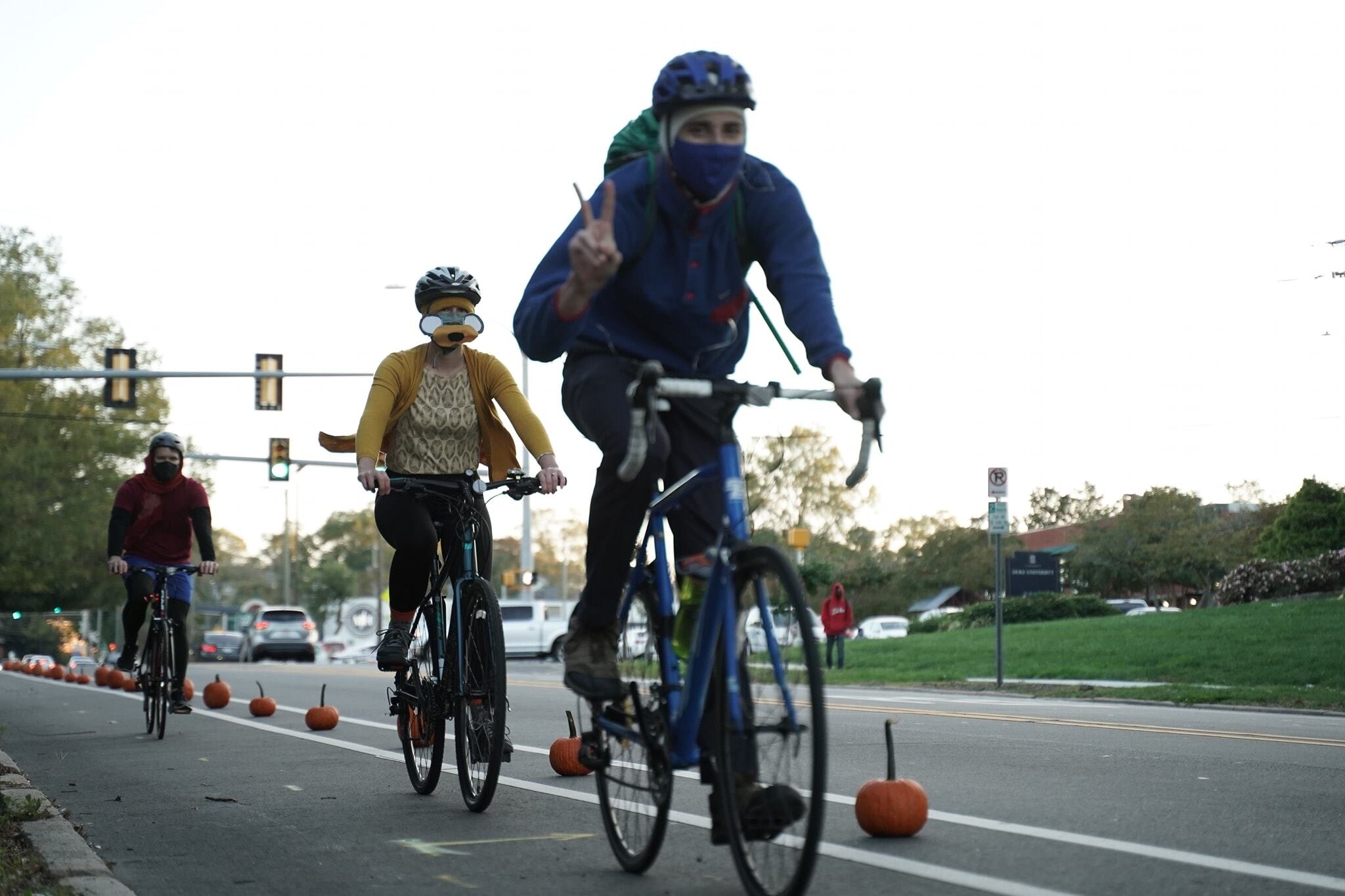
We were thrilled when we discovered that each ride had reached the cap, although we were disappointed that we couldn’t include everyone who wanted to go on the ride. Ride leaders Danielle King, Shaun King, Alison Klein, Seth LeJacq, Marc Maximov, and John Tallmadge led the groups on a 10-mile trip around the city at dusk: one group on Saturday, October 24, and two groups on Saturday, October 31. We gave away candy and lights, and we were delighted at the costumes that bikers wore: a clown and a haunting, two llamas, Amelia Earhart, and a witch, among others.  

125052043_3628105313912744_3830729363506398021_o.jpg


We set up the route in Ride with GPS, a route planning app that allows planners to add stops, information, and even photos (Bike Durham membership comes with a free account on Ride with GPS). We were therefore able to include archival pictures for each stop, as well as additional information about the story of that location, which riders could look at when we reached a stop or browse later at their convenience.

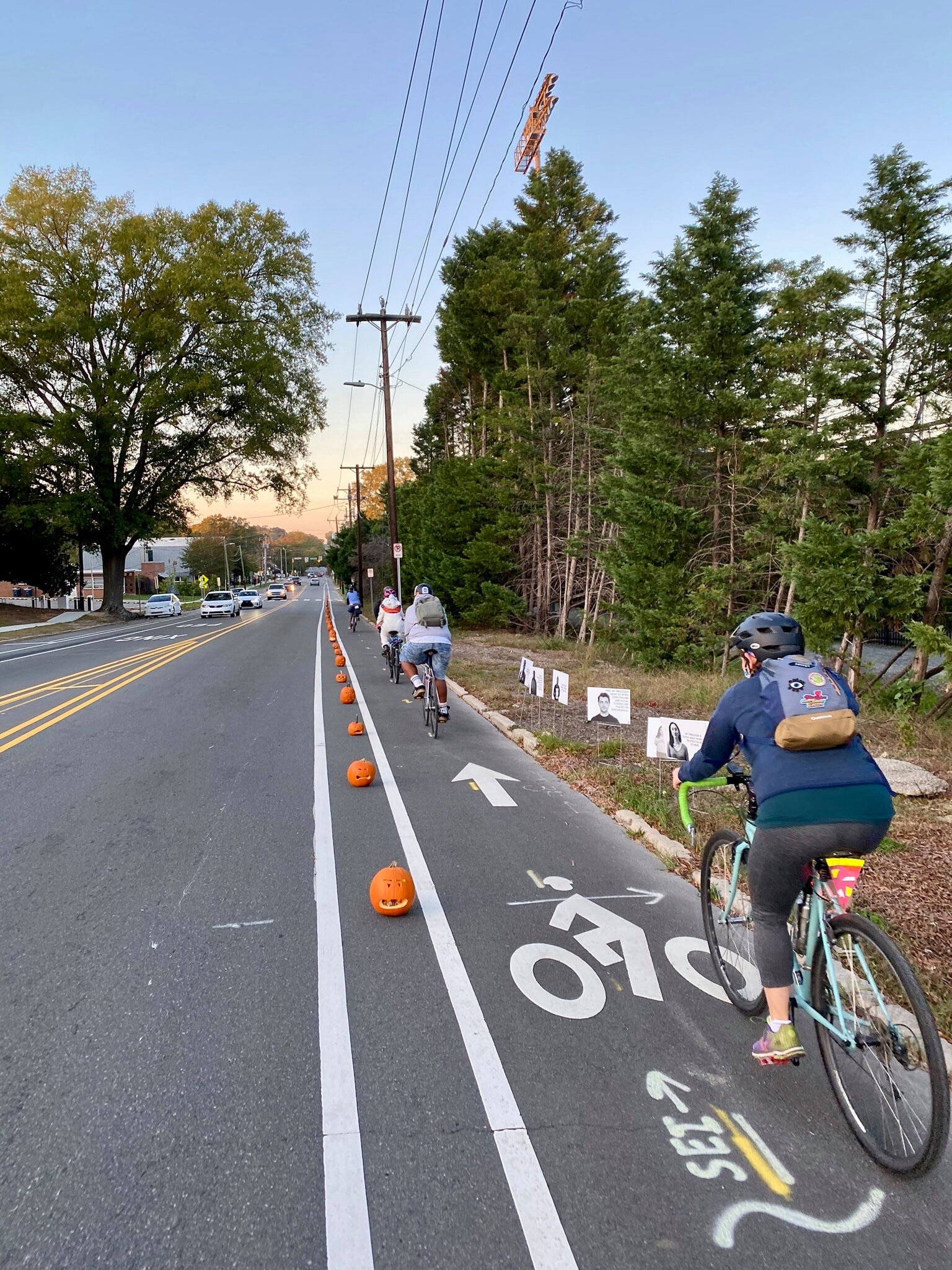
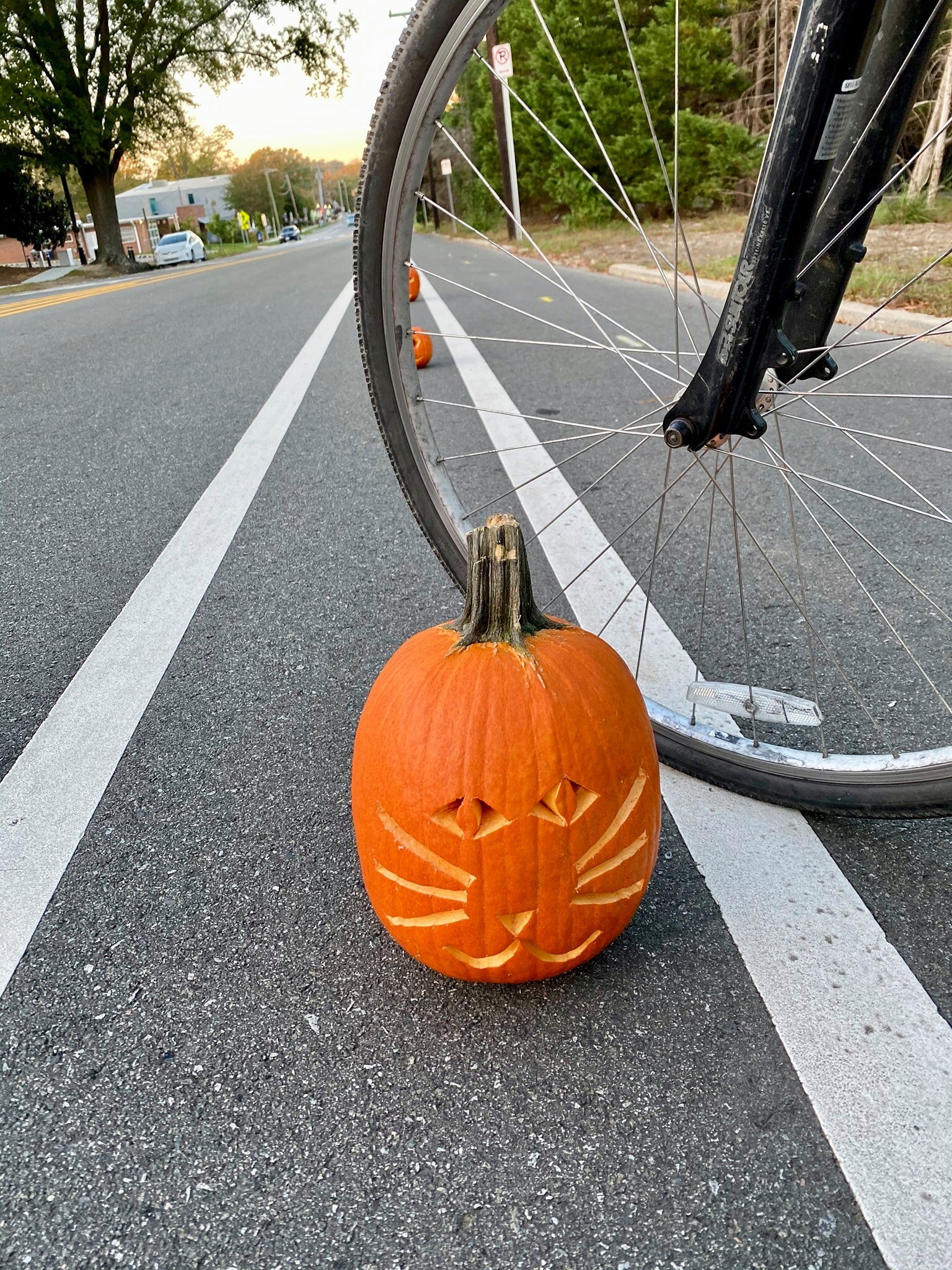
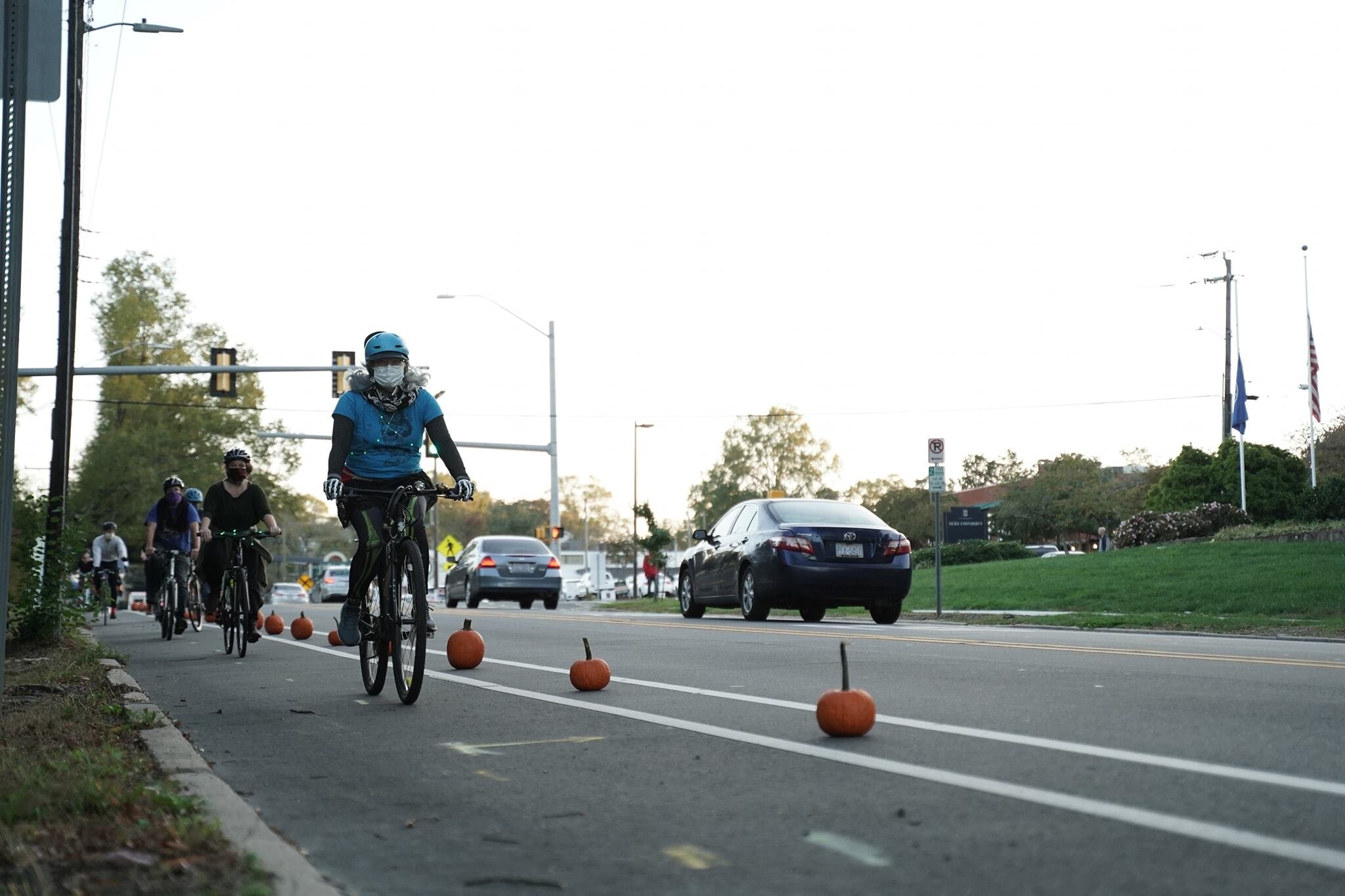
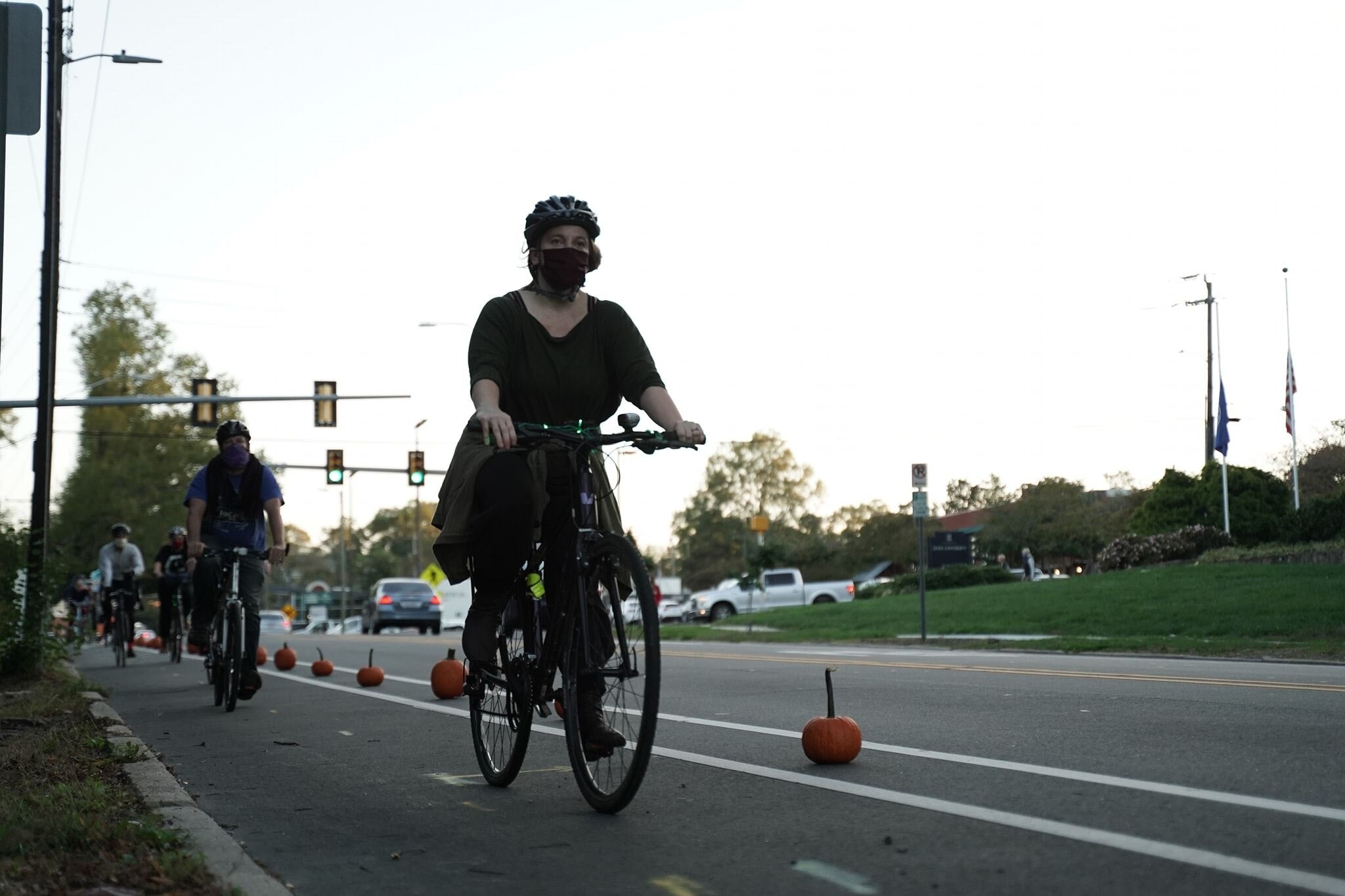
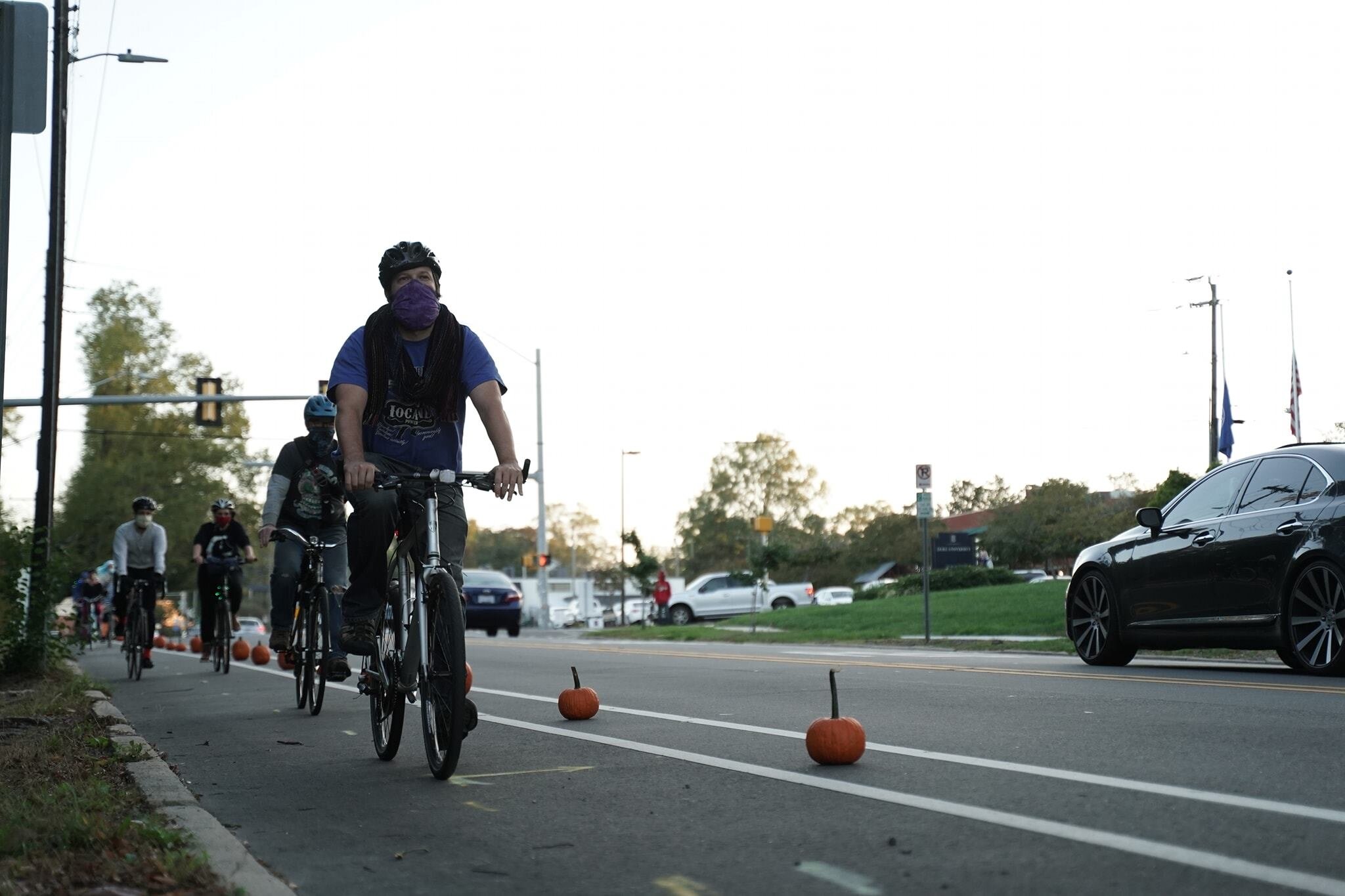
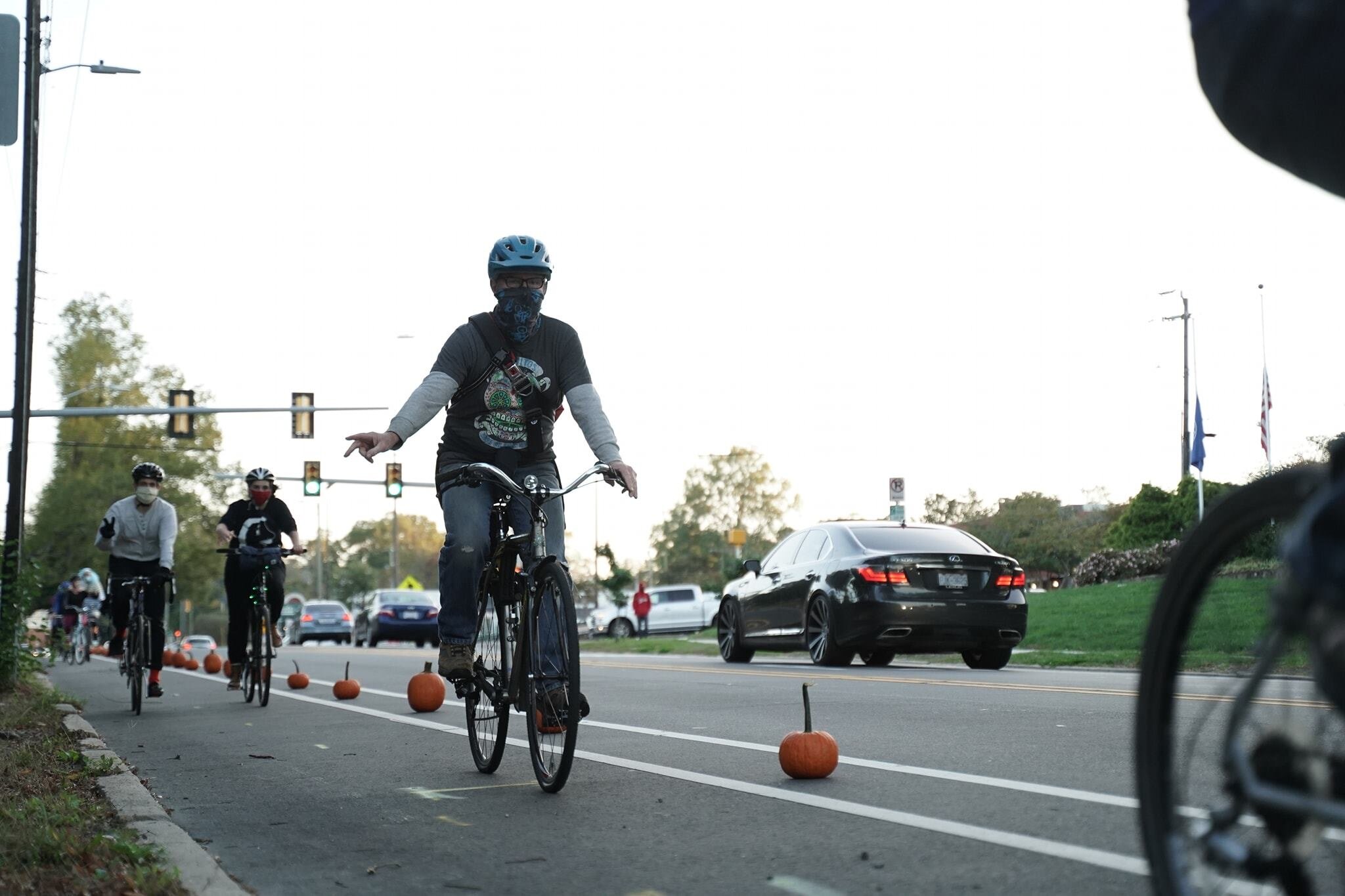
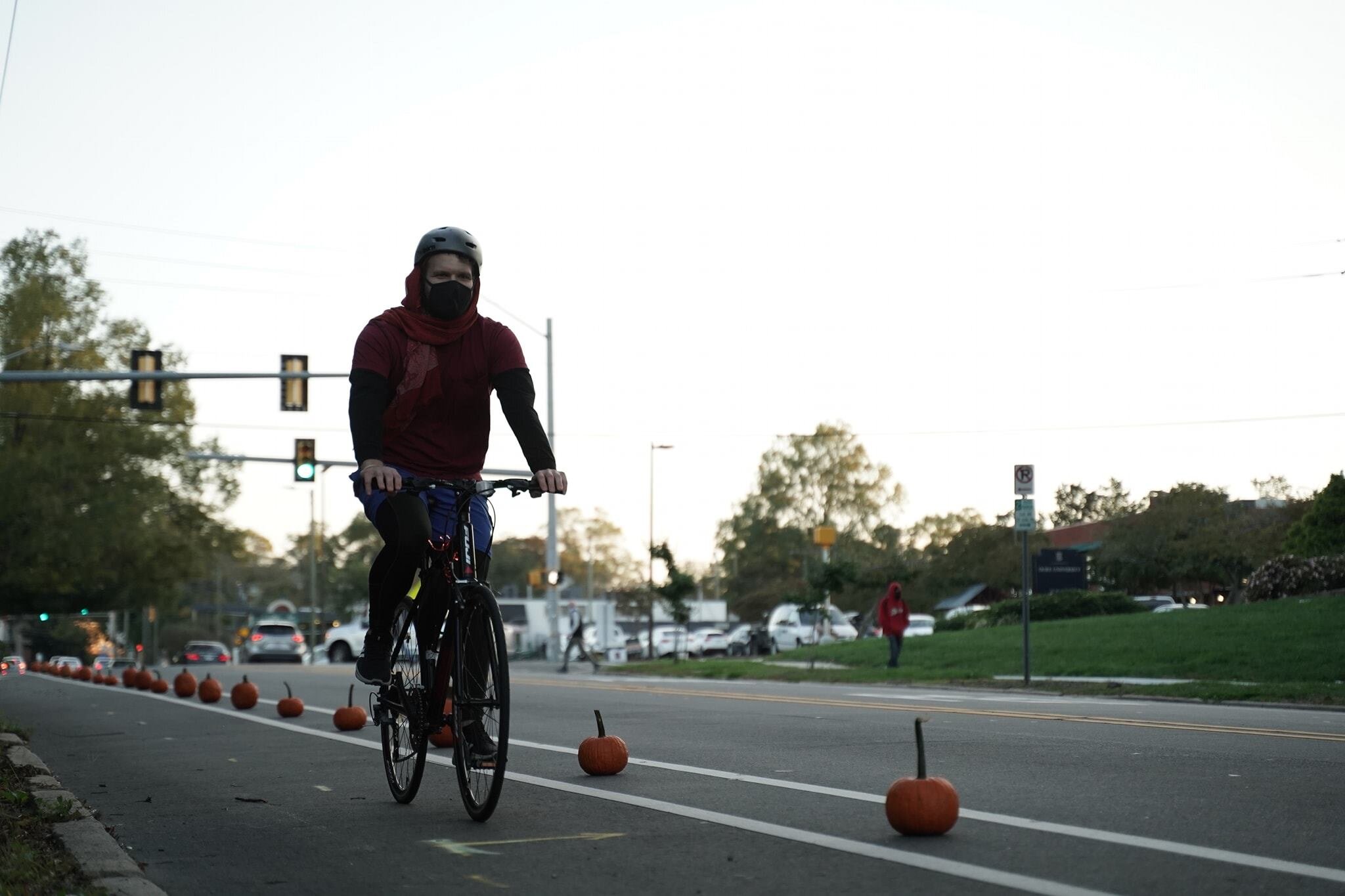
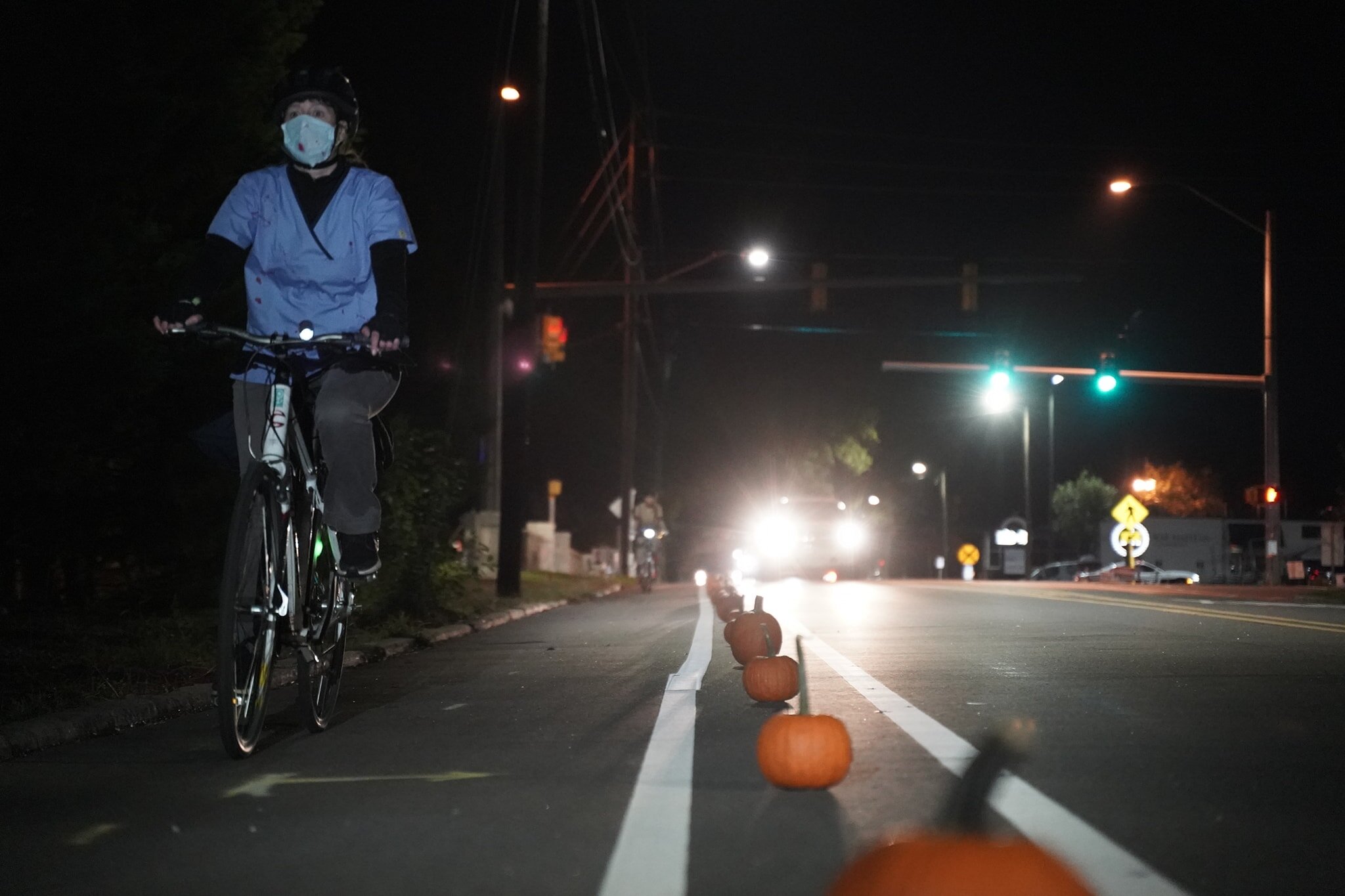
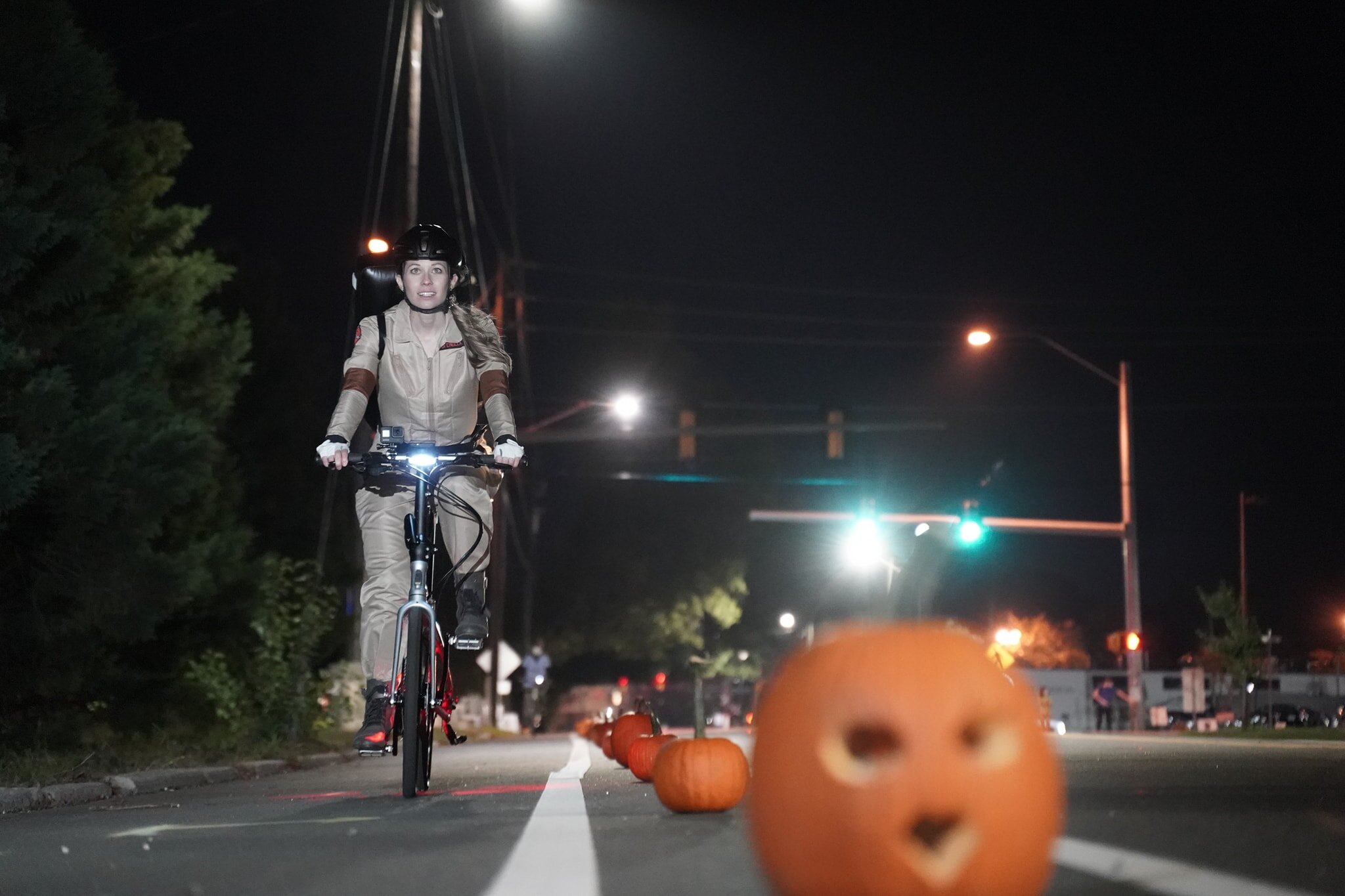
Last year, we created a pumpkin-protected bike lane along one block of the route, Broad Street between Perry and Markham, it was featured in Streetsblog USA and we made a short video about it. We recreated it again for 2020 with dozens of carved pumpkins standing in the gap between riders and vehicles, drawing attention to the need for physical barriers on bike lanes throughout the city in order to protect bikers.


At each stop, we played snippets of horror movie music, and participants guessed which movie the piece came from; winners were rewarded with Reese’s peanut butter cups. Darkness fell as we completed the route, which made the stop at the old railroad tracks on Washington even spookier, and the giant lawn decorations in the shape of Beetlejuice sandworms even more impressive. At the end of the October 31 ride, bikers stood and chatted in CCB Plaza for 20 minutes, and some new friends even went off to an art exhibit together.

We hope to make this ride an annual tradition! We want to thank librarians Valerie Gillespie, Kelley Lawton, and Elizabeth Shulman for their help in uncovering these ghost stories; Open Durham for their excellent archival photographs and historical information; Kyle Sullivan for sharing his professional-level photographs with us; and everyone who participated. We hope you had as much fun on the ride as we had planning it.

 
125239115_3628109833912292_6450808514538263590_o.jpg
 

Switching Gears during COVID-19

Jamaican-Dr-Naima-Stennett-Journey-from-Sports-to-Medicine-and-her-Passion-for-Kids-with-Cancer-2.png


Author Dr. Naima Stennett, Board-Certified Family medicine physician and Sports Medicine Fellow 

We have a saying in medicine, “Exercise is medicine.”  During this pandemic one way we can be healthy is to re-visit an old skill or try something new. After all we know once you learn how to ride a bike you never forget. There are multiple benefits of riding a bike. These can be remembered with the mnemonic C.Y.C.L.E

Naima Stennett-08827.jpg
  • C: Cardiovascular health and other chronic conditions: cardiovascular health include stroke, high blood pressure and heart attack. Regular cycling improves circulation as week as heart and lung function. These benefits your risk of cardiovascular diseases. Regular cycling has the added benefit of glucose control and reducing risk of diabetes. 

  • Y: Your weight – Cycling can help burn fat and paired with a healthy eating plan can boost your metabolism helping you lose weight. 

  • C: Clear mind: Cycling like other aerobic exercise stimulates the release of endorphins,  (the feel good hormones) this results in a feeling of well-being and promotes positive emotions such as happiness.

  • L: Lean muscle and strong bones: Resistance activities such as pedaling up the sloping trails help to build and strengthen muscles as well as increase bone density.

  • E: Easy on your joints: Cycling is a low impact sport. Due to the minimal stress on the joints Individuals who suffer from joint pain can easily participate.

Getting Started with the basics 

  • Helmet: With safety being the priority it is important to purchase a helmet that fits appropriately. 

  • A bike that fits: It is important to connect with a local Bike shop that will help you pick the right bike for your height. They will help match you with a bike for the type of terrain well as customized fitting to make you’re ride enjoyable. 

  • Saddle: It is important to know that this just as important as getting fitted for the right pair of sneakers. One of the main purposes of the saddle is to provide support and prevent increase pressure to the perineum. It is important to have the right saddle as this can reduce numbness and tingling in the legs due to compression of nerves and arteries that supply the lower body.

  • Cycling gear: Bike shorts are engineered to have thick padding to reduce chafing and cushioning while you ride. Various cycle jersey exist that help both in warm and cool temperature. They also have reflective designs so that both motorist and another cyclist can see you.

  • Water bottle rack: It is important to stay hydrated during activities especially If you plan to do more than 1 hours of cycling. Hydrated before, during, and after your ride.

  • Other tips: Find a local bike club that can help you stay motivated to keep pedaling. There are many bike lanes and trails in the Raleigh-Durham area including the American Tobacco Trail. New riders should avoid riding on the street especially if they do not have bike lanes. Lastly, do not forget your sunscreen and sunglasses

Happy Cycling

 No content in this article should be used as a substitute for direct medical advice from your doctor or other qualified clinician.