Bike Month in Durham 2026

Bike Month in Durham brought hundreds of riders together for the Bull City Bike Stampede, Ride of Silence, Bike to Work Day, and more. Here's what May 2026 looked like.


Why do we do Bike Month? Because too often, people who walk, bike, and ride transit in Durham are invisible.

Car culture is dominant here, and we've designed our city around it. There are people in north Durham, in southeast Durham, in neighborhoods all across the city who want to get around without a car, and many of them are afraid to. We haven't built a city where it's safe for them.

Bike Month is about making sure people know we're out here, from all walks of life, all corners of Durham. And that the reason you don't see more of us is because of decisions that have been made about how our streets are designed and which projects get funded.
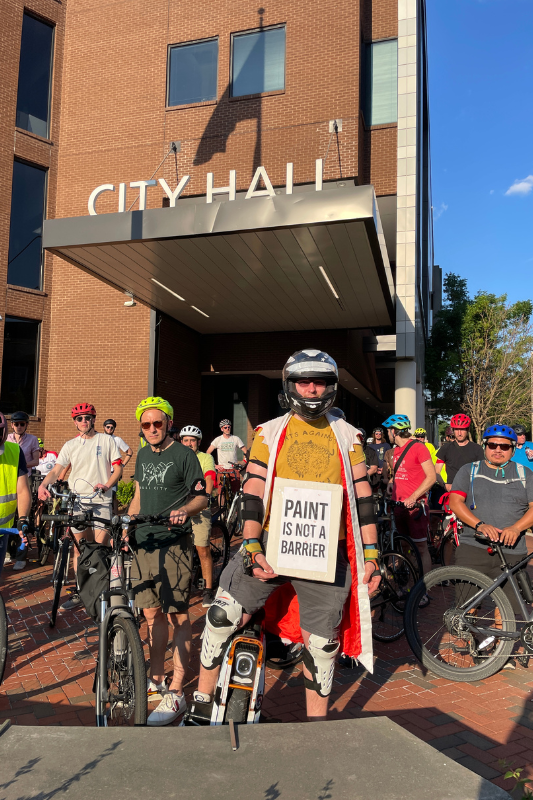
Ride of Silence attendees stop in front of City hall on May 20, 2026.

This year, that point hit harder than usual. In April, 15-year-old Jack O'Shea was hit and killed by an impaired driver while riding his e-bike home on Cole Mill Road. Jack was a freshman at Cardinal Gibbons, a baseball and basketball player, a kid who loved being on his bike.

At the Ride of Silence on May 20, Gregory Williams read the names of people killed by traffic violence, including Jack. Mayor Leonardo Williams spoke. City council members rode with us. Hundreds of people showed up to say that this matters and that no one in Durham has to mourn alone. (Thank you to Bike Law NC for presenting the Ride of Silence, to the Durham Bike Co-op for their mobile clinic, and to Justin Laidlaw and INDY Week for their coverage.)

What changes things is people coming together. That looks like riding in silence through downtown, and it also looks like 300 people rolling out from Crank Arm Brewing for the Bull City Bike Stampede and filling the streets with proof that Durham wants this.

On Bike to Work Day, we heard it from commuters riding to RTP, riding the American Tobacco Trail into downtown, or just showing up because they wanted to be part of something: people love getting around by bike, and they want to feel safe doing it. They want protected infrastructure. They want barriers between themselves and traffic. Kids across Durham showed the same thing on Bike & Roll to School Day, traveling to school together on routes that should be safe every day of the year. Thank you to Acme Plumbing and the Research Triangle Foundation for making Bike to Work Day possible.
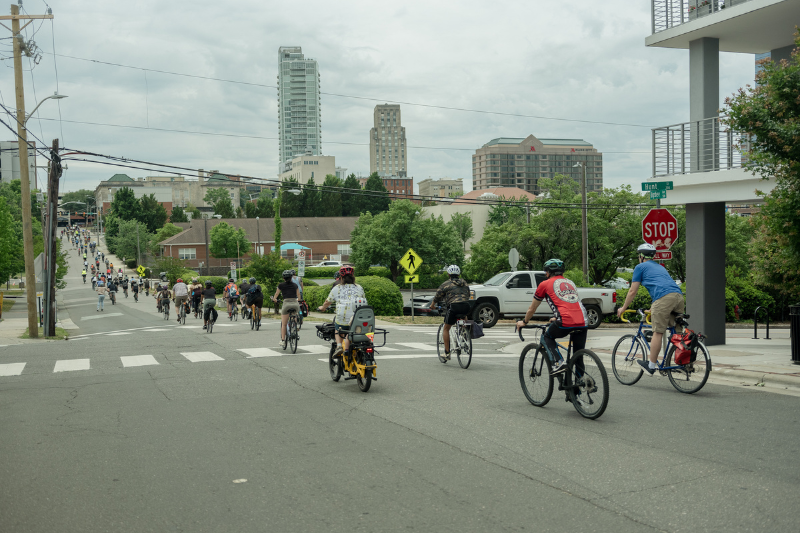
The Bull City Bike Stampede in action.

That desire is shared more broadly than people's behavior currently suggests. The gap between how many people want to bike, walk, and ride transit and how many actually do comes down to how Durham has been designed. Closing that gap takes organizing. It takes showing up at a lobby day in Raleigh with Families for Safe Streets NC to push for Stop Super Speeders legislation. It takes building close relationships with public servants like Rep. Valerie Foushee and her staff, who has since taken a leadership role on transit.

It takes volunteers working with city staff and keeping pressure on council around the Roxboro-Mangum corridor, which this month resulted in City Council approving funding to complete final designs for the two-way conversion.

Closing the gap also means meeting people where they are. Some folks want to ride a bike but need help getting started. That's what our Learn to Ride, Ready to Ride, and Ride Durham classes are for. Some people want to get involved in transportation advocacy but don't know how.

This month we launched our first Change Agent Training for exactly that. And some people just need guidance navigating public transit itself, which is why we've been building out our Transit Travel Training program on GoDurham.
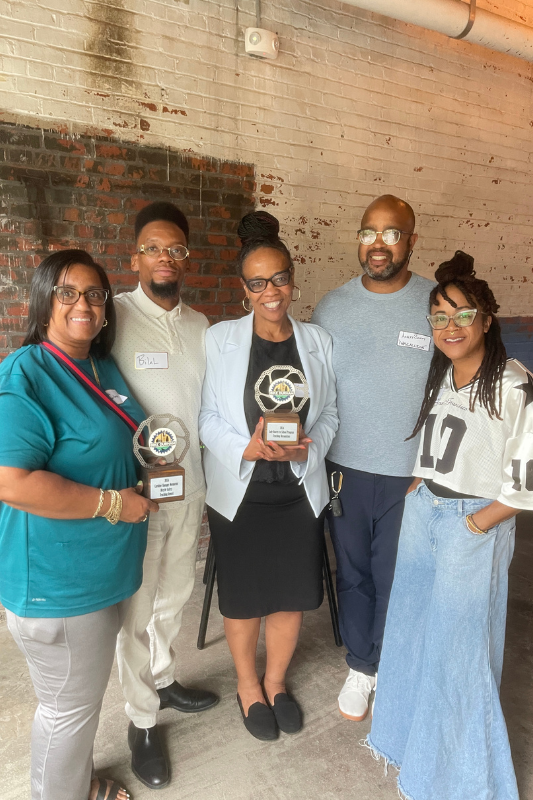
Bike Durham staff Desiree, Bilal, and Ashley celebrate Principal of the Year Dr. Vanessa Alford and Dr. Wanda McClain-Daye, recipient of the Caroline Shauger Memorial Teacher of the Year Award.

Lastly, we gathered at Durham Bottling Co. to say thank you to the volunteers and DPS PE teachers who make all of this possible to put a wrap on a wonderful Bike Month.

If you were part of any of it, thank you. And if this is the first time you've connected with Bike Durham, you belong here. Membership is now free.
Providing Places to Sit on Transit Equity Day

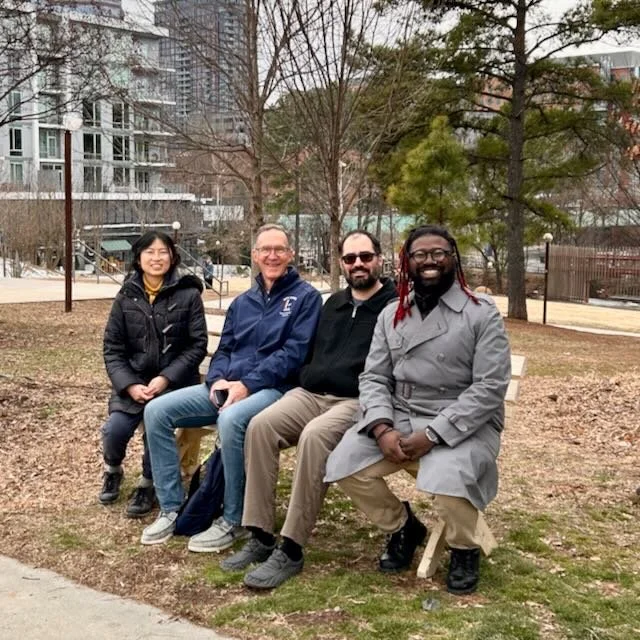
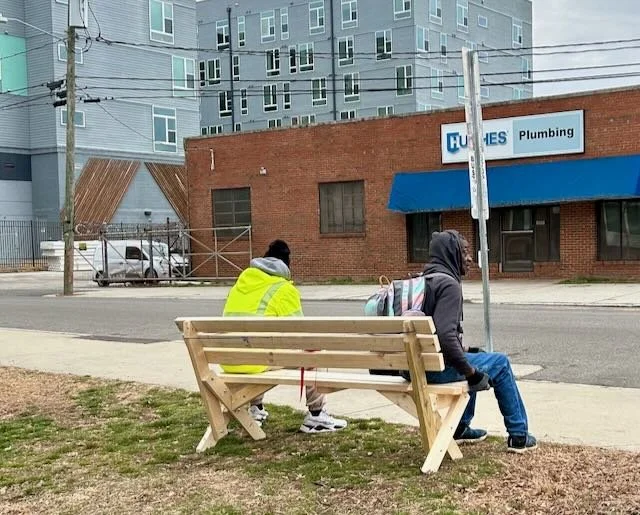
Sitting on a new bench while waiting on Route 4

In recognition of Transit Equity Day, Bike Durham staff and volunteers built and installed five benches at bus stops across Durham, highlighting the importance of increasing funding at the local, state, and federal levels and coordination with community members to build a world-class, accessible, and dignified transit system for Durham residents.

Transit Equity Day is observed annually on February 4, the birthday of Rosa Parks, to honor her legacy and to call attention to the ongoing need for equitable, affordable public transportation. In Durham, advocates will mark the day by focusing on a simple but critical element of transit access: places to sit while waiting for the bus.

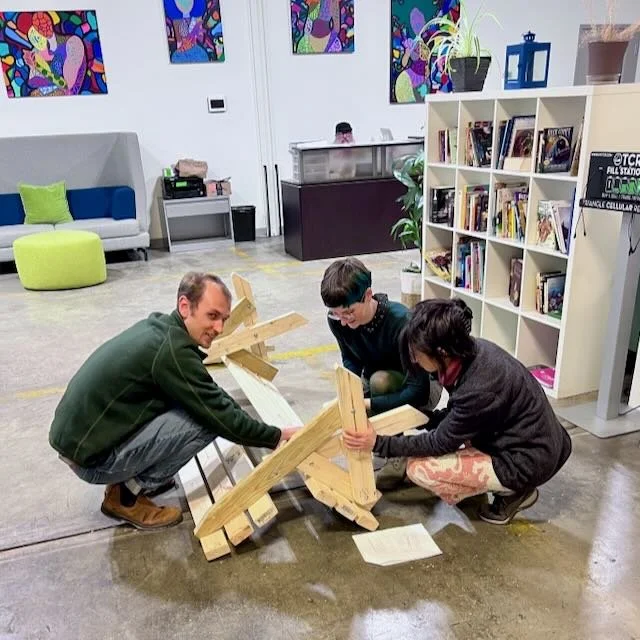
Over the past several weeks, more than 25 volunteers came together with Bike Durham staff to build five benches that have been installed at bus stops in Durham. On January 17th, a group scouted bus stop locations along several bus routes to identify candidate sites that needed seating and were a good fit for our benches. On MLK, Jr. day, more than 20 volunteers came to ReCity to review the plans, cut the wood, and drill holes to make assembly easier. Then, last night, after two postponements due to ice and snow, a group of about 10 finished assembling all the benches.

Volunteers assembling a bench

During the event today at noon, Transit Equity Day, we held a small gathering at the bus stop along Route 4 at Riggsbee and the Durham Central Park Skate Park. Gregory Williams, our advocacy campaign organizer, and I placed the bench at 11:15am and I took my truck back to ReCity so that we could load it with the other four benches following the event.

When I returned to the bus stop at Riggsbee, Gregory was talking to two men who were sitting on the benches waiting on the bus! Already, we had proof that our small, practical, volunteer-led investments led by community members can significantly improve the experience of people using our public infrastructure today, even while our local governments invest in long-term improvements.

Leaders of our bench-build team with Councilmember Carl Rist

Bus stop benches provide essential support for everyone, especially seniors, riders with mobility challenges, and parents traveling with children. Many bus stops across Durham still lack seating, forcing riders to stand for long periods or wait in unsafe or uncomfortable conditions.

The City of Durham and GoTriangle are investing a lot of money into improvements at bus stops, and more are to come. But too often, these projects take too long to complete. This project, which we hope to continue with community partners, aims to fill the gap with near-term seating solutions while the city works on permanent investments.

We Call on local, state, and federal leaders to invest more in bringing world-class transit to durham

We are asking local decision-makers to accelerate the improvements to the transit system in Durham and the Triangle.  Specifically:

  • Local officials should be taking steps to speed up delivery of projects, including committing available transit sales tax to complete critical projects like keeping GoDurham fare-free, increasing frequency on regional bus routes, and expanding the Durham transit maintenance facilities to accommodate planned growth in services.

  • State officials should change spending formulas to prioritize greater access for people riding transit, walking, and biking.

  • Federal legislators should be including new funding for transit operations, and increased funding for walking and biking infrastructure in the transportation reauthorization bill. 

Where are the benches?

The benches are located at the following bus stops:

  • Riggsbee Ave / Broadway St (southbound) (Route 4)

  • North Roxboro St / Trinity Ave (northbound) — (Route 4)  

  • Holloway St / Guthrie St (eastbound) — (Route 3)

  • Fayetteville St / Homeland (southbound) — (Route 5) 

  • Raynor St / N Miami Blvd (eastbound)— (Route 3 & 16) 

Note: Transit Equity Day events take place in communities across the country, connecting our local action to a national movement for transportation justice.

Let's Keep GoDurham Fare-Free Without Raising Property Taxes

Each year since the pandemic hit Durham in 2020, the City Council has voted through the budget to keep GoDurham fare-free for riders. Initially, it was funded through federal COVID-relief funds and then with unspent funds in the City’s transit budget. Each year, residents have lifted their voices, led by Bike Durham, so that City Council members and County Commissioners know that this is strongly supported as an affordability strategy in Durham.

We knew that this coming budget year, Durham’s leaders would be faced with a choice: find local tax dollars to keep GoDurham fare-free, or start charging riders again (perhaps as high as $2 per trip). Bike Durham’s position is that we should not be raising local property taxes to keep GoDurham fare-free when we have unallocated local transit sales tax revenues that are already being collected. Durham should not be forced to raise taxes again when there are transit dollars “sitting in the bank.”

On January 5th, Durham County Commissioners received a presentation from staff about the upcoming trade-offs presented by City and GoTriangle requests for uses of the transit sales tax and limitations on the revenues available. These requests included $2.2 million per year to keep GoDurham fare-free and to support the GoTriangle low-income GoPass program. Additionally, the City requested another $87 million for capital projects, including full funding for completing bus stop and access improvements in the Fayetteville Street corridor and expanded transit maintenance facilities.

The staff said all of the new requests cannot be funded with projected revenues without cutting back or eliminating funding for other projects - whether specifically named in the plan or the $300 million reserved for Bus Rapid Transit projects that have not yet been determined.

It’s clear that without stronger funding partners for transit at the state or federal level, the local revenue options can’t deliver the great transit system that we want. That’s why Bike Durham is working in partnership with other organizations at the national and state levels on medium- to long-term campaigns to change how transportation dollars are spent, prioritizing investments in transit, biking, and walking, and de-emphasizing highway expansion.

In the short-term, this is being framed for and by our elected officials as a zero-sum decision among projects and services. If you want more transit tax funding to keep GoDurham and GoTriangle fare-free for low-income riders, then you’ll be taking it away from another transit service or project.

No one is arguing about the merits of the Durham County Transit Plan adopted in 2023. In fact, everyone wants to go beyond what has been planned, deliver more frequent service to more places and invest in high quality infrastructure that shows dignity to riders and is safe and comfortable and makes transit more attractive for everyone to ride. Some believe that we already are at a point where we need to cut back on what we can deliver.

We reject that scarcity mind-set. It would be reasonable if the transit coffers were dry and the projected $46+ million wasn’t enough to cover next year’s expenses. That is far from the case. As of November, the transit reserves exceeded $200 million! It is true that much of this revenue is obligated to projects in the pipeline or in reserve for future investments, and it would not be wise to unrealistically over-commit the transit revenues. But this is a very strong financial position to be in, allowing for creativity in delivering transit improvements.

We want to see staff and elected leaders from the City, County, Triangle West TPO, and GoTriangle approach this situation from an abundance mindset. The Transit Plan prioritizes investments through 2040 and most agree that we will need a new revenue source in the 2030’s in order to create a great transit system. Rather than cutting back now, what if we assume that future projects that wouldn’t have started until mid- to late-2030’s will be funded with additional revenues.

Most importantly, we don’t want our leaders to be jostling for who gets a bigger slice of the pie or pointing fingers at whose responsibility it is. We all want a great system that is free, frequent, comfortable, and convenient. We’re only going to get there if our leaders - elected and staff - bring a mindset that they are working together on the same team.

I ask you to join Bike Durham in communicating with our elected officials, city manager, and county manager that we want them to work together to find a solution to keep GoDurham fare-free without increasing property taxes and keep the transit plan projects moving forward to completion.

You can email the County Commissioners at commissioners@dconc.gov

You can email City Council members at council@durhamnc.gov

Our Advocacy Priorities for 2026

In 2025, we had many significant advocacy wins:

  • Continuation of fare-free bus service on GoDurham

  • City adoption of its first Vision Zero Action Plan (a priority since 2022)

  • Funding for design of the two-way conversion of Roxboro and Mangum Streets and the study of strategies to slow speeds on Duke and Gregson/Vickers Streets

  • Launched monthly Advocacy Meet-ups to provide more hands-on volunteer opportunities

  • Organized the biggest Open Streets event in Durham’s history - Move-A-Bull City

We also participated in the League of American Bicyclists’ federal lobby day advocating for continued funding of sidewalks, bicycle facilities, and trails as well as other traffic safety legislation.  This summer we participated in a BikeWalkNC state lobby day for the first time, advocating for the repeal of legislation that prohibits spending your tax dollars collected by the state on projects to build sidewalks or bicycle facilities unless a road is being widened.

We also turned out in force to shape the recommendations on:

  • street re-striping projects, 

  • bike lane protection projects, 

  • sidewalk/multi-use path projects,

  • Bus rapid transit projects and plan,  

  • the Bike/Walk Plan update, and 

  • the city’s Unified Development Ordinance.

This is a lot to be proud of, yet there is much more to do.

In November, more than two dozen gathered at our Community Meeting or our Advocacy Committee meeting to discuss priorities for 2026 to build on our success.

These priorities are:

  • Re-energize Safe Streets Durham, a Durham-wide alliance of residents, business owners, and organizational leaders advocating for changes to make our streets safe for everyone.

    • Focus for 2026 will be on the Roxboro and Mangum Streets campaign to convert them to two-way travel.  We have chosen this campaign because this project already has momentum, but it will need an organized push to get a good design approved by NCDOT and funded by the City.  If we can’t get these streets right, we’re going to have an even harder time getting busier NCDOT-maintained streets changed to a safe design.  This campaign will require:

      • Defining design priorities that we believe will make the corridor safe for all users

      • Organizing residents, business owners, and employees to understand their desires and concerns and to identify leaders, supporters, and detractors

      • Working with leaders to mobilize supporters when we need to pressure the City or NCDOT to approve and fund our priorities

      • Working with volunteers to continue pressuring the local governments to make changes that will accelerate project delivery

  • Win long-term funding commitments to keep GoDurham bus service fare-free, to make all bus stops accessible, and to continue improving service frequency

    • Focus for early 2026 will be on getting the City, the County, and regional agencies to commit transit sales tax revenues that are already being collected to cover the estimated cost of fare-free service ($2-$2.6 million per year)

    • We will also grow this into an alliance of residents, business owners, and organizational leaders who support a multi-year campaign for better service and accessibility throughout Durham. 

  • To grow our cadre of volunteer leaders, we will create an advocacy training program to prepare residents to effectively engage with public processes, speak with decision-makers, organize their neighbors, lead a quick-build traffic calming project, etc.

  • To engage our community, we will also build on last year’s Advocacy Meet-ups with monthly service projects (e.g., bike lane/bus stop cleanups, trail maintenance, walk audits, traffic calming demonstrations). 

Finally, we are considering how best to engage with other organizations to win change at the state and federal levels.  We will look for ways to leverage our local campaigns to make the changes at NCDOT, the General Assembly, and in Congress that will be necessary to make Durham’s transportation system safe, affordable, and sustainable for everyone regardless of who they are or where they live.

If you’d like to learn more about how you can get involved with any of these advocacy priorities, please fill out the volunteer interest form with the button below.

Fostering Independence (and Making Life Easier for Parents!)

The Family Responsibility Zone plan was rolled out in many DPS elementary schools a few weeks ago, and while families are still figuring out their plans despite the latest winter temperatures, we would like to share another parent’s experience in organizing walking and biking groups and the use of GoDurham buses to get to school.

This will target older students (middle school), giving them the opportunity to expand their independence and transportation options, while connecting with their communities and neighborhoods.

Erik Landfried, Bike Durham member and volunteer, explains how organizing with other parents goes a long way and initiates habits that students then build into their routine trip to school. 

For the better part of the past seven years, our son and daughter have walked or biked to elementary school nearly every day. We are fortunate to live in a part of Durham where walking and biking is safe and we live only ½ mile from the nearest elementary school. Taking our kids to and from school was always one of the highlights of the day for us as parents. We would talk about school or something fun coming up, see friends along the way, and get some exercise while we did it. When he was old enough, our son gained a lot of independence by being able to walk or bike on his own.

Our son started 6th grade this year, which presented a new commuting challenge, but also a new opportunity. The school he now attends is nearly three miles away and while still in a relatively walkable and bikeable part of Durham, the distance and difficulty crossing some streets meant that he did not feel comfortable biking there alone.

Organize with other parents to gain momentum and help other families. BIKE BUSES!

As Erik explains, there is safety and power in numbers, especially when sharing the road with cars and in the absence of dedicated bike paths or lanes:

My friend’s son was in a similar situation, so his father and I got organized. We know there is safety (and fun!) in biking in numbers, so we recruited other families to join us. We contacted the parents of some 7th graders who had biked to middle school the previous year to find out their routine. We reached out on the PTA listserv and talked with families who have kids we thought might be interested in biking together. We discovered that there were a lot of folks interested in not having to drive their kid to school every day or rely solely on the school bus, including some that don’t live in our neighborhood.

A few parents tested out the bike-to-school route on a weekend and got to do a trial run with the kids during the Summer Bridge program at the middle school (a fantastic program, by the way). We set up a WhatsApp group for the parents to stay in touch and the kids exchanged contact info if they had their own device. During the first week of school, a few parents rode with the kids to and from school, testing out different routes and ways to safely get through difficult intersections. By Week 2, the kids biked to school on their own. Most mornings, they meet up at the same elementary school most had walked or biked to when they were younger and take their “bike bus” to middle school.


Students on their way to school - May 2024

How can public transit help?

There have been challenges for sure - bad weather, the timing of before or after school programs, transporting trumpets - but each time the parents and kids came up with a solution. I took some of the kids to school on the GoDurham bus one morning to teach them how to ride and where to get on and off the bus. Now several of them use the city bus when they need to transport something or the weather is too icky to bike. And on days when driving is more convenient, we carpool, using the WhatsApp group to organize rides. Families who had originally signed up for the school bus realized they no longer needed it, lessening the load for a school system struggling to hire enough bus operators.

Students using a GoDurham bus on a rainy day - May 2024

Best of all, we’ve formed a community of parents and kids who help each other out. The kids have expanded their independence and we’ve created multiple options for helping them get to and from school, which makes our lives much easier.

Not everyone can do this: what are the takeaways and what can we all do?

I write this knowing that what’s worked for us is not going to work for everyone. Many schools in Durham are sadly not safe to walk or bike to or the distance to them is too far. Some don’t have GoDurham service nearby (though more do than you might think - the DPS Safe Routes To School team has produced these handy transit guides!). But there are opportunities out there. And with the change in how middle schools are districted next fall, this is the perfect time to explore what you can do to give your kids some independence and a healthier commute and make your lives easier at the same time.

Here are a few suggestions for getting started:

  1. Make a plan this summer. What are the options for your kid(s) to get to school? What are your needs as a family?

  2. Test it out. If it’s feasible, walk or bike with your kid(s) to their new (or old!) school. Or try a GoDurham bus. Do it on a weekend if you can’t on a weekday.

  3. Reach out, connect with other parents. Contact other families at your kids’ school through a PTA listserv or other type of school communication or simple word of mouth.

  4. Get organized. Create a WhatsApp group or whatever form of communication works best for you. Pick a location and time to meet if you’re doing a walk or bike bus. Do a test run before the school year starts.

  5. Start small. We started with the bike bus, but tacked on GoDurham and carpooling later. You could even just try it one day a week to start.

  6. Keep communicating and iterating. Figure out what works best for everyone’s situation.

  7. Have fun! Walking is fun. Biking is fun. Taking the bus is fun. Especially with lots of friends. And having lots of options and a community to lean on relieves stress, which is also fun!

Know that you are not alone! If you’re not sure how to get started, please reach out to education@bikedurham.org or feel free to contact Erik directly (erik.landfried@gmail.com).

Bike Durham on DPS Family Responsibility Zones

Bike Durham sobre las Zonas de Responsabilidad Familiar en las Escuelas Públicas de Durham (DPS)

For English, CLICK HERE

Muchos padres de estudiantes en las Escuelas Públicas de Durham (DPS) han estado viviendo semanas complicadas debido a la falta de conductores de autobuses escolares. Hace poco, la Junta de DPS aprobó una nueva política que eliminará el servicio de autobús para muchas familias de las escuelas primarias. Esta política, llamada Zona de Responsabilidad Familiar (o Zonas de Caminata), elimina el servicio de autobuses en un rango de 1 a 1.5 millas alrededor de las escuelas afectadas, siguiendo ciertos criterios (ver diapositiva 11).

Caminata a la Escuela, Octubre 2024, Escuela Primaria Holt

Con esto, sumado a los retrasos y cancelaciones por el clima invernal reciente, muchas familias están enfrentando un tiempo de gran incertidumbre.

Sin embargo, cada desafío es una oportunidad para generar un cambio positivo.

En Bike Durham estamos colaborando con el equipo de Rutas Seguras a la Escuela de DPS, padres afectados y administradores escolares para apoyar a las familias que se han quedado sin opciones de transporte escolar. Estamos trabajando en recursos para ayudar a los padres a organizar “autobuses escolares a pie” y “trenes de bicicletas” en sus comunidades. Aunque la implementación de la Zona de Responsabilidad Familiar ha traído desafíos significativos para las familias, también representa una oportunidad para que más estudiantes y familias caminen o usen bicicleta para ir a la escuela, conectándose con sus comunidades y disfrutando los beneficios de empezar el día en movimiento.

¿Qué puedo hacer como papá, mamá u organizador de mi comunidad?

El éxito de estas iniciativas depende de los padres, quienes son clave para generar entusiasmo y organizar a la comunidad escolar. Solo se necesita que uno o dos adultos entusiastas (generalmente padres o tutores) tomen la iniciativa para que la participación comience a crecer a medida que más estudiantes se enteran de que sus amigos están caminando o yendo en bicicleta a la escuela.

Un ejemplo claro de esto es David Bradway, líder voluntario de Bike Durham y padre de un estudiante de DPS. David ha trabajado junto a otros padres para organizar un Tren de Bicicletas semanal que reúne a estudiantes (y algunos padres) todos los miércoles por la mañana, sin importar el clima, para viajar desde un parque local hasta la escuela primaria E.K. Powe.
David comparte cómo las familias en E.K. Powe han encontrado maneras de adaptarse a esta nueva realidad:


“En la escuela primaria E.K. Powe, muchos estudiantes caminan, usan bicicleta o son llevados en carro. Sin embargo, hay familias que se han visto afectadas por el servicio rotativo de autobuses y los cambios de la Zona de Responsabilidad Familiar. Para ayudar a estos padres, enviamos mensajes a través de la lista de correos del PTA y de la aplicación Seesaw de la escuela. Estos mensajes ayudaron a las familias a coordinar planes de carpool, conectando a quienes necesitaban transporte con quienes podían ofrecerlo. En otras escuelas, los padres han usado grupos de WhatsApp para organizarse mejor. En nuestra escuela, también organizamos un paseo semanal en bicicleta llamado el ‘Bike Train’ (Tren de Bicicletas). Este paseo sigue el modelo de otros movimientos de trenes de bicicleta que existen en el país y el mundo. Lo promocionamos en listas de correo del vecindario y en redes sociales. Pedimos que un adulto acompañe a cada grupo de niños que participe, y dejamos claro que los organizadores no asumen ninguna responsabilidad legal por el paseo.”

Otros padres han estado involucrados en este proyecto, Scotty Mathess ha estado a carga de los correos electrónicos semanales:

“Hola a todos:
Mañana es miércoles y eso significa que el Tren de Bicicletas de E.K. Powe estará listo para salir. Nos reunimos a las 7:30 am en las canchas de tenis del parque Oval para ir juntos a la escuela, celebrar la amistad y el transporte activo. Ahora más que nunca, el movimiento de Tren/Autobús de Bicicletas es importante para nuestra comunidad, especialmente con los cambios en el sistema de transporte de DPS.

Recuerden que cada voz cuenta. Participen en los comentarios públicos sobre el plan de caminatas y bicicletas de Durham para mejorar las condiciones de transporte en nuestros barrios.

Nos vemos mañana en las canchas de tenis del parque Oval a las 7:30 am. ¡Abrigarse bien y traer luces si es necesario! Como siempre, les recordamos que si manejan por la zona o cerca de la escuela por la mañana, conduzcan con precaución y reduzcan la velocidad. Hay niños y familias en la calle, y todos queremos llegar a salvo a nuestro destino.
¡Nos vemos allí!”

Tren de Bicicletas Semanal, Diciembre 2024, Escuela Primaria E.K. Powe

Sabemos que andar en bicicleta no es una opción para todos, pero estas estrategias también pueden aplicarse para organizar grupos de caminatas. Esperamos que estas iniciativas sean cada vez más comunes a medida que las familias se adapten a la eliminación del servicio de autobuses.

Si te interesa unirte como voluntario para apoyar a las escuelas, por favor contáctanos en education@bikedurham.org. Estamos aquí para ayudar a las 21 escuelas afectadas, proporcionando apoyo en la planificación de rutas y el inicio de grupos organizados de caminata y bicicleta.

¡Hagamos que más jóvenes de Durham disfruten del camino a la escuela con una sonrisa en sus rostros, empezando el día con energía positiva!

Por un transporte seguro, accesible y sostenible para todos nuestros estudiantes.

Hemos creado un documento práctico de 1 página con recursos útiles para padres, tutores y líderes comunitarios, y lo compartiremos con las 21 escuelas afectadas.

Haz clic en las imágenes para verlas en tamaño completo


Misión de Bike Durham

A través de eventos, defensa y educación, Bike Durham empodera a las personas a caminar, andar en bicicleta y usar el transporte público con mayor frecuencia.


Visión de Bike Durham

Creemos que todos deberían tener acceso a transporte seguro, accesible y sostenible, sin importar quiénes sean o dónde vivan.

recursos adicionales:

Haga clic aquí para ver los recursos implementados por el equipo de Rutas Seguras a la Escuela (SRTS) de DPS

Haga clic aquí para ver los detalles de cada zona y la lista de escuelas afectadas


Bike Durham on DPS Family Responsibility Zones

Many parents of students in Durham Public Schools (DPS) have been in turmoil scrambling in the last few weeks due to the shortage of school bus drivers. The DPS Board recently approved a policy that will remove school bus service  as an option for many families at DPS elementary schools. The policy is called the Family Responsibility Zone (walk zones), which cuts bus service from areas up to 1-1.5 miles from each affected school, following this criteria (slide 11) 

Walk to school October 2024, Holt Elementary school

Factor in the recent delayed starts and cancellations due to winter weather, and this has been  a rocky and uncertain time for many families.

However, every period of disruption creates an opportunity for positive change.

Bike Durham is working closely with the DPS Safe Routes to School team, affected parents, and school administrators to provide support to the families that are affected by the bus shortages. We are creating resources to help parents navigate the logistics of starting “walking school buses” and “biking trains” in their school communities. While the Family Responsibility Zone is a disruption that is sure to create many challenges for DPS families, it is also an opportunity for more students and families to walk or bike to school, connecting with their communities and experiencing the joy and benefits of moving their bodies on the way to school every day.

What can I do as a parent or community organizer?

Making walking school buses and biking trains successful at a school depends on contributions from the parents, whom we rely on to rally excitement and coordinate within the school community. It all starts with a few enthusiastic adults (usually parents or guardians) who take the lead, often just one or two, who are dedicated and consistent. From there, participation snowballs as more students learn their friends are walking, biking, or rolling to school.

David Bradway, Bike Durham volunteer leader and DPS parent, has coordinated with other parents to establish a weekly Bike Train that gathers students (and some parents) every Wednesday morning (regardless of weather) to travel from a city park to E.K. Powe Elementary.

David describes how he and other families at E.K. Powe have been coming together to address the new school transportation realities.

‘’At EK Powe elementary school, we have many students who walk, bike, or are dropped off by car. There are families, however, who have been negatively impacted by the rotational bus service and FRZ changes. To help these parents with carpool plans, messages went out through the PTA's email listserv and the school's communication channels such as the Seesaw app. These messages instructed people in need of carpools or who were willing to drive to reach out to a specific point of contact who helped serve as matchmaker. Other schools have used WhatsApp chat threads to plan carpools and other transportation strategies. At EK Powe, there is also a weekly bike-to-school group ride which is organized by parents, without direct involvement from the school or PTA. We call this weekly ride the BikeTrain, and it follows the model of similar "bike bus" rides elsewhere in the country and world. We have utilized the local neighborhood email lists and occasionally social media to promote this ride. We require a parent or other adult to accompany each group of kids who joins the ride, and the parent volunteer organizers do not assume responsibility or liability for the ride.’’

Other parents have been involved in this project, Scotty Mathess has been in charge of weekly emails:

‘’Hello Friends, neighbors, caregivers, parents.

Tomorrow is Wednesday again which means we climb aboard the EK Powe Bike Train at 7:30 am at the Oval Park Tennis Courts to ride to school and celebrate friends and active transportation. The mission of the Bike Train/ Bike Bus movement is even more important to our community now that the DPS transportation system has changed. More people than ever have a good reason to ride and walk to school. Be sure to check out the public comment for the Durham walk and bike plan update and make your voice heard to improve conditions for walking and biking in your neighborhood! Every voice helps improve conditions for those who can't or choose not to drive cars, which in turn makes things better for those who must, or choose to drive. 

So once again we meet at the tennis courts at Oval Park at 7:30 am and roll out shortly thereafter, Dress warm and lights are recommended. And as Usual if you must drive in the neighborhood or near the school in the morning, remember that there will be children and parents out so slow down, use due caution, and avoid distractions, so everyone can get where they are going safely. 

Hope to see you there!’’

Weekly Bike Train December 2024, E.K. Powe Elementary School

While biking is not suitable and accessible to all, these same strategies can be applied to walking groups, which we expect to be more common as a response to the elimination of bus services. 

If you are interested in joining our group of volunteers to help support schools, please reach out to education@bikedurham.org. We will offer assistance to all of the 21 affected Elementary schools in routes planning and kickstarting organized walking and biking groups.

Let’s help families so  more of  Durham youth will enjoy a fun and energetic walk or ride to school, and start the day with a big smile on their faces!

To a great continuation of our mission in giving safe, affordable, and sustainable access to all of our students to their beloved campuses.

We have created a compact and shareable 1-page to provide guidelines for parents, guardians, and community leaders and we will share it with all of the 21 schools affected.

Click on the images for a full size version


Bike Durham Mission

Through events, advocacy, and education, Bike Durham empowers all people to walk, bike, and ride transit more often.

Bike Durham Vision

Everyone should have access to safe, affordable, and sustainable transportation regardless of who they are or where they live.

Additional resources:

Click here to see DPS Safe Routes To School team’s implemented resources (SRTS)

Click here to see the details of each zone, and the list of affected schools.

Bike Durham Releases Delivering Durham Report

PRESS RELEASE:  

Bike Durham Releases Delivering Durham Report Recommending Changes to Speed Up Durham Completion of Transportation Infrastructure Projects

Durham, NC - On November 5th, more than 75% of Durham voters said yes to a $115 million bond referendum to fund the completion of sidewalks and streets projects. One of the projects to be completed with the money is 1.5 miles of new sidewalks and bike lanes on Morreene Road between Erwin Road and Neal Road in west Durham. This project has been in development since 2012 - even earlier in the planning phase. Many residents and safe streets advocates have been wondering why this project, and others like it, are taking so long for the City to complete.

Bike Durham, one of the leading groups advocating in support of the bond, has released a new report, Delivering Durham - four case studies on transportation projects in Durham and ten recommendations for how the City of Durham can speed up the delivery of the bond projects and other projects that are earlier in the project delivery pipeline. Bike Durham executive director John Tallmadge states, “This is a clear-eyed look at what’s been happening to slow these projects down. There are real shortcomings, but nothing that can’t be fixed, and we believe the City is committed to doing better.”

The report looks at what has happened with the recently completed Neighborhood Bike Routes project, the Morreene Road project, a completed sidewalk project on Chapel Hill Road, and the bus stop improvement program (coordinated with GoTriangle). Joe Wilson, Bike Durham’s policy intern, did dozens of interviews with City staff and staff at NCDOT and the regional transportation planning organization. He also pored over project data that was available, but spread over numerous websites.  “One of our recommendations is that the City should create a one-stop website source for information on all of the transportation projects in Durham.  Currently, it’s nearly impossible for an interested resident to know where to look for an up-to-date status on a transportation project,” said Wilson. 

This is just one of ten recommendations (see page 2 for the full list) that Bike Durham urges the City staff and elected leadership to pursue.  Others range from project management process changes to taking over maintenance responsibility for key streets in Durham. Tallmadge said, “These are common-sense changes that will make a noticeable difference speeding up transportation project completion. We know that some of them are already in discussion at the City. It’s time to make them happen.”


MORE INFO: Full report is available at https://drive.google.com/file/d/1eb-Zwr11Xt1_KkZoArv9x7HgKkwgMiFC/view?usp=sharing

Abbreviated StoryMap is available at https://bikedurham.org/delivering-durham 

Bike Durham Recommendations to Speed Up Delivery of Transportation Projects


1. Fund more projects locally.

2. Fund preliminary project design in department budgets, rather than through the CIP.

3. Accept maintenance responsibility from the NCDOT on key streets.

4. Train staff on Federal Highway Administration standards and on the requirements of NCDOT collaboration.

5. Hire or assign a program manager to guide the portfolio of transportation projects.

6. Join the North Carolina Benchmarking Project.

7. Adopt a street design manual.

8. Begin property acquisition for a project at 60% design.

9. Actively evaluate and invest in staff capacity.

10. Develop an accessible and authoritative capital projects viewer.

# # #

The Case For the Connecting Durham Bonds

Resources for early voting 

  • You can vote at any early voting location in your county any day through November 2nd. See locations and hours here

  • You can register to vote or update your registration when voting at these locations.

  • As a reminder, you’ll be asked to show photo ID this year. However, if you don’t have photo ID you can still vote! You’ll just need to fill out an “ID Exception Form” when voting. Here’s some information about voting with or without photo ID: https://www.ncsbe.gov/voting/voter-id

Early voting is underway and we urge you to get out and vote yes for both Connecting Durham bonds on the back of the ballot - one for sidewalks and streets and one for parks.

This Spring, Bike Durham members advocated for the Council to put a referendum on the ballot to fund greater investment in sidewalks, bicycle facilities, and traffic calming. Since then, we have been teaming with the members of the Connecting Durham Campaign Committee, including Council members Caballero and Rist to inform Durham residents about the benefits that both the sidewalk and street bond referendum and the parks bond referendum will bring to Durham.

We feel strongly that these bond referenda are the right choice for the residents of Durham. Here’s why:

These projects match our values

Whether a long-time resident of Northeast Central Durham or a new resident near Southpoint, whether a worker at Duke Medical Center or in a restaurant kitchen, Durham residents have consistently said that improving our sidewalks, streets, and public transit system are among their top five priorities for investment (2022 resident survey, page viii). Most of us want a Durham that is inclusive and thriving. That requires a transportation system that works for everyone, whether walking, biking, using transit, or in a car. And we can have that by building and maintaining complete networks of sidewalks, protected bike facilities, safe streets, and great transit.

We have been held back from having the transportation system that we want and deserve because past leaders at the local level did not and current leadership of the General Assembly do not share our values. Developers were not required to build sidewalks until the mid-1990’s, and our General Assembly passed a law in 2013 forbidding the spending of state transportation funds on stand-alone sidewalks and bicycle infrastructure (article by Center for American Progress).

The sidewalk projects that have been identified for completion with these bond funds are key links in this network. They have been clearly identified and prioritized, and are ready for construction. The maintenance projects have been prioritized through recent assessments of street and sidewalk pavement conditions, and a Council commitment to pave all gravel roads. You can see the projects on a map here and you can read more detail about the new sidewalk projects here.

The parks projects were identified through the City’s Splash & Play Project, which was a multi-year community outreach project developed in partnership with East Durham residents. The parks and aquatic center projects came out of this planning process that involved thousands of residents who told Durham Parks and Recreation the features that they want in their local parks.

These Projects Will Make Us Safer

Completing our networks of sidewalks and protected bike facilities (some projects include multi-use paths) are essential elements of reaching zero deaths and serious injuries and zero carbon emissions from transportation. The bond would fund projects to address more than a dozen missing connections.

I was recently interviewed by reporter Michael Perchick of ABC-11 about the bonds. I asked him to meet me at LaSalle Street where it crosses the railroad. While I waited for them to arrive, I saw two middle school age girls walking on the other side of the street, pushing through tall grass with their hands, trying to stay as far from the traffic as they could. This is stretch of LaSalle Street will have sidewalks in the next few years if the bonds are approved.

Thumbnail of Instagram reel (click to view)

I also took a walk with Council member Nate Baker along Hillandale Road between the interchange with I-85 and Club Boulevard. We got our feet wet and muddy along the “goat path” on the side of the street, and stopped to pay respects to the memory of Seth Vidal who was killed on this stretch while riding his bike back in 2013. If the bond passes, this stretch of Hillandale Road will have a new multi-use path giving a safe space for people to walk and bike.

On the bond bike ride hosted by Council member Carl Rist to close out Move-A-Bull City, everyone stopped at the Southside neighborhood community center to see some of the traffic calming measures that were installed by the City at the request of the neighborhood last year with the repaving of their streets. If the bond passes, traffic calming will be possible in several neighborhoods across Durham slated for street repavings.

These Projects Will Improve Transit Access

One of the common complaints about our transit system in Durham is that too many of our bus stops are just poles on the side of the road. Everyone riding the bus deserves the dignity that comes with safe access, and a clean, comfortable bus stop. Seventeen of the sidewalk projects will connect to bus stops and will add ADA-accessible landing areas, large enough to accommodate benches or shelters.

Thumbnail image from Instagram reel with Bike Durham staff member Kelsey Graywill in foreground and Commission candidate Mike Lee and Council member Carl Rist in background

Thumbnail of Instagram reel (click to view)

Leading up to the Week Without Driving, Council member Carl Rist and County Commission candidate Mike Lee did a ride-along on GoDurham bus route 9 with Bike Durham staff Kyle Sullivan and Kelsey Graywill, getting off on East Club Boulevard at a dangerous spot where there is currently no sidewalk. If the bond passes, this segment of East Club Boulevard will have continuous sidewalk on both sides of the street from N Roxboro Street to Glenbrook Drive.

Thumbnail of Instagram reel (click to view)

During the Week Without Driving, a challenge to transportation decision-makes and the community to experience what it’s like to move around our community without driving, I also walked with Council member Chelsea Cook along Northpointe Drive where there is currently a temporary material down on the grass to make a firm landing area at the bus stop, but no connecting sidewalk. If the bond passes, this segment too will be connected to the sidewalks between Guess Road and the sidewalks that start at North Pointe shopping center.

These Projects are ready to be constructed

The new sidewalk projects have already been completely or mostly through the design phase and property is being acquired, as needed. These projects are all expected to be bid out for construction in the next 1-3 years. The sidewalk repair, street paving and repaving, will move forward to construction beginning with the start of construction season next Spring and should all be completed within two years.

Many of the new sidewalk projects have been in the planning and design phase for years - too long really. The City had underinvested in its staff and consultant capacity to manage the design process and procure the necessary right-of-way for these and other projects. While we have been raising concerns about the pace of project delivery for several years, we are encouraged by steps that the City has been taking recently to speed up the delivery of these projects and believe that the leadership is there on the staff to resolve the systemic issues that have been slowing project delivery. We will be releasing a report about the City’s record on project delivery next month, but today, know that we’re confident that the City is ready to deliver on the completion of these projects in the next few years.

These Bonds are the Fastest and Least Expensive Way to Complete these Projects

The bonds are the least expensive and fastest way to fund the completion of these projects (see here). If the bonds pass, all the projects can proceed to construction on their current schedules. If the bonds do not pass, then many of the projects will have to be paused until alternative funding sources can be raised. This would likely add years to some projects, during which time inflation would further raise the costs.

I have heard some argue that these projects should be funded through the regular Capital Improvements Program. If you agree that these projects are important to our community and priorities to be completed, then this is either an argument that $200 million should cut from other projects or services over the next several years to make room for these projects, or it is an argument for raising the property taxes by 46.8 cents per $100 of valuation (currently only 11.5 cents per $100 of valuation for capital projects and debt). This is why taking on debt makes sense for large capital investments. The City gets a very low rate because of their history of good financial management leading to a AAA rating, and the bonds spread the payments over years. As Tim Flora, the City’s finance director, often says, “Paying with bonds is a strategy for generational equity. Bonds are repaid over the useful life of the infrastructure, spreading the project cost equitably among current and future taxpayers as they receive the benefits of the infrastructure over time.”

I’ve already voted Yes for the Bonds, i hope you will too

I'm convinced that this bond funding is the cheapest way to deliver these projects that are a critical next step in building the infrastructure that we all deserve in Durham.

You can help make sure these bonds pass so the projects can be completed by taking these steps:

  1. Make a plan to vote and mark yes for both bonds on the ballot

  2. Tell three friends or family members to do the same

  3. Sign up for a shift to canvass or make phone calls to other voters

Tomorrow is the First Day of School: Let’s Slow Down and Continue Advocating for Change

My daughter’s parking space at high school

Tomorrow, my youngest daughter is starting her Senior year at Riverside High School. It will mark the eighteenth consecutive year that one of our daughters has attended Durham Public Schools.  In addition to feeling excited for her, I’m also nervous because we’ll be letting her drive to school for the first time.  We know that back-to-school time can be particularly hectic on the streets and roads as there is concentrated activity around schools, many navigating new travel patterns, and lots of people new to walking, biking, and driving, all on the streets together.

Over the past eighteen years, with our three daughters, we’ve done it all.  There has been walking, biking, riding a kick-scooter, riding the school bus, and carpooling.  There has also been driving (by my wife and me) and driving by our daughters.  We have been fortunate that the only injury has been some scrapes from a fall on a kick-scooter.  And I feel privileged that we live in a neighborhood where walking and biking to school has often been a good option. 

Most families in Durham are driving their children to school or putting them on a school bus.  Walking or biking to school has become a rarity, not just in Durham, but across the country.  This is not because families don’t want their kids to walk or bike to school, most would love to give their kids that kind of independence and save themselves the time it takes.  But it is usually the rational choice given distances or dangers between home and school.  This is the outcome of decades of policy choices at the local and state levels about how we build our communities and our transportation system.

At Bike Durham, we want all families to have the choice to send their kids out the door each day to walk or bike or roll to school.  And we want that to be a safe option that parents feel good about. 

Here is what we are doing about it:

  • Advocating for the City to continue funding sidewalk, intersection, and crosswalk improvements near schools so that all students will have safe walking access to schools;

  • Advocating for measures to slow speeds City-wide, starting in school zones;

  • Training elementary school students on bike riding and walking safety skills; and

  • Supporting families that are starting bike trains/walking school buses. 

These infrastructure improvements require investment at the local, state, and federal level.  In addition to direct public investment, we need to change the rules that our governments administer to ensure the private developers are building communities where it is easy to walk and bike and that are well-connected to neighboring development and the rest of Durham.


Responsible Road User Behavior: For Drivers

While improved infrastructure and better development is crucial, it must be complemented by responsible behavior from all road users. Tomorrow, we will all be navigating the infrastructure we have, so here are reminders from the National Safety Council about how to be safe tomorrow, regardless of whether you have kids at schools or not.  

If You're Dropping Off

Schools often have very specific drop-off procedures for the school year. Make sure you know them for the safety of all kids. The following apply to all school zones:

  • Don't double park; it blocks visibility for other children and vehicles

  • Don't load or unload children across the street from the school

  • Carpool to reduce the number of vehicles at the school

Sharing the Road with Young Pedestrians

According to research by the National Safety Council, most of the children who lose their lives in bus-related incidents are 4 to 7 years old, and they're walking. They are hit by the bus, or by a motorist illegally passing a stopped bus. A few precautions go a long way toward keeping children safe:

  • Don't block the crosswalk when stopped at a red light or waiting to make a turn, forcing pedestrians to go around you; this could put them in the path of moving traffic

  • In a school zone when flashers are blinking, stop and yield to pedestrians crossing the crosswalk or intersection

  • Always stop for a school patrol officer or crossing guard holding up a stop sign

  • Take extra care to look for children in school zones, near playgrounds and parks, and in all residential areas

  • Don't honk or rev your engine to scare a pedestrian, even if you have the right of way

  • Never pass a vehicle stopped for pedestrians

  • Always use extreme caution to avoid striking pedestrians wherever they may be, no matter who has the right of way

Sharing the Road with School Buses

If you're driving behind a bus, allow a greater following distance than if you were driving behind a car. It will give you more time to stop once the yellow lights start flashing. It is illegal in all 50 states to pass a school bus that is stopped to load or unload children.

  • Never pass a bus from behind – or from either direction if you're on an undivided road – if it is stopped to load or unload children

  • If the yellow or red lights are flashing and the stop arm is extended, traffic must stop

  • The area 10 feet around a school bus is the most dangerous for children; stop far enough back to allow them space to safely enter and exit the bus

  • Be alert; children often are unpredictable, and they tend to ignore hazards and take risks

Sharing the Road with Bicyclists

On most roads, bicyclists have the same rights and responsibilities as vehicles, but bikes can be hard to see. Children riding bikes create special problems for drivers because usually they are not able to properly determine traffic conditions. The most common cause of collision is a driver turning left in front of a bicyclist.

Far Hand Reach: Take this simple step before getting out of your car. It may save a life.

  • When passing a bicyclist, proceed in the same direction slowly, and leave 3 feet between your car and the cyclist

  • When turning left and a bicyclist is approaching in the opposite direction, wait for the rider to pass

  • If you're turning right and a bicyclists is approaching from behind on the right, let the rider go through the intersection first, and always use your turn signals

  • Watch for bike riders turning in front of you without looking or signaling; children especially have a tendency to do this

  • Be extra vigilant in school zones and residential neighborhoods

  • Watch for bikes coming from driveways or behind parked cars

  • Check side mirrors and use the far hand reach technique when opening your door

By exercising a little extra care and caution, drivers and people walking and biking can co-exist safely in school zones.


Responsible Road User Behavior: For Parents

  • Model good behavior: If driving, never use your mobile device. If walking with your children, always use crosswalks. No matter how you are traveling, always follow traffic rules. Your kids are watching and learning what is acceptable.

  • Teach traffic safety: Regularly discuss and practice safe pedestrian and cycling behaviors with your kids.

  • Carpool or use alternative transportation: Reduce traffic congestion by sharing rides or using school buses when available.

  • Arrive early: Give yourself extra time to avoid rushing, which can lead to unsafe choices.

Responsible Road User Behavior: For Students when walking

  • Use crosswalks and obey crossing guards: Never jaywalk or cross against signals.

  • Stay visible: Wear bright clothing and use reflective gear, especially in low light conditions.

  • Walk on sidewalks: If there are no sidewalks, walk facing traffic and as far from the road as possible.

  • Be alert: Avoid distractions like headphones or mobile devices when walking.


Responsible Road User Behavior: For Students when biking

  • Follow traffic laws: Ride in the same direction as traffic and obey all signs and signals.

  • Use hand signals: Clearly communicate your intentions to turn or stop.

  • Helmet use: Always wear a properly fitted helmet when cycling, skateboarding, or using other wheeled transportation.

  • Stay visible: Use lights and reflectors, especially during early morning or evening hours.

  • Give pedestrians right-of-way: Yield to pedestrians on shared paths and at crosswalks.

  • Be alert: Avoid distractions like headphones or mobile devices when biking.


A Call to Action: Making School Zones Safer for All

As we embark on a new school year, let's commit to a vision for a Durham where everyone can thrive, and all families can make the choice for their kids to walk, bike, or roll to school.

Here's how you can get involved:

  1. Become a Bike Durham member advocating for change.

  2. Support the Connecting Durham bond referendum: Vote for and promote this measure to fund sidewalks, bike lanes, street repair, and parks.

  3. Join or organize a walking school bus or bike train program at your school. Contact us for support.

  4. Educate others: Share traffic safety information with your neighbors and on social media (use #saferoutesDurham) to raise awareness.

  5. Report hazards: Use Durham OneCall (919-560-1200) to notify the City about dangerous conditions near schools.

The first day of school should be filled with hope and possibilities, not danger and fear. By working together to improve our infrastructure and promote responsible behavior, we can create a safer environment for all our children.