


On May 20, Bike Durham held a panel discussion on how the coronavirus is changing the streetscape in cities across the country. It featured Durham community organizer and BPAC officer Aidil Ortiz; UNC-Chapel Hill professor Tabitha Combs; and special guest Warren Logan, who directs policy on mobility and interagency relations for the mayor’s office of Oakland, CA. The discussion was moderated by Bike Durham member Erik Landfried.
Bike Durham's Letter to the City, May 11, 2020
The City’s vitally important stay-at-home measures have changed the way Durhamites are using our streets. In a letter to transportation director Sean Egan, Bike Durham called upon City staff to address these changing circumstances with concrete action.
Here are the main points of the letter, in brief:
While the governor has begun the slow process of re-opening the economy of North Carolina, evidence suggests that the effects of the stay-at-home orders and physical distancing recommendations will continue to change the way people get around Durham in a profound way. Bike Durham believes there is an urgent need to do more to address the inequitable impacts of this change. This need will only continue to grow as the economy opens back up and more people need to travel around Durham.
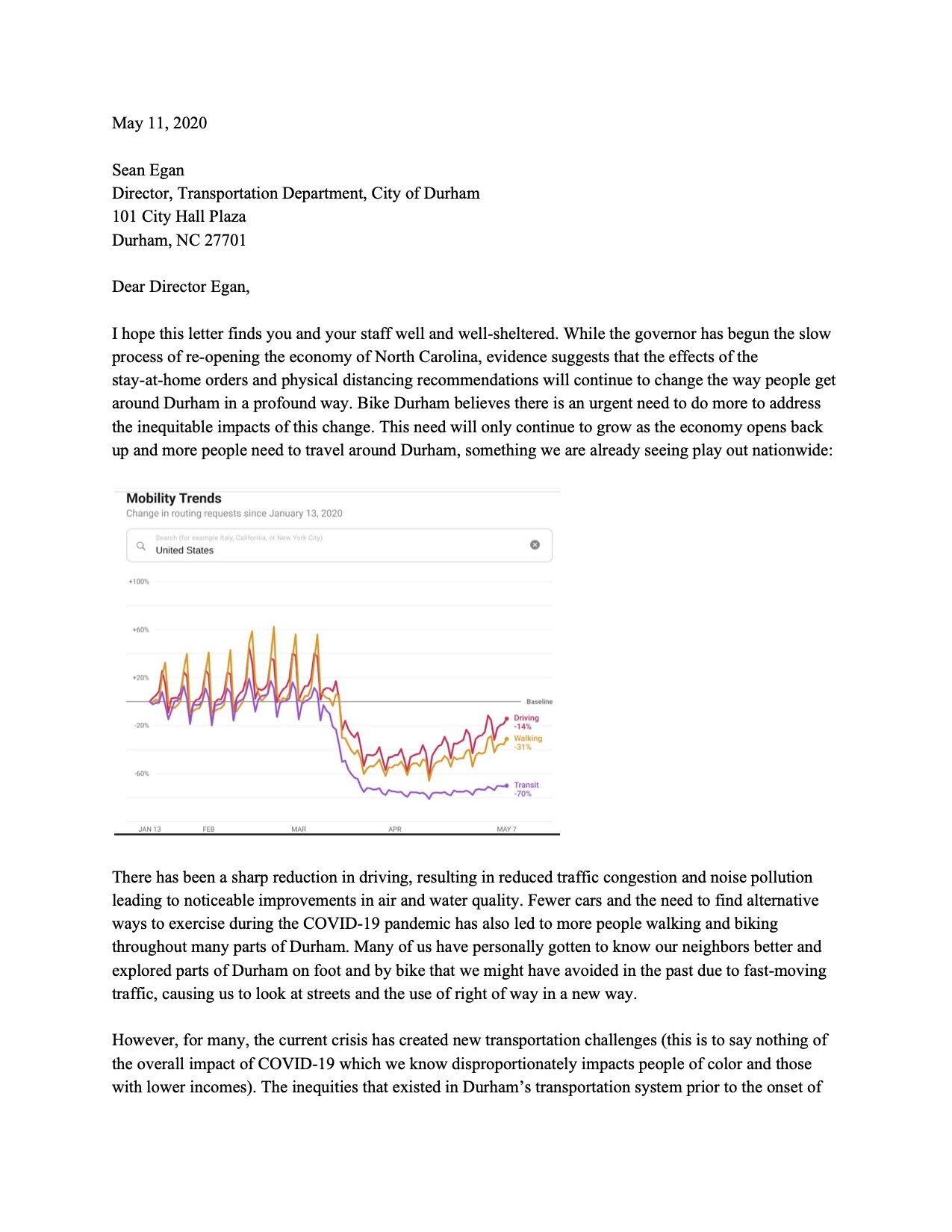
For many Durhamites, the current crisis has created new transportation challenges (this is to say nothing of the overall impact of COVID-19 which we know disproportionately impacts people of color and those with lower incomes). The inequities that existed in Durham’s transportation system prior to the onset of the pandemic have only been further exacerbated. Bus operator availability led to the recent decisions to reduce GoDurham to Sunday-level service and physical distancing recommendations (essential to protect bus operators) now limit the number of people on board buses to 16. This has left people behind and created additional delays for those who rely on the service.
To address these inequities and facilitate safe physical distancing on Durham's streets, Bike Durham has requested that the City, with assistance from Bike Durham members and volunteers, do the following things:
For the protection of riders and drivers, provide face masks free-of-charge to all fixed-route and paratransit customers who need them until the need for them ends.
Develop strategies to ensure that Durham’s most vulnerable residents are still able to travel to essential jobs or services without extra delays or unreliability due to the new capacity limits on GoDurham buses.
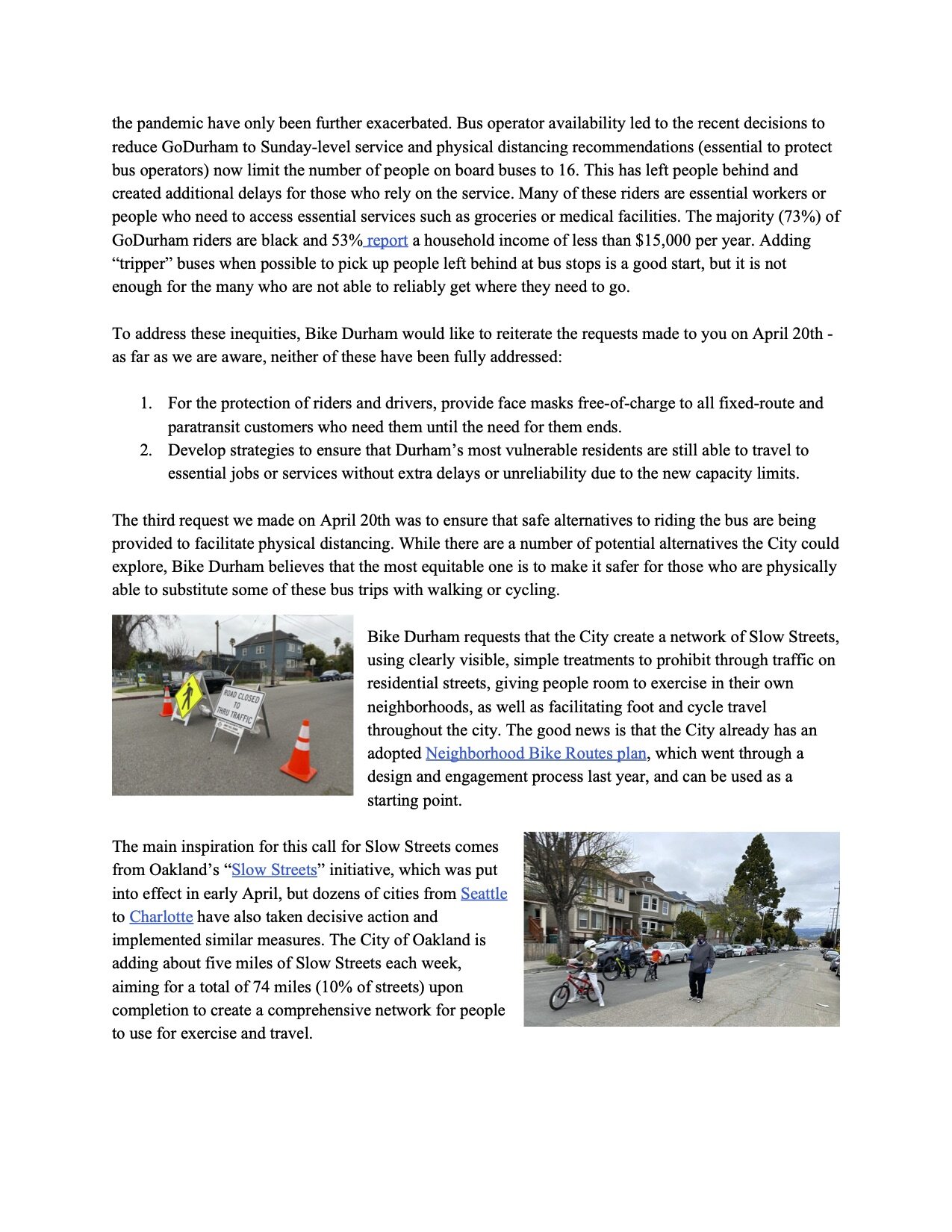
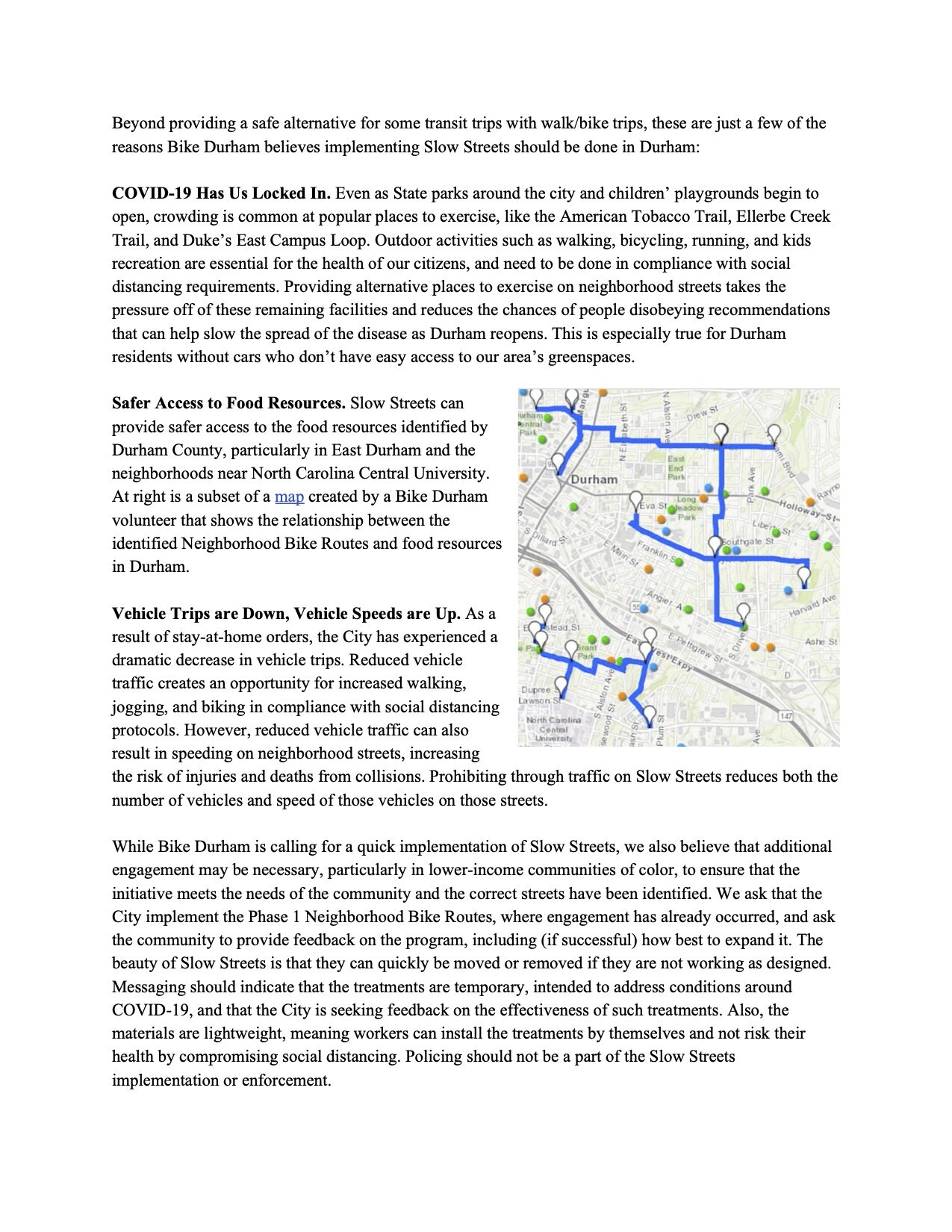
Create a network of Slow Streets, using clearly visible, simple treatments to prohibit through traffic on residential streets, giving people room to exercise in their own neighborhoods, as well as facilitating foot and cycle travel throughout the city based on the City's adopted Neighborhood Bike Routes plan. The main inspiration for this call for comes from Oakland’s “Slow Streets” initiative.
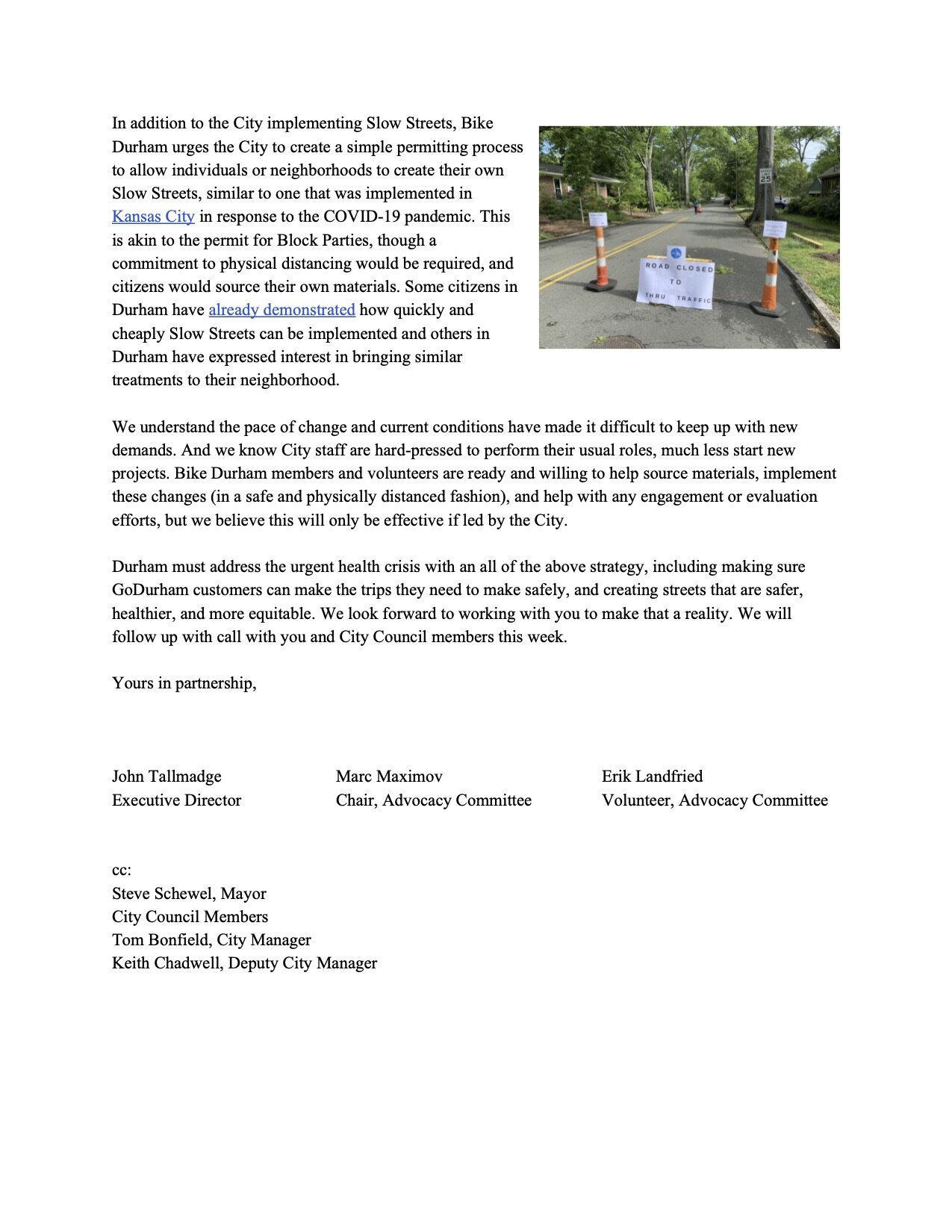
Create a simple permitting process to allow individuals or neighborhoods to create their own Slow Streets, similar to one that was implemented in Kansas City in response to the COVID-19 pandemic.
The full text of the letter is below.
Celebrating Bike Month During the COVID-19 Pandemic

Bike Month is Here!
The month of May has been celebrated as Bike Month around the country for 64 years. We celebrate the joy of riding, the way that riding for transportation or exercise or hobby can make us healthier, save us money, and connect us with nature and our community. We encourage others to join us in enjoying the benefits of biking, and we call for safer streets so that everyone can ride.
While that remains true, this year’s Bike Month will be like no other. The COVID-19 pandemic, and the stay-at-home orders that are keeping it contained, have forced us all to consider what is important, what is essential for keeping ourselves, our families, and our neighbors safe from this virus. At Bike Durham, we’ve had to consider how travel is changing in our community, and how we should adapt.
With our roots as a bicycle advocacy organization, we have cheered the sights of more people getting out on their bikes for transportation and exercise with fewer cars on the road. As an organization that is wrestling how to center racial equity in our work, we have observed that racial disparities that persist in our community reveal themselves in terms of whose travel is made more difficult through physical distancing requirements, and who has an easier time of keeping themselves and their families safe by staying-at-home. This awareness led us to join many in our community in supporting essential workers, especially those operating and riding GoDurham buses. At the same time we have questioned why Durham hasn’t yet followed the lead of other communities in designating slow streets and neighborhood bike routes to give more space for people to walk and bike safely in this time of required physical distancing.
As we have looked for a way forward through this time, we have tried to keep these priorities in mind:
Everyone in Durham should have safe access to food, medical care, mental health care, and recreational space. Essential workers should have safe access to their jobs and while at their jobs. Safe access now goes beyond traffic safety, freedom from crime and over-enforcement by the police, and extends to safety from COVID-19 through physical distancing, hand washing, and face coverings.
Changes to our streets or transit system should be unwinding racial and economic inequities, not perpetuating it.
When moving about in Durham, everyone must consider not just how our actions affect our own safety, but the safety of others. We need to learn how to expand our thinking about “rules of the road” to cover physical distancing.
These are all priorities that Bike Durham has held, but the pandemic and stay-at-home order has brought them into starker relief and forced us to wrestle with what is essential. We have tried to acknowledge the differences that people are experiencing - supporting those who are finding their way back onto bikes as well as those essential workers who are anxious about safely getting to work on GoDurham. This remains a work-in-progress, but it is the spirit in which we are carrying our work forward into Bike Month.
Just in time for Bike Month, we’ve added a subscription to the RidewithGPS app as a new Bike Durham member benefit. This May, when you’re ready to get out on your bike, we encourage you to try the bike routes we’ve planned in the RidewithGPS (including May the Fourth Be With You, Koala, and a tour of NCCU’s campus). They’ll be fun, and the app should enhance the experience and give us a sense of togetherness, even while we’re keeping physical distance. We’ll have webinars on topics ranging from using RidewithGPS to how to select safety equipment for yourself and bike to a panel on how travel has changed in Durham during the pandemic. We’ll be profiling Durham bike riders throughout the month and encouraging you to share your stories about why and how you bike Durham. We’ll close the month with a Scavenger Hunt week that we each can do on our own, while sharing the experience virtually, with prizes for winners. More details on all of these activities can be found at bikedurham.org/bikemonth.
We want to thank our sponsors the Way to Go Durham program of the City of Durham, and the GoPerks program at GoTriangle.
We also want to thank our partners in rethinking Bike Month and pulling this together - staff from the City of Durham, the Durham-Chapel Hill-Carrboro MPO, North Carolina Central University, Duke University, and the Bicycle and Pedestrian Advisory Commission.
Bike Durham Supports Transit Workers and Riders
This IS Our Mission
Bike Durham believes everyone should have access to safe, affordable, and sustainable transportation regardless of race, wealth, gender identity, ability, or where they live. During this time of the COVID-19 pandemic, our mission has led us to raise awareness that essential workers rely on our public transit system, and many of our most vulnerable residents continue to rely on GoDurham during the stay-at-home order in order to get to essential services. We have lifted up the stories of transit and paratransit operators who continue to drive the buses and vans of this essential service. We are continuing to partner with other local organizations in working with the City, GoDurham, and GoTriangle to ensure that our most vulnerable people can stay safe while riding GoDurham and ACCESS, and can reliably get to work and essential services without long waits. Our work is also connected to a national movement to draw attention to these issues and get more federal support.



Many Durham Residents Still Rely on GoDurham and ACCESS Services
Despite a recent 40% decrease in ridership on GoDurham due to the COVID-19 crisis, many people in Durham still rely on the system to make essential trips for work, groceries, and medical care. The majority (73%) of these riders are black and 53% report a household income of less than $15,000 per year. More resources are needed to ensure that the bus and paratransit employees and riders are protected from the virus, and that Durham’s most vulnerable citizens are not additionally burdened in their essential travel.
Riders are being informed at Durham Station that the number of people allowed on the bus will be limited. Bike Durham supports the decision to limit the number of riders on board each GoDurham bus to maintain recommended physical distancing. However, this policy means that riders are being passed up at bus stops and are having to wait long periods of time to board the next bus if the one they are trying to board is full.
DeArman S. told Bike Durham’s executive director, John Tallmadge, that she has had to wait a full hour to get to and from her home in south Durham to her job at a McDonald’s on Horton Road in north Durham due to full buses on Routes 5 and 9. Brandon W. also has had to wait 30 minutes for the next Route 12 bus when going to and from his job at a Waffle House on Highway 55.
We Can Have Safety AND Mobility
GoDurham recently announced that they are increasing the limit on the number of people who can board a bus from 10 to 16. It is encouraging to see the City taking seriously the issues we’ve raised about customers missing buses leading to long waits, but this raises new questions about whether this allows for recommended physical distancing on the bus. It also does not fully solve the capacity issues.
According to data obtained from GoTriangle for a time period covering March 29–April 11, 2020, there were more than 16 riders on a GoDurham bus on 10% of weekday trips, 7% of Saturday trips, and 13% of Sunday trips. On Route 3, the busiest route in the system, 56% of weekday trips carried more than 16 riders at any given time.
Riders who cannot board a bus because it has reached the capacity limit are faced with a difficult set of choices. They will either need to wait up to an hour for the next bus, which may also be full, or find another way to get to their destination. These alternatives likely include a combination of shared rides, walking or biking along roads that may or may not be safe, or simply not making the trip at all. This type of uncertainty is an unwanted added stress at a time when many are already risking their own health to make essential trips.
Bike Durham Requests Further City Action
Bike Durham has requested that the City and GoTriangle address the following urgent issues immediately:
Provide face masks free of charge to all customers and operators who need them until the need for them ends. Bike Durham has distributed more than 2,000 masks at Durham Station thanks to Covering the Triangle, but more are needed now and until this pandemic has passed.
Develop strategies to ensure that Durham’s most vulnerable residents are still able to travel to essential jobs or services without extra delays or unreliability due to the new capacity limits. This may require partnerships with other transit agencies to provide more bus service on crowded routes.
Ensure that safe alternatives to riding the bus are provided to facilitate physical distancing, such as temporary walking paths using underutilized road capacity, or partnerships with e-scooter companies currently operating in Durham. This is important now, and will be critical when the stay-at-home order begins to be lifted and more people who rely on GoDurham and ACCESS paratransit will need to travel again.
For more information about Bike Durham’s request to the City and GoTriangle, please see our letter to Sean Egan, Transportation Director for the City of Durham.
We Want to Work With the City and GoTriangle to Address These Issues
Bike Durham understands that this is a challenging time to make additional requests of the City and GoTriangle, and we would not do so if we did not believe this is an urgent matter. Our organization has volunteers and board members who are ready to assist the City and GoTriangle to help identify and promote solutions to these issues.
Video: Bike Durham Supports Transit Operators
In these challenging times, some cities have suspended bus service. Durham has kept the buses running, which has provided crucial support to some of the city’s more disadvantaged communities. It’s also moved bus operators to the front lines of the battle to preserve the normal workings of the economy, while placing their personal safety at no small risk.
Bus ridership is down, and service and hours of operation have been cut back. While many customers are able to stay home or have found other ways of getting around, bus and paratransit van operators continue to work their shifts serving the remaining customers.
To protect bus operators and keep customers properly distanced, the City and GoTriangle have instituted fare-free, rear-door boarding. Some seats are marked unavailable, and operators can activate a "Bus Full" sign once 14 people are on the bus. The City of Durham is paying for operators of GoDurham buses and ACCESS vans to receive a 5% wage premium during the Stay-at-Home order.
Bike Durham appreciates the GoDurham operators and staff who are keeping the buses running during this time of crisis. #TransitIsEssential
Video: Bike Durham Supports Transit
As discussed in our two previous blog posts, Durham’s decision to keep the buses running during this time of “flattening the curve” has been crucial to the people who rely on it to get around. Mayor Steve Schewel’s “Stay at Home” order allows for “essential” services to continue operation; along with hospitals, this includes bicycle shops, grocery stores, restaurants, construction sites, utilities, and other places of work.
On March 23rd, GoDurham began offering fare-free, rear-boarding service to protect the safety of bus operators. Transportation Director Sean Egan says “GoDurham intends to provide service for essential trips in our community for as long as it is safe and appropriate to do so.” Bike Durham applauds this decision. #TransitIsEssential
Durham Residents Continue to Rely on GoDurham During Pandemic
After Durham Station, the second busiest bus stop in Durham is in east Durham at the Village Shopping Center, sometimes called Wellons Village, near the intersection of North Miami Blvd and Holloway Street. There is always a crowd, of varying sizes, getting ready to get on a bus headed downtown, out toward Walmart on East Geer Street, toward the Holton Career and Resource Center on Driver Street, or east down Highway 98.
This Tuesday at mid-day, the scene was no different. As the time neared for buses to arrive, people would gather on either side of Raynor Street, ready to get on. Some were clearly concerned about the COVID-19 virus, keeping their distance from one another, or wearing masks and gloves. Talib W., an older man from east Durham was wearing a worn light-blue face mask and winter gloves. He said since the virus, “it’s changed a lot. There are less people, it’s not as crowded as it used to be. You see more people are using protective gear. Masks and gloves. Not all of them, but you’ve got those who are conscientious.”
Others were less concerned, joking with one another, or sitting right next to each other under the lone shelter at this busy location. A young man sitting under the shelter said he’s not worried about being too close to others on the bus. “I think people are taking this virus too seriously.” The young woman with a toddler in her lap said people need to get to work to make money. She said when you have to choose between making money and risking getting sick, people are going to do what they have to to make money.

Earl C.
Photo by John Tallmadge
Others shared their stories about how critical GoDurham was for them. Earl C., a middle-aged man from east Durham, said “If the buses shut down, it would affect me in my responsibilities in going to see my kids, probably to go to work, everyday travel.” He’d continued, ”Education, health, doctor’s appointments, picking up medications, the post office. It would affect a lot for my everyday travel, everyday use. It would be very detrimental to my everyday life.”
Mr. Glenwood J, who lives near Northgate Mall shared, “I use GoDurham almost exclusively. To pick up personal items, to get groceries, especially to get to Durham Tech’s campus to take classes. It’s a critical part of my daily life.”
Ridership is Noticeably Lower
All the people waiting at the Village had noticed that there were fewer people on most buses. That’s confirmed by data from staff at GoTriangle who shared that on Monday, ridership on GoDurham was down about 25% from a normal Monday, and that ridership on GoTriangle was down 60-70%. These figures are in line with results from other transit agencies around the country, where commuter-oriented services have seen precipitous declines in riders who are now working from home or have been laid off. Local transit services, whose customers use the services for work and education, but also for connections to grocery stores, medical appointments, and other services, have seen lower declines in usage.
Here in Durham, it can vary by route. Talib W “was surprised that I got on one bus, and there was nobody but me when normally these buses on Route 3C have 20 or more people on them. But for those who have to go shopping, they can’t help but get on a crowded bus, but [many] still have the protective gear.” According to GoTriangle planners, Route 3, which goes to Walmart, only had 12% fewer riders than a normal weekday. Mr. Johnson said “I just came down on Route 3 and it was probably three-quarters, almost full capacity.”
Earl C. observed that many buses are less crowded because lots of things are shutting down. “I went to Social Security today. Social Security office is shutting down. I tried to get some clothes at CitiTrends [a clothing store] and it was shut down. A few other places where I tried to go do some things were shut down. And the buses are shutting down [early at 9:30pm].” He was concerned about whether GoDurham service would continue to operate. “I don’t know if thery’e going to have the buses too long, because everything is shutting down. And there’s less people on the bus and they don’t really want to be together with each other, so I don’t really know how long that will hold up.”
GoDurham Connects Some Riders Who Donate Life-Giving Plasma
Adjacent to the bus stop is a CSL Plasma donation center. CSL Plasma is one of the nation’s leading producers of blood products. According to their website, “Plasma is the essential ingredient for products crucial to treating patients suffering from a host of life-threatening conditions and bleeding disorders.” At companies like this, donors are compensated for their donation. Again, according to their website, new donors can earn up to $400 in their first month. Continuing donors can earn about $300 if they make donations twice each week. Earl C. said sheepishly, “I go sometimes [to earn money] to pay bills, get groceries, pay fines. City fines for traffic tickets or things of that nature. It’s pretty beneficial to have that open. I was surprised it’s open because of the COVID virus. I don’t know how long that’s going to be open.”

Glenwood J.
Photo by John Tallmadge
As long as it remains open, and GoDurham remains operating, Earl C. and Glenwood J. will continue to ride here to donate plasma so that they have the money to pay their bills and get groceries. It’s an important source of income for them. This is the underlying message in all of these stories - GoDurham is essential in connecting them to ways to earn money and to all of life’s necessities. While some are nervous about exposure to the virus, nearly all are more concerned about what it would mean for GoDurham to stop running.
NOTE: This post is the second in a series about how people are using transit and bicycles during the emergency response to the COVID-19 pandemic in Durham.
Transit Is Essential Connection to Healthcare Jobs
Standing away from the others at the bus shelter in front of the Duke Medical Center, Jani Hale waits for her GoDurham bus. Wearing her light blue surgical gloves, she’s ready to take the bus home at the end of day working for Duke University Medical Center’s Department of Psychiatry and Behavioral Health. She rides every day and has noticed that it is a lot emptier on the buses since the COVID-19 pandemic took hold in Durham. She has continued to ride because it’s her only way to work, and she appreciates that there is hand sanitizer on-board and that the city of Durham has recently made the buses free of charge. “It kinda lessens the heavy weight that we’re all carrying right now.”

Jani Hale, Duke University Medical Center Employee, waits on GoDurham Route 20
Photo Credit: John Tallmadge
On Sunday night, the City of Durham, followed by GoTriangle, the City of Raleigh, and the Town of Cary, suspended fares and required boarding through the rear doors in response to the COVID-19 pandemic. As reported Monday in the Raleigh News & Observer, Sean Egan, transportation director for the City of Durham said these measures are intended to keep customers and employees safe. “GoDurham operators and all of our front-line colleagues face the same pressures as everyone else right now,” Egan said in a written statement.
“They have families, kids out of school, loved ones with health concerns, and others may know someone already impacted by COVID-19. Despite these pressures, and despite understandable concerns, our workforce is showing up out of a sense of duty to the community.”
Egan said GoDurham will continue to operates as long as it is “safe and appropriate to do so.” Durham Mayor Steve Schewel shared in an email that he’s “worried about the social distancing on buses.” He is discussing with partners whether to run extra buses on busy routes “so we can cut down on the number of people on each bus. I’m not sure this is going to be able to happen, but I think it would be good if we could do it.”
Jen an Occupational Therapist at Duke Hospital who lives about two miles from the hospital on Route 11B, remarked that “everybody seems to be adhering to the precautions about being six feet apart. I just try to be careful and carry hand sanitizer with me and not touch anything.”
If the local bus systems or GoTriangle stopped running their services, or significantly cut back on their frequency, most remaining passengers would have few, if any, remaining options. While Jen has a car, she does not pay for a parking space at Duke Medical Center, so if the buses stopped running, she believes that “she would be in a bit of trouble.” Jen thinks she “might have to ask friends for a ride, which would be very inconvenient and scary for them. They don’t want to be close to others right now when we’re supposed to be socially distancing. I think that the bus is probably a better way to socially distance oneself than carpooling.”
Masti, a young woman who works in a lab at Duke University Medical Center, rides GoTriangle route 405 and connects to Chapel Hill Transit routes. She has already had to adjust to last week’s cutback in Chapel Hill service to less frequent Saturday levels. Monday morning, she missed her connection to work and ended up calling Uber to get to her job. If GoTriangle were to discontinue or reduce service levels she is afraid she couldn’t come to work or would have to pay for an Uber most days. Doug M., who works at the Veteran’s Administration Medical Center, and uses the same route as Masti, expects he would reluctantly switch to driving or taking Uber to work.
Ms. Hale has considered biking, but like in most cities, few of the streets in Durham have been designed to be safe for all users. She mapped out a bike route, but found “they don’t have the bike lane throughout the whole path coming here, so that would be kinda dangerous.” She called out Duke University Road, Academy Road and University Drive as the three main roads along her route where she wouldn’t feel safe on a bike. Jen also considered biking but noted that on day’s like Monday when it was raining, “it wouldn’t really be convenient to have to change once I got to work.”
For Hale, keeping the buses running is essential. “Yeah, I don’t know what I would do if the bus system was to stop running. I wouldn’t be able to get to work. Where I live and where I work was based on the bus route.”

NOTE: This post is the first in a series about how people are using transit and bicycles during the emergency response to the COVID-19 pandemic in Durham.
Call to Action: City Council Budget Public Hearing March 16, 2020
Calling Bike Durham Advocates!
UPDATE: In light of the COVID-19 containment recommendations, the City is asking that all comments for Monday's City Council public budget hearing to be submitted electronically.
There are 2 ways to be heard:
Send in comments on the budget by email at council@durhamnc.gov
Answer the 3 short questions in our survey by clicking the button below. We’ll gather your responses and present them to the Council. Please respond by tomorrow, Monday, March 16 at 5pm.
If you would like to watch the hearing, you can tune in online via video livestream on Monday at 7pm.
Tl;dr: Our request
1. Support the proposed FY2020-21 Durham Department of Transportation budget and all the capital project requests for infrastructure to improve walking and biking facilities.
2. Fully fund the 2017 Bike + Walk Plan
3. Establish a quick-build program budget of $500,000 in FY 2021 for a Low-Stress Network and on-street transit reliability improvements. Continue this program, committing $4m annually through 2025.
We do not accept that traffic deaths are an inevitable price to pay for our mobility.
In Durham County during the five-year period between 2014 and 2018, there were:
1,094 crashes between people driving cars and people walking (855) or biking (239)
30 people were killed and 53 were suspected to have serious injuries
African-Americans who were walking and biking were disproportionately victims of crashes compared with their representation in the county population, especially among those who were killed or seriously injured while walking
Source: NCDOT 2014-2018
Proposal for a City-Wide Low-Stress Network
In support of the City’s Vision Zero initiative, its values for creating an equitable Durham, and the Mayor’s call for cities to lead in fighting climate change, Bike Durham proposes creation of a city-wide “Low-Stress Network” of protected (“light individualized transportation” or LIT) lanes and intersections, slow streets (aka Neighborhood Bike Routes), and greenways for all residents to safely walk, ride bikes or scooters, or use wheelchairs to travel around Durham.
We commend the progress that the City Council and staff have been making to establish strong goals and in planning new projects that designate LIT lanes or that improve transit schedule reliability. However, we find the following shortcomings to the current approach:
Project delivery is taking too long
Project designs and installations do not reliably include slowing traffic or physical barriers for protection of vulnerable LIT users
The piecemeal funding by project, rather than program, results in isolated projects rather than a more usable network
Our Ask of the Durham City Council:
Fully fund the remaining projects in the Bike+Walk Plan that are capital projects not well-suited to a Quick-Build approach.
Reduce posted speed limits on designated Neighborhood Bike Routes to 20 miles per hour. Add traffic calming measures as needed until 80% of drivers travel below that speed.
Set a goal of 125 new miles of a “Low-Stress Network” of slow streets, protected LIT lanes, and greenways by 2025.
Establish policy that all new on-street LIT lanes on streets with speed limits over 25 mph will provide physical separation from traffic through vertical barriers and protected intersections.
Create a team of staff to develop a Quick-Build program for delivering projects, by March 2021, using low-cost, temporary materials (versus civil works construction) that considers the engagement period to extend past installation of the initial design.
Establish a Quick-Build program budget of $500,000 in FY2021 and $4,000,000 annually through 2025 to fund a Low-Stress Network and on-street transit reliability improvements so that staff can proceed with developing a quick-build approach with confidence that the projects have the funding available for implementation.
Request the staff to report on progress annually in terms of mileage of Low-Stress Network implemented and improvements to transit time reliability.
2019 Bike Durham Year in Review
Perhaps our biggest achievement in 2019 was ending the year under contract with a part-time Executive Director, John Tallmadge, who will be carrying our momentum into 2020 as our first paid staff person. We have significant growth in store for 2020 and to motivate us this year, we wanted to reflect on last year’s successes!
Advocacy
We envisioned a Low Stress Network of Light Individual Transportation (LIT) lanes in Durham, designing comprehensive maps that will be shared with various community groups for input before presenting to the city.
The Ride of Silence, which honors cyclists who have been killed or injured while biking, and our Jack-O-Lantern tactical urbanism project, in which we placed pumpkins along the unprotected bike lane on Broad Street, drew attention to the need for bike safety infrastructure and garnered coverage from ABC11, CBS17, the Herald Sun, News & Observer, IndyWeek, and Streetsblog.
Events and Rides
We hosted Bike-a-Bull City, our annual fall event, which included three community bike rides, a kids’ bike rodeo, a maintenance clinic, and a raffle at the family-friendly Scrap Exchange.
Board member Jen McDuffie led 22 Bike/Walk to School events in addition to several Bike Safety classes in Durham Public Schools, and she helped city staff write a state grant to transfer ownership of these programs to the Durham Dept. of Transportation going forward (Bike Durham will still contribute volunteers).
We hosted three summer community rides to Audio Under the Stars, an outdoor storytelling event at the Center for Documentary Studies.
We tabled at the Eno River Festival, Durham Co-op Market, and the Farmers’ Market, among other events, and we offered bike valet along with BPAC at the Center Fest Arts Festival.
We hosted monthly community meetings, with featured guests like Alta Planning & Design, Leah Shahum, the Founder and Director of Vision Zero, and Sean Egan, the City’s new Director of Transportation.
We demonstrated our holiday spirit and sweet rides, including some cool e-bikes, in the Durham Holiday Parade.
Membership and Engagement
We’ve grown our membership to 223 current, renewing member individuals or households.
We raffled off a brand-new bike (valued at $2,000) as part of our summer membership drive.
Our monthly newsletter subscribers have increased 41% since February; Facebook, Twitter, and Instagram followers are up an average of 26%.
Community Connections and Capacity Building
We started a business membership program and now have support from business partners such as Visual Rituals and soon the Triangle Rock Club of Durham.
We now conduct board and committee meetings at ReCity, a co-working space that we share with several other social justice non-profits.
Working with BPAC, bike shops, and many other organizations, we promoted 20 Bike Month events in May including seven Bike-to-Work Day pit stops.
Through financial sponsorship and volunteering, we contributed to the Untokening Conference, a multiracial collective and gathering that centers the lived experiences of marginalized communities to address mobility justice and equity.
To learn more about systemic racism and how we can continue pushing for equity in our work and diversity in our organization, the board attended a ½ day workshop by the Racial Equity Institute
We partnered on a Durham 150 grant with BPAC that contributed to Bike Month and other events and provided helmets to those in need. We also secured a donation from Lyft and raised funds through Facebook fundraisers.