Teaching and Learning Perseverance through Safe Routes to School

Students and families participating in Walk and Bike to School Day in October 2021

We have a little story about perseverance we want to share with you.  On a cheerful sunny morning this past December at Eastway Elementary, we ended a bike riding safety class and Jacopo asked the 3rd grade students what they were proud of that day. One 8-year old girl, who we'll call Jasmine, raised her hand and said, “At last week’s class, I wasn’t good with balancing, but today I started to get it.”  Jasmine’s classmates started to clap and her smile grew and grew.  That feeling of balancing between two wheels: for children, that’s magic!  The reality, though, is that it’s the result of taking a risk, falling, getting back up, and persevering by trying something a little different, building on what feels like it’s working, until suddenly…you get it and it feels incredible. 

Perseverance is one of the lessons we teach students through our bike riding safety classes, and it’s a lesson we’re learning ourselves as we develop our Safe Routes to School program.  Our goal is for more and more families to walk, bike, or roll to school every day.  There are so many benefits for students, their families, and our communities, but there are significant obstacles. From siting schools on roads without sidewalks and protected bike lanes, to designing streets for high speeds without safe crossings, to the disconnections between many schools and their surrounding neighborhoods - both physically and culturally.

Our approach is to combine teaching students bike riding and walking safety skills, promoting and encouraging families to try walking and biking to school, and organizing to call for building sidewalks and protected bike lanes between schools and neighborhoods.  We testing these strategies to learn what works, and we start at Eastway Elementary where we’ve had great support from PE Coach Nisha Watson and Principal Dr. Jackaline Teel. 

Starting with Eastway Elementary 

Thanks to a relationship that former Bike Durham board member Jen McDuffie already had through past Safe Routes to School activities with Eastway Elementary, we reached out to Coach Nisha Watson in September 2021 to implement programming and test new strategies in order to expose more students and families to walking and biking activities.

The first partnership activity with Eastway was the October 2021 National Walk to School Day. The whole school met on a sunny morning just before Halloween at the Save A Lot store across Alston Avenue to walk together to school: buses were rerouted to safely drop students in the parking lot and car drivers did the same.  Nearly 400 students and parents, many in costume, walked along the streets around the school campus, finishing with a big welcome from the Principal and PE teacher.  They gave powerful speeches about the importance and the benefits of walking and biking as transportation, both for personal and community health.

Building on the momentum from that event, we started our bike safety classes program in December 2021, following a model we had used at Merrick-Moore and Spring Valley elementary schools.  The program at Eastway was such a success that we decided to organize a last-minute “end-of-class celebration” on a Saturday morning on the school campus: parents, teachers, and students joined our 2-hour session of bike safety instructions, where we transformed the whole car parking lot into multiple biking courses: the students that participated to the Bike Safety Classes program were able to show their skills to Eastway students of all grades and their families.  Thanks to the generosity of Ari Birenbaum of Ninth Street Bakery, everyone also celebrated with delicious cookies. 

Eastway Elementary students celebrating at the end of the bicycling celebration on a Saturday in December 2021.

The event was intended to be one-of-a-kind: for the first time we decided to organize a bike-themed event outside of the school week.  It was so well received, though, that we have started incorporating such celebrations in our bike safety classes program: for the current school year, we are planning on having six of these events throughout the school year.

Now that we feel pretty confident with the bike riding safety classes, we have started a conversation with DPS transportation, PE Teacher Coach Watson and Eastway Parent-Teacher Association (PTA) to establish a regular series of walking and biking activities to school.  We want to engage families in establishing a walking bus activity that aims to help families that walk their children to school and to encourage more to do so.

In February we joined the Eastway PTA meeting where we presented the concept to the principal, the teachers, and some parents: hopefully, in the spring we will have the first Walk To School bus at Eastway Elementary!

The progress of activities at Eastway will not only be beneficial for that school community.  We will learn from our work there to spread successes to other school communities.  During the 2022-2023 school year we will be present in 12 DPS Elementary schools with Bike Safety Classes and what we did at Eastway will shape our programming to help us be successful in all of those schools.

As we gain experience with promoting regular walking and biking activities, we also look forward to taking another step toward our goals next year.  Thanks to our supporters, we’re adding an Advocacy Organizer who will work with parents, schools, and DPS to build on family interest in identifying infrastructure needs and advocating for their implementation with the City and NCDOT. 

Again, we plan to start at Eastway, learn what works, and persevere until we succeed at giving every family the opportunity to choose for their students to walk, bike, or roll to school.

Today is Transit Equity Day

Today, February 4th is Transit Equity Day in the U.S., named in memory of Rosa Parks on her birthday.  When Rosa Parks refused to yield her seat in the Whites Only section of a Montgomery bus in 1958, she sparked a 381-day boycott of the bus system, demanding equal treatment.  Today, public transit is an essential service in a transportation system that is still inequitable.  Access to reliable transportation is closely linked to educational and economic opportunity, and in regions like the Triangle, that means access to a private automobile.

In order to achieve a transportation system that provides equitable access for everyone, while also eliminating carbon emissions and traffic deaths or serious injuries, we are going to have to make the public transit system work better for today’s customers.  We have been advocating for this through the Durham County Transit Plan since 2020.  This is the plan that establishes how $1.1 billion will be spent on public transit in Durham over the next 17 years (until 2040).  The final draft plan was released in December and the County, the regional planning organization (DCHC MPO), and GoTriangle are soliciting comments on the plan now.  This will be the topic of our next Community Meeting on February 27.

Through the Transit Equity Campaign, we have been successful at getting the public agencies to invest in authentic community engagement, and to put the needs of current transit riders at the front of the plan.  More than $800 million (74%) of the recommended investments accomplish those goals. These investments include increasing bus service frequency, running service later on weekends, and new crosstown routes that will shorten travel times.  It will speed up the construction of bus stop shelters and safe access to those stops, invest in improvements to the speed and reliability of bus services, and study the possibility of bringing Bus Rapid Transit to Durham.  The Plan also funds a study of the needs of the paratransit service for those whose disability keeps them from using the bus; the costs of paying increased wages to operate and maintain a growing transit system; and provides staff resources to increase the accountability for whether these dollars are being spent effectively.

This is Not Enough

This is an important start on transforming our public transit system to one that creates more opportunities for riders as we make a transition to a clean, safe transportation system for everyone.  However, it is not enough.  For all the investments recommended in improving our bus systems, other improvements are left out:

  • The plan leaves many critical bus routes unfunded (listed on page 107 of recommended plan), meaning that travel times will remain too long and services will remain too infrequent for too many people.  

  • The plan doesn’t show a commitment to electrifying the entire bus fleet.  

  • The plan does not make a commitment to keep zero fares.  

  • The plan does not show how sidewalk connections, or the Better Bus Project recommendations on Holloway and Fayetteville Streets and other locations throughout the city, will be fully funded.  

  • Finally, the plan does not show a viable option for how riders will experience fast, reliable, and frequent regional transit service between Durham and opportunities in RTP, Cary, and Raleigh, or Chapel Hill.

The Commuter Rail is Not Viable in Durham Today

Bike Durham is strongly supportive of fast, reliable, and frequent regional transit services between Durham and opportunities in RTP, Cary, and Raleigh.  And we understand the desire to bring rail service to the Triangle.  However, the Commuter Rail project that has been studied would not be reliable or frequent because it would only offer two trips in the middle of the day, two trips at night, and no service on weekends.  This would not be useful for people who work jobs other than 9-to-5'ers, nor for getting to cultural or entertainment opportunities.  We are disappointed that options for frequent all-day, all-week service have not been studied to this point in tim

GoTriangle has only been studying rail service in the existing rail corridor, and that is limited to what the North Carolina Railroad and Norfolk-Southern Railway will allow.  At this point in time, these entities have not even agreed to participate in an evaluation of the feasibility of frequent, all-day service in the corridor.  This is why GoTriangle has only been evaluating Commuter Rail service levels (eight trips in the morning, two in the middle of the day, eight in the afternoon, and two at night - weekdays only).  They have recently presented the results of their Commuter Rail Feasibility Study and are also soliciting public comments right now.

The project is estimated to cost $3.2 billion and carry about 12,000 daily person trips by 2040.  At this cost and this level of ridership, GoTriangle has determined that the project is unlikely to be eligible for the Federal funding source that often pays about 50% of major project costs.  The Durham segment of the corridor between RTP and West Durham is estimated to cost about $1.6 billion due to the need for an additional set of tracks and complicated designs for the east Durham railyard and several street crossings.  The draft final Durham County Transit Plan recommends reserving 26% of the revenues through 2040 for a regional connection, or about $290 million.  That leaves a BIG gap - upwards of $1.3 billion - to build a project that doesn’t even have the service levels that we need.  Until Durham and Wake have new robust local transit tax options available to build the full project and operate frequent service, this rail project in Durham is not viable.

Wake County has a stronger tax base and could afford to build either the leg from Garner to downtown Raleigh, or from downtown Raleigh to RTP without Federal funding.  If Wake County is inclined to commit money to the central segment, Durham leaders should not be seduced into spending any transit tax revenues to extend the service beyond RTP until we can fully fund a frequent connection all the way to West Durham.

Here’s why:

  • It would not provide any new access benefits for current riders or those using transit to access the opportunities east of RTP.  For the foreseeable future, an Ellis Road station would be predominantly a park-and-ride location, not a walk-to-transit location. Current riders going to opportunities east of RTP would still make bus connections at an RTP station since GoTriangle would not relocate their regional transit center to Ellis Road.

  • It would consume most, if not all, of the $290 million recommended to be reserved for regional transit connections in the draft final Durham County Transit Plan.  We still would need to raise more than $1.3 billion in order to build out a fast, frequent, and reliable regional transit connection from east Durham, downtown Durham, and west Durham.

  • GoTriangle’s evaluation is that there is a significant level of risk that the project might ever get completed.  In order to build and operate the studied service, GoTriangle would need agreement from North Carolina Railroad, Norfolk Southern Railway, CSX Railway, and Amtrak.  These negotiations usually take years, are unpredictable, and sometimes fail.  Charlotte thought they had an agreement with Norfolk Southern to purchase a corridor for the proposed Red Line project, when Norfolk Southern changed their mind.  That was in 2013.

  • There are other, feasible opportunities to provide fast, frequent, and reliable transit service to key regional destinations that can be accessed from more parts of Durham.

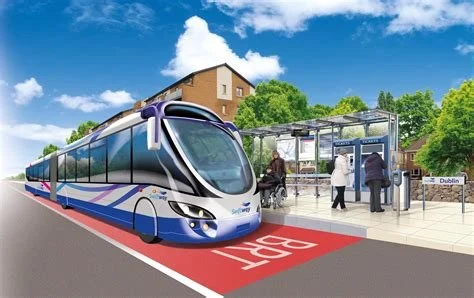
Graphic rendering of a Bus Rapid Transit station.

Another Path to Regional Transit Connections

Though a rail connection is not viable for Durham at this point in time, we must still find solutions to improve regional transit connections between Durham, RTP, Cary, and Raleigh, or Chapel Hill.  As housing prices rise in Durham, demand is growing for connections to other communities like Butner, or Graham, or even Oxford.  Bus connections should be pursued now that increase the frequency of express service to downtown Raleigh and to Chapel Hill.  We should be studying investments that make it possible for these buses to bypass traffic with wider freeway shoulders, priority at traffic signals, and bus only ramps for easy on-off at key stops.  We should also be studying high quality bus rapid transit services where buses have dedicated lanes and stops that are similar to rail stations.  This can be a progression of steps over time that starts now and improves as our communities are ready and can afford them. 

Our local leaders throughout the region should also begin working with their counterparts throughout the state on building support for greater funding options for transit.  We can only achieve our vision for excellent transit with more local and state revenues.

Our recommendations

For Durham’s elected leadership:

  • Durham leaders should support Wake County in their decision about whether to pursue one of the two eastern segments with Wake County funds, but they should not support spending Durham transit tax revenues on this project.

  • Durham staff should pursue state and federal funding for projects that would make at-grade crossings and rail bridges safer for everyone in Durham and make it less expensive to pursue a regional rail project in the future. 

  • Durham, and the region, should evaluate transit service and infrastructure improvements that can be made in the next few years with bus service to provide more frequent access between Durham, RTP, Cary, and Raleigh, or Chapel Hill.  This includes evaluating bus rapid transit as an alternative to rail service.

  • Our local elected officials need to begin working with colleagues across the state to educate NC legislators about the need for additional investment in transit infrastructure and operations.

For you.

You can support transit equity in the Triangle by taking these three steps:

  • Submit comments on the Commuter Rail Feasibility Study by February 19 urging that the project not be pursued west of RTP at this time.

  • Send an email to Durham elected officials on the final draft of the Durham County Transit Plan supporting the investments in improvements to our local and regional bus networks and urging study of alternative regional connections that would be fast, frequent, and reliable.

  • Sign up for Bike Durham’s email list to get updates on transit and safe, affordable, and sustainable transportation in Durham.

World Day of Remembrance for Road Traffic Victims

Attendees standing vigil for the 22 victims of traffic violence in Durham during 2022. Luminaries were placed in the outside lanes of Guess Road at the trail crossing as a symbol of the type of measure that we would like considered to make this crossing, where Matt Simpson was killed while on his bicycle, safer for everyone.

On the Sunday, November 20, about 50 of us gathered at Westover Park for Bike Durham’s first observance of the World Day of Remembrance for Road Traffic Victims.  It was a simple, yet powerful event.  We called for the City to complete a Vision Zero Action Plan by next November showing the roadmap for getting to zero deaths or serious injuries from traffic violence.  We also called for the City Council to fund a full-time, dedicated Vision Zero Coordinator to lead this work. 

Tyler Dewey, representing the Bicycle & Pedestrian Advisory Committee, said that for those who are walking, biking, or rolling on Durham’s streets, “The dangers are clear to us, but they don’t define us…Our vulnerability is not inherent to our bodies. It is imposed on us by systems and institutions that value speed over human life.” He continued, “There is a way forward…We must build for a people-centered future, rather than our car-dependent present.”

City transportation director Sean Egan confirmed the City’s commitment to Vision Zero and said that the city has applied, together with the regional transportation planning organization, for a federal Safe Streets and Roads for All grant to develop a regional Vision Zero Action Plan.

Council member Javiera Caballero also spoke, challenging Durham residents to tackle transportation safety challenges the same way that we have tackled affordable housing. She said, “We need to be the…leader in the state. I know we can do it. When we put a bond, which is coming, in front of you all, we need you to resoundingly vote yes.”

Bike Durham executive director John Tallmadge and Bridget Bell lighting a candle for the vigil

Then Bridget Bell read a statement prepared by her friend Allison Simpson - widow of Matt Simpson who was killed while riding his bike across Guess Road, just steps from where we gathered.  This emotional moment was followed by lighting hand-held candles and reading the names of the twenty-two road traffic victims who had died this year in Durham, as well as 14-year old Riverside student Aliyah Thornhill who was killed while walking on a dark road in Oak Ridge, NC on Halloween.

We finished the vigil by placing luminaries in the outside lanes of Guess Road to narrow it from four lanes to two at the crossing where Matt Simpson was killed.  Twenty-two of the luminaries had the names of the victims and/or the dates of their crash. We all stood for twenty-two minutes to honor their memories and watched drivers slowly pass using the two center lanes of Guess Road.  We were grateful to the Durham Police Department for keeping us safe while we placed the luminaries in the street and retrieved them, and for producing this video summary of the event.

The following day at the city council meeting, council member Monique Holsey-Hyman (who also attended Sunday’s vigil) read a Mayor’s proclamation recognizing November 20th, 2022 as the World Day of Remembrance for Road Traffic Victims in Durham. Allison Simpson was able to make brief remarks virtually on Zoom in accepting the proclamation. You can watch the reading and Allison’s remarks here.

Our local event, covered by CBS 17 and ABC 11, was part of a larger, growing movement for Vision Zero across the country and world.  More than sixty communities in the U.S. and hundreds across the world held Day of Remembrance events on November 20th (recap here) with the theme of “Remember. Support. Act”.  

Importantly, US Department of Transportation Secretary Pete Buttigieg sat down for an interview recognizing the Day of Remembrance (you can read remarks from the Secretary and watch a recording of his comments here). This was an important reminder that this year the federal government has set a direction to eliminate deaths and serious injuries.  NCDOT adopted a Vision Zero policy in 2015, the City of Durham adopted a Vision Zero resolution in 2017, and our regional transportation planning organization adopted a goal of zero deaths or serious injuries due to traffic violence by 2050.  

The direction has been set and is aligned from the federal to the state to the regional to the local level.  But resolutions and policy statements won’t save lives. This past Sunday, The NY Times ran a story about how the number of roadway deaths in the U.S. began increasing in recent years while it has continued to fall in countries across the world.

Now it is past time for our leaders and government agencies to act on their commitments.  Bike Durham will be working with partners and supporters to move our local, regional, and state governments to action in Durham, starting with our calls for a Vision Zero Action Plan to be completed by the 2023 Day of Remembrance and for funding a full-time, dedicated Vision Zero Coordinator.

Let's Celebrate our Victories on Erwin Road

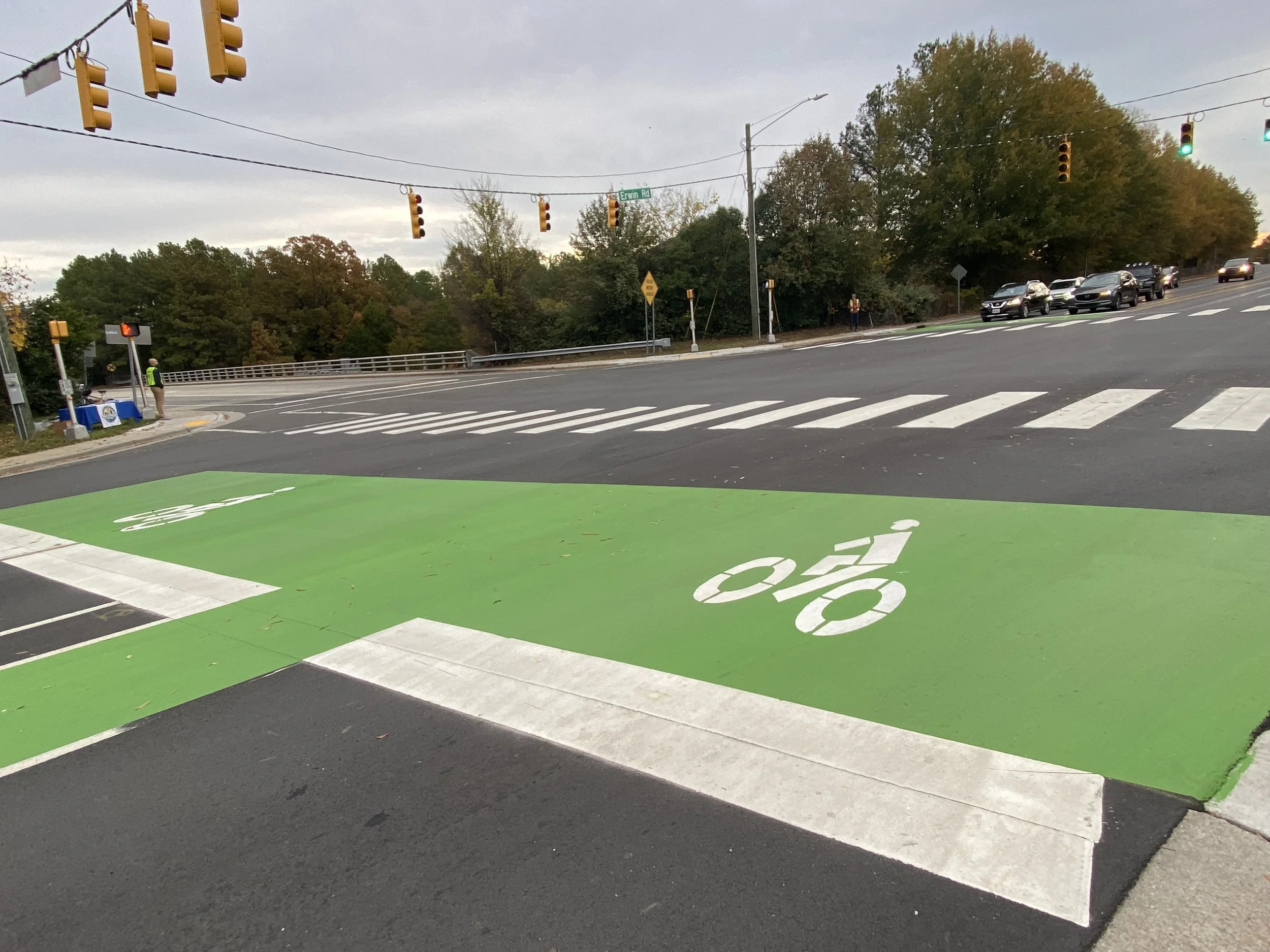
Last week, the City painted the green bike boxes on Erwin Road at the intersection with Anderson Street. This is the most visible example so far of the safety improvements that we were able to gain through our advocacy with the City this summer. While many of the improvements that we asked for to improve safety for people walking, biking, and using transit on Erwin Road were not approved, we should celebrate the improvements that have been made. Without the voices of advocates calling for an Erwin Road that works for all users, it’s unlikely that NCDOT would have made any changes at all.

Green painted bike boxes on Erwin Road at the intersection with Anderson Street

The Improvements to Look for on Erwin Road

The City of Durham was able to convince NCDOT to approve the following safety improvements for people walking, biking, and using transit on Erwin Road:

“The changes to Erwin Road now advancing will improve safety for pedestrians with high-visibility crosswalks, additional crossing time, including a green “walk” signal for pedestrians ahead of the green for vehicular traffic (Leading Pedestrian Interval or LPI). To address cyclist safety, the project adds a new buffered bike lane between Flowers Drive and Anderson St. and adds a 2.5’ buffer to the existing bike lanes between Anderson St. and the NC 147 overpass, along with green pavement markings at intersections to draw attention to the bicycle facilities.” (excerpted from letter by Durham Transportation Director Sean Egan to Bike Durham Advocacy Chair Erik Landfried dated August 19, 2022)

Our understanding from the City staff is that the City also intends to install flex-post delineators to the buffered bike lanes mentioned above in order to further separate people on bikes from the traffic lanes.

What’s a Bike Box and How do I Use It?

At the intersection of Erwin Road and Anderson Street, the City has painted green bike boxes, providing a refuge for people on bikes who are making left turns from Erwin onto Anderson. If you are approaching the intersection on your bike while the light is red, or turning red, you can continue in the bike lane (also green near the intersection) until reaching the large green box at the intersection. Here, you can move to the left to be in front of the first car waiting to turn left. (Drivers must wait behind the bike box while waiting for the light to change.). Then when the light turns green, you are at the front of the line of vehicles to turn left. This makes you more visible in the intersection, and provides strong visual cues for drivers about where to look for people riding bikes. Here is a link to a video clip about how to use a bike box - from Iowa City, Iowa.

Our volunteer leaders on the Erwin Road advocacy, David Bradway and Erik Landfried, joined me on Wednesday morning to educate people biking through the intersection about how to use the new bike boxes. We were also able to make sure that they had lights and a bagel!

Getting the Other Changes We Need

There is a lot of work left to be done to get the changes that people walking, biking, and using transit along Erwin Road need to stay safe, and to make Erwin Road a great street for everyone. We continue pushing the City, NCDOT, and Duke University to commit funds to develop a plan to make Erwin Road a safe and great road for all. The first opportunity for that may be through a bus rapid transit (BRT) study that is expected to be included in the final Durham County Transit Plan this winter.

Through David Bradway’s leadership, we are also continuing to engage with Duke staff and students to encourage their active participation in identifying ways to connect through campus as an alternative to biking and walking directly on Erwin Road.

Finally, we have a team of volunteers we call the Safe Streets Research Team who are gathering insights from other communities about how to effectively advocate for changes with NCDOT. We’re also coordinating with the City’s Bicycle/Pedestrian Advisory Committee (BPAC) to advocate for safety improvements on streets scheduled for repaving by NCDOT and the City in 2023 (see letter from BPAC Chair Susanne Schmal to City and County staff).

We’d like you to volunteer with us to make Erwin Road and all of Durham’s streets safe for everyone. Contact Erik Landfried at erik@bikedurham.org to plug into our advocacy work - our Advocacy Committee meets monthly on the third Thursday at 7pm.

Walk and Roll to School Day is almost here!

As the community transportation planner for Durham Public Schools, I spend my days observing, planning, and coordinating ways to improve multi-modal school travel, this day is as close as we come to a holiday in my line of work (in addition to Bike and Roll to School Day, Bus Driver Appreciation Day, and Crossing Guard Appreciation Day).

Walk, Bike, and Roll to School events promote physical activity, sustainable travel, and strengthen social connections between families, schools, and the broader community. These events celebrate active travel to school and can also help build awareness for the need to prioritize the safety of young people walking and bicycling. 

Walk to School event at Merrick-Moore Elementary in Spring 2022

I sometimes feel conflicted when a walking and biking to school event requires detailed coordination, permission slips, and law enforcement support to close streets or to escort families along a route. I don’t dispute that these precautions are often necessary, but I also think it makes these events look like an extraordinary undertaking, when really, walking or rolling to school should be an easy, everyday occurrence—a choice that is safe, comfortable, and familiar for every family that lives close to the school their student attends. The ability to walk, bike, or roll to school can also foster independence and ensure that students observe and experience their world at a human-scale, not just through the passenger window of a vehicle. 

I see two key domains when it comes to increasing the number of families whose students can walk, bike, ride the school bus, or take transit—our built environment (i.e., land use, street design) and our social context (i.e., social norms, policies). We need to turn the tide on both fronts while also considering how these domains influence each other. 

A safer, more inviting environment for multi-modal school travel could look like streets with lower driver speeds and vehicle volumes; more dedicated space for walking and biking; conspicuous and accessible crossing locations; and a robust network of transit options. Ultimately, streets that work for our youth will work better for everyone. I recognize that the location and design of school sites also affects transportation outcomes for our students. While Durham Public Schools (DPS) can pursue initiatives that improve the safety and efficiency of internal site circulation and access onto campuses, we value our positive working relationships with the City of Durham, North Carolina Department of Transportation (NCDOT), Durham County, and the Durham-Chapel Hill-Carrboro Metropolitan Planning Organization (DCHC MPO) to keep school travel in mind when identifying and prioritizing local and regional transportation projects.  

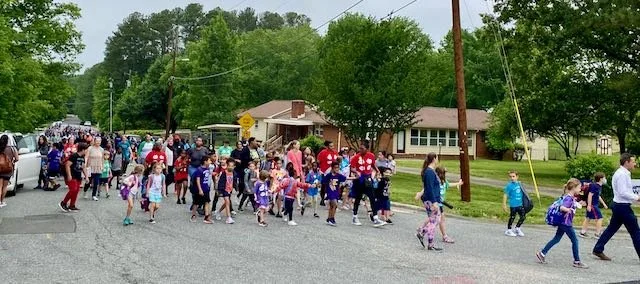
Photo of youth and adults participating in Walk, Bike, and Roll to School Day for Pearsontown Elementary School in May 2022

Walk, Bike, and Roll to School Day activity for Pearsontown Elementary School in May 2022

Safer streets are game changers for encouraging active travel, but we still need the next generation of Durham residents to be able and excited to ride bikes and to choose walking or riding transit when those modes are reasonable options for a trip. We also want the next generation to know what is possible when it comes to the design of our cities and how we get around so they can continue advocating for improvements. Bike Durham’s Safe Routes to School program, supported through a contract with the City, provides education and encouragement for walking, biking, and rolling to school.  Teaching Bike Riding and Walking Safety skills during physical education classes and coordinating Walk, Bike, and Roll to school events are important steps for shifting our transportation culture. Bicycle riding and walking safety education involves the development of skills, not solely the acquisition of knowledge, so it’s significant that these weeks-long classes provide the time and space for students to practice. The classes also have a multiplying effect since they empower physical education teachers to teach the curriculum in the future and as a conclusion to the classes, Bike Durham plans a bike festival at the school so that families can observe and celebrate their student’s improved bicycling skills. 

My children are four and a half and one and a half. My older child has been to a few Walk, Bike, and Roll events for my own version of “bring your daughter to work day.” When we are going somewhere new, she usually asks me if it will be a walk or drive. I’m dreading the day when she stops asking because she realizes that so many of our trips are drives. 

Photo of Kristen Brookshire with her young daughter

Kristen Brookshire with her young daughter

I’m glad we have Walk, Bike, and Roll events at least twice a year for the smiles they bring to the faces of thousands of students and for the visual reminder to grown-ups to stop and think about what it would take to see kids walking and biking more often. These events have taken place around the country for over 25 years and there is a good reason—they can inspire change. These changes could range from improving a single pedestrian crossing or PTA-led monthly events or walk audits, to a city-wide school traffic safety committee or a new school district policy codifying the importance of active school travel. 

I hope you’ll be out walking on Wednesday, October 12 or cheering along the kids walking and rolling in your neighborhood!

Kristen Brookshire

Community Transportation Planner

School Planning, Transportation, and Nutrition

Durham Public Schools

Another Hit-and-Run Driver Sends a Friend, who was Riding his Bike, to the Hospital

On the evening of Friday, September 9th, a Bike Durham member and frequent volunteer was struck by the driver of a truck while cycling through the Five Points intersection in downtown Durham. The crash was a hit-and-run, though we understand that the driver and vehicle have been located thanks to several eyewitness accounts. Two off-duty paramedics immediately assisted the crash victim until an ambulance could arrive at the scene.

Photo of damaged bike on ground at Five Points in Durham following crash when driver hit man on bike and drove away

Photo of damaged bike on ground at Five Points on September 9

The crash victim suffered a fractured pelvis and broken hand and is currently recovering in the hospital following three surgeries. Despite this, he is in good spirits and plans to continue biking and advocating for safer streets in Durham once he recovers from his injuries. Bike Durham wishes him a speedy and complete recovery.

Unfortunately, these types of crashes are all too common in Durham. On average every 16 days someone is killed or seriously injured while walking or biking in Durham. Just two months ago, Matt Simpson was killed crossing Guess Road on his bike with his family. These tragedies will continue to occur in Durham as long as motor vehicle speed and delay at intersections continue to be the number one priority for how our streets are designed.    

The formula for safer streets is simple:

  1. Reduce motor vehicle speed on all streets. Speed kills.

  2. Create fully protected places for people walking, biking, and using transit on larger streets. 

  3. Shift funding away from projects that make it easier to drive to projects that make it easier to walk, bike, or use transit.

Cities that have implemented a human-centered transportation system instead of a vehicle-centered one have achieved remarkable success. Oslo, Norway, a city twice the size of Durham, recorded zero pedestrian or cyclist fatalities in 2019 and only a single vehicle fatality. This is not some type of Scandinavian exceptionalism - Oslo had 41 traffic fatalities as recently as 1975. By prioritizing people instead of cars, Oslo made the streets safer for everyone, not just those walking or biking.

The City of Durham must do more to implement the Vision Zero program adopted in 2017. Vision Zero is a framework to eliminate traffic fatalities. There needs to be dedicated funding for the Vision Zero program in the City’s Fiscal Year 2024 budget, beginning with the hiring of a Vision Zero coordinator staff position.

The City should also begin conducting more holistic crash investigations that include people from the City, State (if it is on a State-maintained road), and transportation safety advocates. They should also produce follow-up reports available to the public following each crash that leads to a fatality or serious injury, similar to those done in Washington, DC.

Bike Durham Member Cynthia Bland on Her Car-Free Summer

I appreciate the friends and family who have offered rides and the strangers with their tepid or apologetic waves as I've lived car-free this summer, but I don't need those. Instead, I ask you to contact your local and state government leaders to support your friends and neighbors who travel by walking, rolling, riding bikes or transit. We need safety, visibility, care, and funding. 

For context, I was in a severe crash in June where my car was totaled.

The totaled car

I was headed to get a Friday night milkshake at the Cook Out when the driver of a cargo van turned left in front of me and crashed into the driver’s side door of my Corolla. I blame this crash on a flashing yellow turn signal that lulled this driver into thinking it was safe to turn left. The driver wasn’t sure exactly what happened, except that it was his fault, and he was really sorry. I’m grateful to the good vehicle engineering that left me remarkably OK and just some lingering neck soreness these two months later.

Site of the crash

It’s hard to get a car these days and part of me doesn’t want a car again. I struggled with the idea that I could look at this as an opportunity to make a personal change, but it’s been hard to get around Durham without a car. I worry about my safety as a pedestrian and cyclist. Even being on the fence, I started the paperwork and contacted a car dealership and my credit union soon after the crash and it still looks like it’ll be September before they can secure a car for me. I wasn’t too worried since I’m a household of one, don’t travel a lot, mostly work from home, live near a grocery store and on some bus routes.

Plus, I love my bike! A big thank you to the folks at Bullseye Bicycle who listened to my needs and got me set up in 2019. My office in RTP reopened in late June. One of the things I missed about the office was a once or twice a week trip by bike. It’s 40 minutes each way. Much of that is on the American Tobacco Trail (ATT), but also includes a few places that feel uncomfortable with traffic. 

Cynthia Bland

So what’s not working? Much of it can be summed up as: Cars. Or more specifically that Durham plans for and prioritizes cars and little else. Drivers go really fast! It’s a me-first attitude. Our city is designed so that cars get to take up space and people walking or cycling seem barely considered.

It’s also summer and it’s hot out. There’s very little shade on our streets. Organizations like Keep Durham Beautiful do great work to increase our street trees by raising money to plant native species, but trees grow slowly. The bus stops near my house are just posts without benches or shelters. Fellow riders and I try to stand in the shadow of the power poles or anything for a respite from the direct sun. My floppy brimmed hat helps, but walking in this heat or even waiting at bus stops without shade is hard.

GoDurham bus stop on Fayetteville Road

As a kid I was confused by the Shel Silverstein book “Where the Sidewalk Ends” because it ended in so many places! My mom had to explain that in cities like New York and DC sidewalks are continuous. They sure aren’t in Durham! I live in a neighborhood with walking trails, but not sidewalks. To get to the bus stops I walk through sections of town where there aren’t sidewalks or they start and stop. Last week I traveled to a conference out of town so I took my rolling suitcase with me as I walked and took three buses to RDU. I rolled it more than I carried it, but just barely. Sometimes the sidewalks need intensive repair and other times they’re blocked by signage or seemingly random spools of heavy wire.

Where the Sidewalk Ends, Durham style

Sidewalks connect people and places. They’re the last little bit that can make a trip feel safe or dangerous. I would have more choices of destinations near my home if we had more continuous sidewalks and if there were safe places for people to cross bridges. I live near Southpoint Mall and the roads over I-40 are not at all designed for people to travel by foot. Sidewalks make a place feel like a community and are vital to the transportation of people with wheelchairs, strollers, or luggage.

I would love to see more prominently marked crosswalks. The zebra-style crossings look more like crosswalks to drivers and maybe that type would keep cars out of the crossing areas at intersections. Mostly, I’d really love the white walk signal to actually mean it’s safe for me to cross the street. I discovered this summer that it doesn’t! The traffic lights are set up to allow drivers to think it’s their turn when it’s also my turn to walk. This is a huge conflict and has led to several close calls since I have to turn and keep looking back for turning left-traffic and ahead for right-turning traffic. That sore neck hasn’t made this any more fun.

It would help for drivers to use turn signals. They're cheap and easy! Please use them all the time, not just when you think another car needs to know where you're headed. They’re super helpful to pedestrians and cyclists. Using turn signals should be a habit and not a decision. A bit of advice to new drivers that seemed obvious was “look where your car is going.” Wow, huh? Well, it’s excellent advice related to turning! I can tell that many drivers are not looking where they are going. If they were, they might notice a person trying to cross the street.   

Turning to transit, many of our GoDurham and GoTriangle bus routes only come every 30 minutes or 60 minutes. This lack of frequency means transit users have to meticulously plan our day! There are some decent apps for this, but riders pay a high price for their time when bus schedules don’t align or when you have to arrive somewhere 45 minutes early so you’re not 15 minutes late.   

Many transit routes are organized to funnel riders to our downtown station. That worked well in a world where people commuted to a job each day. But there are other reasons to use the bus like shopping, childcare, doctors, entertainment and this model doesn’t work as well. There’s also evidence that this type of model doesn’t serve women as well as men. Women tend to travel in off-peak hours and link more errands or activities together. The move toward telemedicine is helpful in some situations and I wish my doctors would be more adaptable in offering that for situations that are more conversational.

Most GoDurham routes end at the downtown bus station

Back to cars: people tout the freedom and pure fun of driving. That’s totally fine! But while they say they love driving, they don’t demonstrate it. I see so many people who are much more interested in their phones than the road. Please show your love for driving by using care, focus, and attention! 

That’s a lot of complaining, but I’m having a great summer! I’ve gained strength by riding my bike more often. I’ve enjoyed summer smells and breezes, increased my time with birds and nature, eaten blackberries along the ATT, stopped for ice cream and donuts, said hello to more people and had fun! This whole post is apparently about how I only travel for my sweet tooth! I’m proof that people on buses, bikes, and sidewalks really do stop into more shops than people driving who are worried about finding parking.

My story isn’t a sad one. I’m OK from my crash. I can afford a new car loan. I haven’t missed out on summer adventures. I’m not worried about me, but I’m worried about our community. We need to prioritize people in Durham. That means all people. We need a city where we can work, shop, attend school, visit parks, and enjoy entertainment without having to use a car or be subject to traffic violence. 

I believe that being a true local shouldn't be about the university you went to, team you root for, hot restaurant you're a regular at, or how long your family has lived here. I feel like a real local knows where their closest bus stop is to their residence. What's that route number? How often does it come? Where does it go?  

Talk to your city, town, county, and state leaders. Donate and get involved with local advocacy organizations like Bike Durham. Even if you have and use a vehicle, make a plan to use transit! It’s not just for people who have to use it. Start with a bus near you: What are the points of interest you might use? Plan a trip to explore and have fun!   

Bike Durham’s Open Letter to Local Officials on Erwin Road Repaving

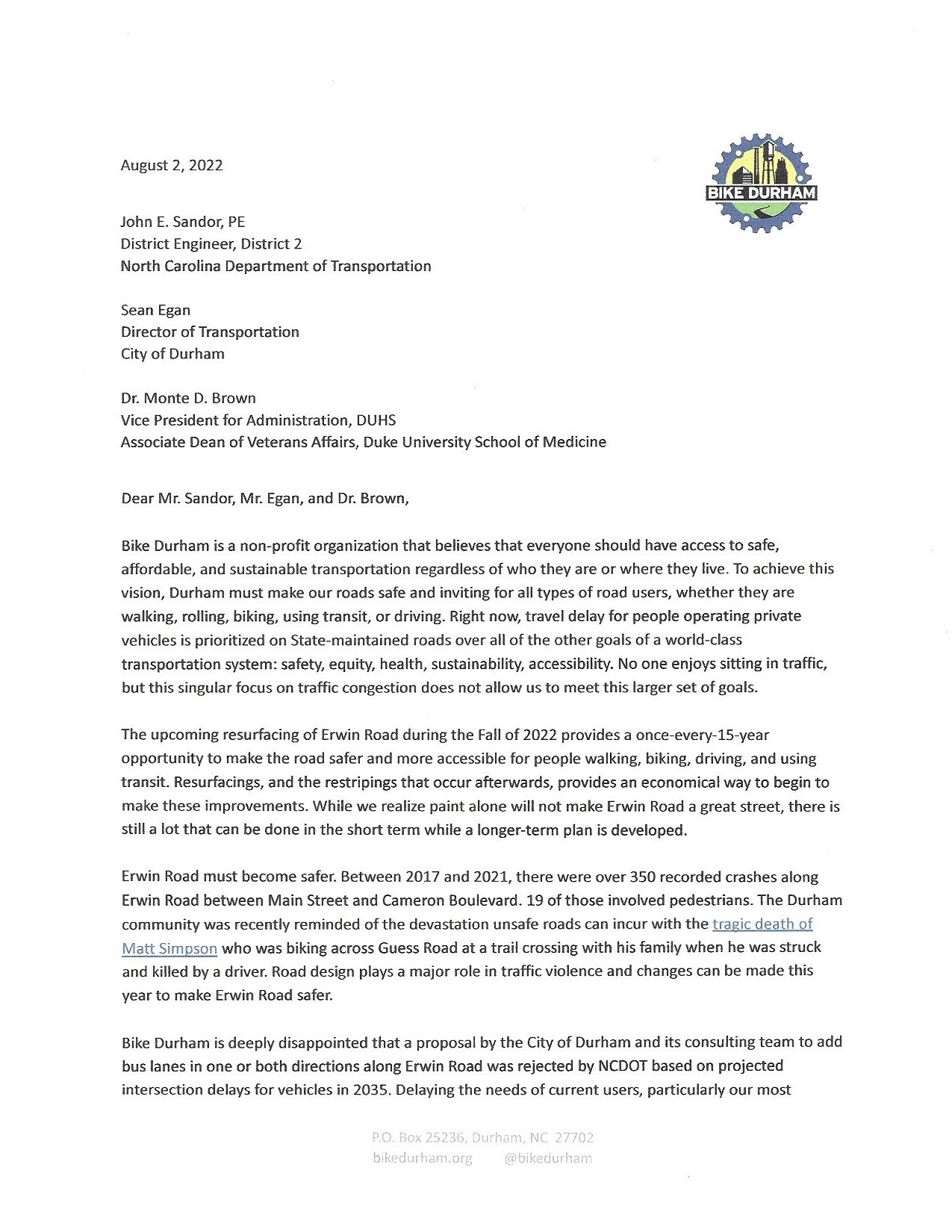
On August 2, 2022, Bike Durham sent a letter to the local NCDOT district engineer, the City’s director of transportation, and the VP for Administration at the Duke University Health System. The letter outlines our disappointment with current restriping plans, which will essentially keep Erwin Road as-is rather than making it safer for all users. The text of the letter is below.

Memorial Gathering and Ride of Silence for Matt Simpson

Photo of Matt Simpson; credit Allison Simpson

Photo of Matt Simpson; credit Allison Simpson

With the approval of Allison Simpson, Matt's widow, Bike Durham has organized a memorial gathering and ride of silence to honor the memory of Matt Simpson who was killed in traffic violence while bike riding with his family.

We will gather Sunday morning, July 24th, at 11am at Westover Park near the intersection where the West Ellerbee Creek Trail crosses Guess Road.  Allison and her friends placed a ghost bike at this spot last weekend.

Photo of ghost bike for Matt Simpson

We will have cards for you to write messages that you can insert into spokes of the ghost bike, and markers for you to sign the bike directly.  We will have black armbands for you to wear, if you choose to participate in the ride of silence.  We also encourage you to bring a cut flower to place at the ghost bike.

At about 11:15, we will call everyone together and Allison Simpson will address the group, and likely one or more of Matt's friends will say a few words.  I will follow with a message about how you can continue to honor Matt's memory with further action to make Durham's streets safer for everyone and some instructions about the ride for those who are able to join us.

We will have a moment of silence before starting the ride.

The ride will be just over three miles in a mostly “on-road” loop starting with a crossing of Guess Road where Matt was hit and killed and finishing up back at Westover Park.  We'll take it at a slow pace and should complete it in about 30 minutes.  We will have at least 8 ride "facilitators" to keep the group safe and together.  They will ride at the front, at the rear, and positioning themselves at intersections to make sure we can all go through together.  We'll have one or two mechanics on the ride in case anyone gets a flat tire or a chain falls off.

The forecast is for hot and sunny weather.  We'll have plenty of cold water.  We encourage you to bring your own water bottles, sunscreen, hats, and helmets if you are riding.

We know that Matt's death has touched many people in his family's circle, in his neighborhood, and in the wider Durham community.  We hope that this event will be an opportunity for you to join in solidarity with others to honor Matt's loss of life and to recommit ourselves to organizing for safer streets for all in Durham.  Please let us know if you plan to join at this link so that we have an idea of the size of crowd to expect.  If you cannot join us, but would like to leave a message for Allison, we have created a digital way for you to express your thoughts.

Statement about the Death of Matt Simpson

We are deeply saddened at the tragic news that Matt Simpson died Friday after being hit while bike riding with his wife and two young children last Sunday. We are angry at the driver, Omari Newsom, who crashed into Matt and then drove away from the scene after removing the bike from under his car. And we are fed up with the officials at legislature, NCDOT, and the City who have not done enough to keep us all safe while walking and biking on Durham streets.

This tragedy is not isolated. On average every 16 days someone is killed or seriously injured while walking or biking in Durham. Unfortunately, it is often difficult to find out details about the victims and their families' interests. Through neighbors, we have been connected with Matt's widow and know that she wants Matt's memory honored with the placement of a ghost bike at the site where he was killed. We will follow up soon with details about the ghost bike event and how you can get involved to make our streets safe for everyone.

Here are links to two media stories about what happened:

https://www.newsobserver.com/news/local/article263536723.html

https://www.wral.com/durham-police-search-for-hit-and-run-driver-after-bicyclist-crash/20368469/ (from last Monday)

Learn more about our Safe & Healthy Streets work here.