Aligning Transportation Plans with Our Values

The future we want captured in an Image of youth walking and biking to school from transformca.org

The future we want captured in an Image of youth walking and biking to school from transformca.org

I think I observed an important breakthrough on September 1, 2021, in Bike Durham’s work for a safe, affordable, and sustainable transportation system for everyone, regardless of who they are or where they live.  Elected officials from Durham, Orange, and Chatham counties had a long overdue conversation about developing a transportation plan that actually aligns with the values and policy direction that they agree upon around eliminating carbon emissions, eliminating traffic deaths and serious injuries, and eliminating racial and economic disparities in access to jobs and other destinations.  Further, they went beyond conversation and voted unanimously to direct staff to develop a plan alternative that is intended to reach these goals by 2050.  They broke through the mindset that they don’t have the power to set a new course, and took a step toward a safe, equitable, and sustainable transportation system. 

Here’s the story: 

The little-known regional transportation planning organization known as DCHC MPO met to discuss and take comments on the staff-developed Transportation Plan Alternatives for the next 30 years.  This governmental organization is required under federal law to adopt a long-range transportation plan every four years.  It’s called the Metropolitan Transportation Plan or MTP.  Despite how obscure the organization is, it plays a crucial role in determining what transportation projects get built.  Any transportation project that receives federal or state funding must be included in the MTP.  The final set of projects in any MTP must be agreed upon by the state department of transportation (NCDOT) AND the locally appointed DCHC MPO board. 

Last summer the planning process for the plan looking out to 2050 started by identifying goals and objectives.  Bike Durham reviewed that draft proposal and raised concerns that they were inadequate and would not lead to change.  In commenting on the Goals and Objectives, we called for a bold vision of Zero Carbon Emissions, Zero Deaths or Serious Injuries, and Zero Racial or Economic Disparity of Access.   The Board agreed with us and directed the staff to revise the Goals and Objectives to include this bold vision.

It’s hard to understate how much of a departure these goals are from the past, and the staff has the uncomfortable challenge of working with analytical tools that are designed to evaluate benefits and impacts for drivers, not equity or safety, and carbon and other emissions have typically been measured at the end of the process, not used as a driver of the plan.  As the staff proceeded with the planning steps, they acknowledged the need for performance measures for these goals, but pointed out that they don’t have good tools to measure them.  This led to the development of three alternative future transportation systems that have differences, but none would make an appreciable difference in reaching the bold goals (in fact, there was no analysis to even indicate how they would affect the goals).

At the September 1st DCHC Board meeting, staff member Andy Henry presented the Alternatives Analysis, and Board members and the public followed with comments.  I listened while waiting my turn at the Zoom mike, and heard very encouraging questioning from Carrboro Council member/Mayoral candidate Damon Seils and Chapel Hill council member/GoTriangle Board chair Michael Parker.  It was clear that neither thought that the alternatives were bold enough.  

There were only two of us there to provide comments at the public hearing and both of us are white men who used to work at GoTriangle - a serious indictment of the public engagement process!   A link to a recording of Bike Durham’s comments, delivered by me, is embedded below.  The written remarks are at the bottom of this post.  (If you’re really interested in this, start at the 31:35 minute mark with the points raised by Carrboro Council member Damon Seils.)

In our comments, I closed with a call for the Board to direct the staff to develop another alternative that would address all three goals and reduce the drive alone mode share by 25% by 2050.  In the discussion that followed, the Board members came to the conclusion that they could ask for an alternative that reflected their priorities, that would reveal many of the difficult changes that will have to be made to achieve our vision, and that would serve as an advocacy piece, making it clear what the benefits will be if those changes to projects, policy, laws, ordinances, and budgets are made.  I am optimistic about the opportunity that the Board’s action creates, and am proud that Bike Durham played a role in making this happen.

Best quotes of the day

“If we move forward with a preferred option based on those before us, I’m not sure what we’re doing here.” - Damon Seils, Carrboro Council member/mayoral candidate

“It’s not just about adding more transit projects, it’s also subtracting car-oriented projects.” - Michael Parker, Chapel Hill councilmember/GoTriangle Board Chair

“This is part of a system that is not functioning in a way it needs to get where we want it to go.” - Jenn Weaver, Hillsborough Mayor

“This may be the best MPO meeting that I’ve ever been to.  And these may be the best two public comments I’ve ever heard at an MPO meeting.” - Charlie Reece, Durham City Council member

Bike Durham comments delivered to the DCHC MPO Board on September 1, 2021 by John Tallmadge

“Thank you for the opportunity to comment.  I’m John Tallmadge, Executive Director of Bike Durham.

After the Board adopted goals that included zero deaths and serious injuries, zero disparity of access, and zero carbon emissions, we were optimistic that the 2050 Plan would chart a new course toward a safe, affordable, and sustainable transportation system for everyone, regardless of who they are or where they live.  That’s Bike Durham’s vision for the future.

We were hopeful that the bold vision that the MPO adopted would drive the development of bold alternatives that would illustrate the likely difficult choices needed to achieve these goals.  We grew concerned when the deficiency analysis largely addressed the issues of driver delay, driver commute time, and highway capacity - the same variables that are typically used - and measures of safety, carbon emissions, and disparity of access.  Vehicle miles traveled (VMT) was presented, but not in the context of carbon emissions.

We were disappointed to see the alternative scenarios presented for comment.  The staff has not attempted to develop a scenario that could achieve the goals.  The All Together alternative is the best of the bunch, but it does not rise to the occasion required.

We understand why this is the case, but we do not accept it.  When urging you to adopt bold goals, we said that it takes a long time to turn a big ship onto a different course, and that’s why it’s important to turn the wheel hard now.  It appears that in attempting to turn the wheel hard through bold goals, other problems have been revealed.

First, the navigation tools that the staff uses don’t provide any visibility into impacts on safety, carbon emissions, or racial disparity of access.  All we can see are delay, travel time, capacity, and mode share.  What we don’t measure, we don’t manage.  The answer is not to rely on changes to the travel demand model.  The staff needs to develop new analytical approaches.

Second, the steering mechanisms are stuck.  The alternatives accept the next 10 years as fixed, and the staff has found the model to be largely unresponsive to changes in the projects.  The projects selected are all through technical staff, there is very little community engagement in the development of projects.   

Third, the engine of transportation funding keeps chugging away, driving us in the same disastrous direction.  When we limit our alternatives to what we can fund with existing laws and rules, then we cannot even see what it would take to achieve our goals.  The final recommended plan needs to be fiscally constrained, that’s required.  But if alternatives were developed that achieved our goals, or even approached them, then we could all see what changes are going to be needed from the local, state, and federal levels.

The All Together alternative is the best of the bunch, but we’d like to point out a few ways in which it falls short.

1) There is no indication that the alternative is increasing funding to make our streets safer.

2) There is no indication that there is an increased investment in transportation demand management.  We have just seen that the capacity for telework is much greater than we ever imagined.  

3) There is no indication of investments in the infrastructure or incentives for electrification of our transportation system.

4) There is no indication of whether neighborhoods that are currently the heaviest users of public transportation will be closing the gap with neighborhoods that don’t use public transportation in terms of access to jobs or other destinations within 45 minutes.

5) While the alternative includes the conversion of a portion of the Durham Freeway to a boulevard, which may be a good idea if we could make sure that the benefits accrue to the Black residents whose community was destroyed in the first place, but at the same time we assume that we’ll push ahead with converting US70 and US15-501 into freeways.

It’s time for the DCHC MPO Board to direct the staff to develop a bold scenario that gets us on the path to our goals.  You need to find levers that will result in the creation of new navigation tools, that will unstick the steering wheel, and cut the engines to create time to fix those other problems.  We ask that you start by directing the staff to develop another alternative that would address all three goals and reduce the drive alone mode share by 25% by 2050.  Thank you.”

Update: I have been informed that Carrboro officially changed the name of their governing board to a Town Council. I have updated references to Damon Seils’ position from alderman to Council member.

Bike Durham Hears Support for Protected Bike/Walk Lanes from Residents Around North Miami Boulevard

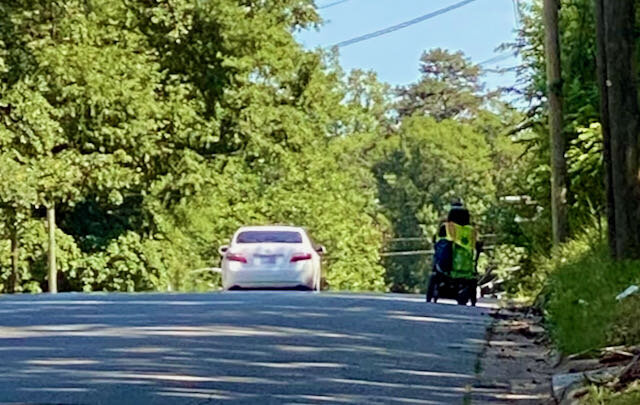
On June 24th, Bike Durham joined with staff from Durham’s Department of Transportation to talk with neighbors of North Miami Boulevard about a proposal to add protective posts to the bike/walk lanes planned for this stretch of street between Raynor Street and East Geer Street.  This is a stretch of street where three people have been hit by drivers while walking in the past two years.  

The first woman who stopped to speak with us was Ms. Brown.  She was using her powered wheelchair in the curb-side travel lane because there is no sidewalk on stretches of the street.  She liked the idea of adding the bike lanes with protective posts so that she has a designated space to operate her wheelchair.  Next we spoke with Mr. Davis who lived around the corner.  He told us that he had purchased a bicycle two years ago, but doesn’t ride it because the streets are too dangerous.  He also supported adding bike/walk lanes with protective posts so that he could bike or walk his dogs in them.

In all, we heard from twenty-one residents who were all concerned that too many drivers go too fast up and down North Miami Boulevard, and reported hearing or seeing crashes on a regular basis.  In addition to speeding concerns, we heard concerns about gun violence in the area.  This is an important reminder that we need to think beyond street design in our advocacy for safe and healthy streets for everyone.

The City had already planned to restripe this street to reduce the driving lanes to one in each direction, adding buffered bike/walk lanes to each side.  In 2019, the City held their own public input process for re-striping this street and eight other streets totaling just over eight miles of new buffered bike lanes.  These projects, all funded with federal grant funds, were all delayed last year by NCDOT when they decided to slow down spending due to their financial problems.  We received grant funds from the American Heart Association to work with the City to install protective posts on buffered bike lanes.  This project should be completed this Fall.

We are hoping to secure additional funding to continue this work with residents in the neighborhoods where all eight miles of planned buffered bike/walk lanes that the City will stripe this Fall.  If they are supportive, we’d like to see all of these bike/walk lanes protected with posts. 

Why We Need Safe Streets: A Perspective From Someone Who Is Blind

Donna Permar is a resident of Durham, NC and a long-time local advocate for safe places to walk and improved transit service. 

I recently joined the Bike Durham Advocacy Committee because I strongly support its mission of empowering all people to walk,  bike, and ride transit more often. Therefore, I wish to do whatever I can to help shape policies that promote safe pedestrian travel, enjoyable bike trails, and a public transportation system that meets the needs of current riders and attracts others who are not yet on board.

Due to my vision loss, my guide dog and I travel to work, appointments, shopping, et cetera via GoDurham, and we log hundreds of miles walking to many destinations. I have fought for sidewalks where there weren’t any and have promoted the installation of audible pedestrian signals (APS), which enable those of us who are blind and low-vision to cross streets more safely. My advocacy led to an APS installation at Hillandale Road and Croasdaile Commons where there are medical clinics, an urgent care center, Walgreens and several restaurants. Most recently, my efforts helped to get an APS installed at the very dangerous intersection of Fayetteville Road and Renaissance Parkway, which would make travel much safer for cyclists and pedestrians. 

I am also eager to provide input on improving transit service in Durham. I participated in the Transit Equity Campaign videos as a small way to advocate for improved transit in Durham. My ability to travel independently relies in large part on Durham’s transit system. Changes to transit routes present unique challenges for people with disabilities, and while changes can be inconvenient overall, the adjustment period to navigate a new routine and other changes can be longer and more frustrating for people with disabilities.

I do this work because I want to increase public awareness surrounding the idea that people with disabilities also bike and hike and would greatly benefit from improved trails, sidewalks and a transit system that is more reliable, efficient and serves more of the places where people need to go. I’ve been riding tandem bicycles with Bridge II Sports, and I enjoy it as a way to show others that people with disabilities are fully capable of athletic activities, such as biking. 

Back-seat biking provides impromptu opportunities to explain how I live my life, and it gives others a space where they can grow more comfortable when interacting with those of us who have disabilities. I enjoy riding tandem bikes with my guides as they describe the scenery to me along our route. We also discuss topics of mutual interest ranging from work, vacations and gardening, to sports and cooking. Most times, I find back seat pedaling on a tandem bike so pleasant that I wish my guide dog could be my captain. Alas, that skill was not included in his training. 

I firmly believe that achieving an excellent public transit system is crucial if the City of Durham truly wants to include all of its diverse populations in employment, education, recreation and health care opportunities. Transportation to such facilities is a huge barrier to participation for those who cannot afford to drive vehicles, have a disability which prohibits driving, or the senior-citizen population who once drove cars but are no longer able to do so. My hope is that some day Durham’s public transportation system will be second to none!

Bike Month DIY Rides

Bike Month DIY Rides

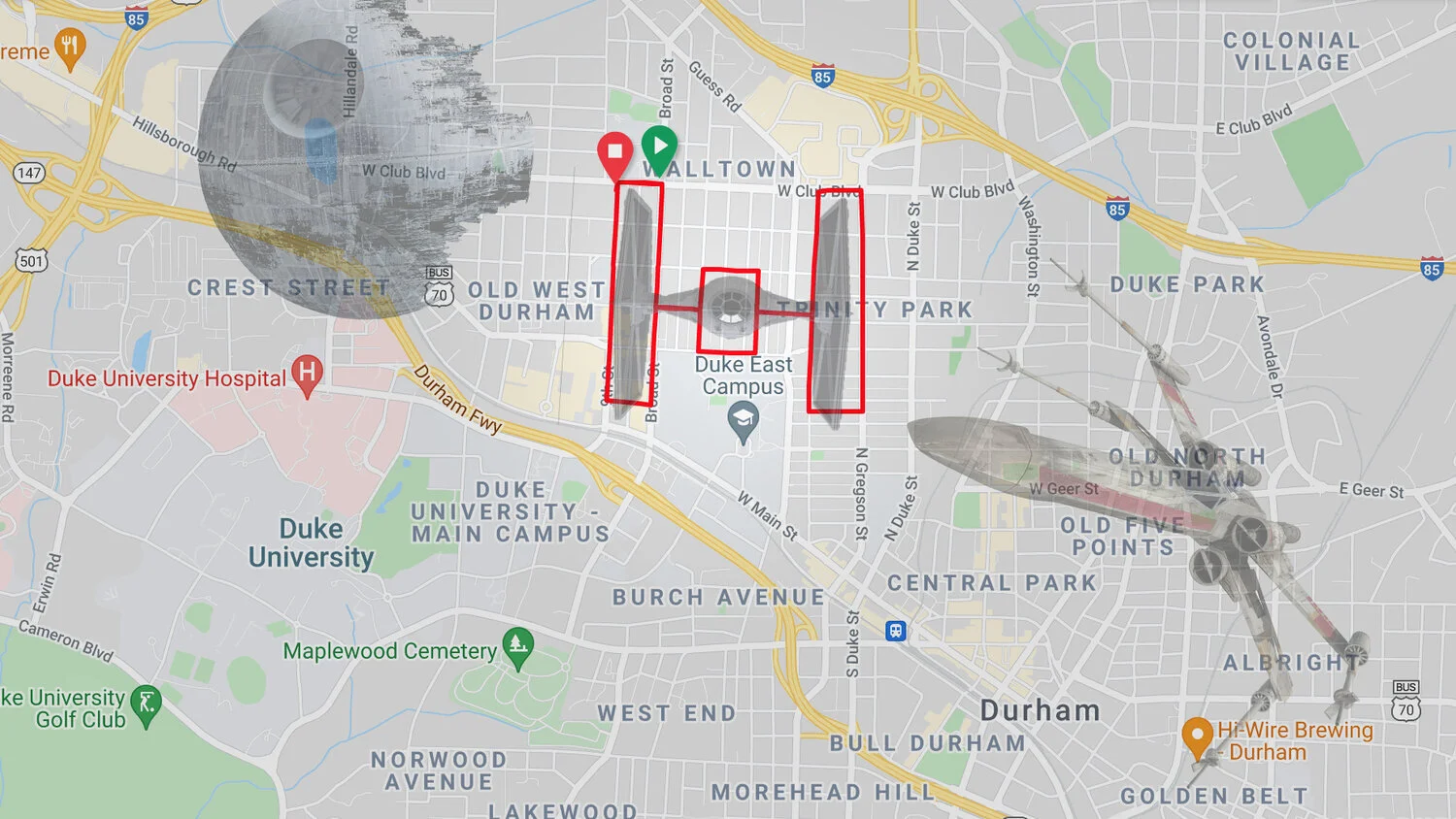
May was a busy month for Bike Durham, hosting several DIY rides in honor of Bike Month, including a scavenger hunt, a Star Wars inspired ride, and encouraged cyclists and other community members to ride their bikes to work.

Bike Durham Bull Ride

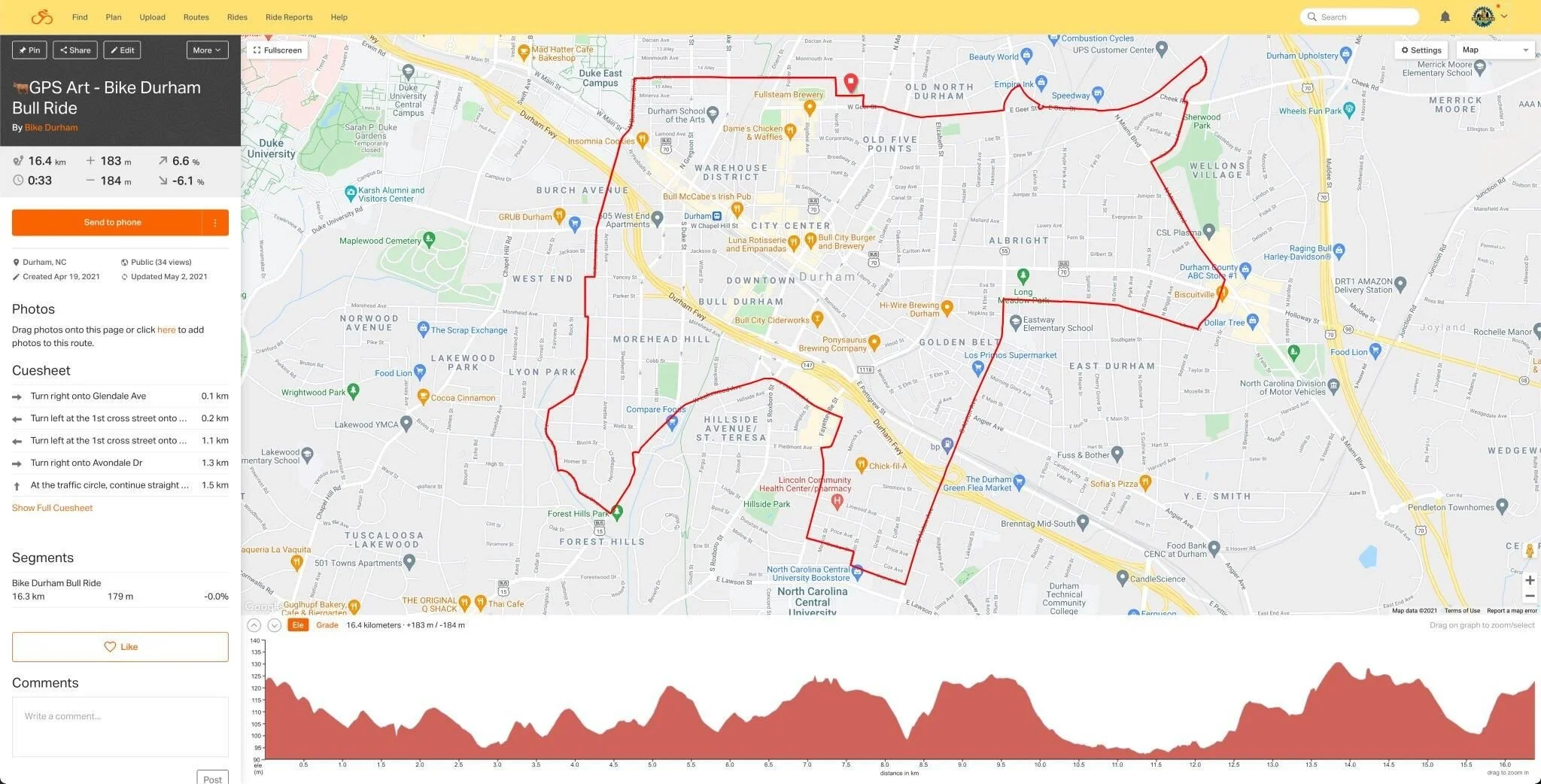
We were on the hunt for the perfect city bike ride to represent Durham for over a year. We couldn't find it, so we had to go to Alaska and partner up with Aurora Hablett aka Stravzilla, who creates the rarest forms of GPS visualizations.

Planning the Bull Ride Screenshot.png

The goal was to find "Major the Bull," over the city's center mass, in a closed-loop ride that stays on relatively safe streets, highlights neighborhood diversity, and cruises past NCCU and Duke.

RWGPS Bull Ride.jpeg

The ride needed to be long enough to be an experience but short enough to be accessible.

Bike Durham Bull Ride_group pic.jpeg

The big reveal is that Aurora worked with us to create a commemorative art piece that has the city inside of the shape of the bull. Now, we can show our Bull City Pride as we literally draw the bull with our bikes and then celebrate our city with this new street portrait of Major.

BIKE DURHAM BULL RIDE duality.jpeg

There are a lot of different drawings and sketches of Major the Bull, but this one is in the blueprint of our streets! And it's going to take over!

 
Bull Ride Poster.jpeg
 

A special thanks to our Sponsors for helping us bring creative events to Durham!

Victims Fair Treatment Act

Think of all the times in your life you have pressed the walk button, waited for the lights to change to red, got the “all clear” signal, and then proceeded to cross the street. If a driver ran the red light and hit you while you were in the crosswalk while you had the right of way, they would be at fault and you would be compensated for your injuries, right? Not so fast.

Even if the sequence of events happened as mentioned above, you may not collect anything for damages in North Carolina due to “contributory negligence.” Under the obscure doctrine of “contributory negligence,” people who negligently harm others and are 99% at fault are legally not required to compensate their victims. In our thought experiment above, the driver who ran the red light could argue that you had headphones and couldn’t hear, or that you didn’t look both ways. If a jury agreed that you contributed just 1% to the blame for the crash, you would not be able to recover anything. Stated plainly, contributory negligence means that you cannot recover money for any injuries caused by a negligent person if you are deemed even 1% at fault. The person who hit you would not be accountable for their actions. Not at all.

For those of us who advocate for better walking, biking, rolling, and transit, contributory negligence can be especially unjust and harmful.

As we know all too well, many people consider walking and biking to be inherently risky activities and are all too ready to blame the person walking or riding. Most news coverage tends to subtly shift blame to the victim (“car hits cyclist”, or similar, is the usual passive construction). People are more used to navigating our streets by car than by bike, foot, or bus. This bias is found in police reports, courtrooms, and jury boxes. If most people on a jury think riding a bike is inherently risky, they will be more likely to find that 1% fault regardless of facts. That 1% is all it takes to lose all hopes of recovering even just a small amount of compensation for damages or injury. Check out BikeLawNC to learn more about how the current law negatively impacts people on bikes.

What about insurance? That’s why drivers are required to have it, right? No. With contributory negligence, it is just as difficult, if not more difficult, to recover money from insurance companies as it is in court because insurance companies know that the law plays in their favor. Our friends at BikeLawNC have stories of insurance claims rejected on the basis of contributory negligence. Contributory negligence makes it harder to recover damages in court and harder to receive compensation through insurance companies. This is true even if the person who hits you is negligent and 99% at fault. They can walk away with zero consequence. 

There is an opportunity to change this zero sum game for those of us who navigate our streets exposed to negligent drivers. A bill was recently introduced in the NC Senate—Senate Bill 477 The Victims’ Fair Treatment Act— to move away from contributory negligence and use comparative negligence like 45 other states. Comparative negligence essentially eliminates the “all-or-nothing” framework and increases the likelihood of compensation for victims. 

Our friends at BikeLawNC have written more extensively about putting an end to contributory negligence. Bike Durham has asked our state lawmakers to support the Victim’s Fair Treatment Act. To support The Victims’ Fair Treatment Act yourself, take a moment to join the movement and contact your lawmaker

Tyler J. Dewey (he/him) is a Bike Durham volunteer and full-time bike commuter. Prior to transitioning to Durham, he worked as the executive director of a bicycle non-profit organization in Athens, GA where he facilitated bicycle education programs, headed up bicycle advocacy, and co-ran a bike recycling program.


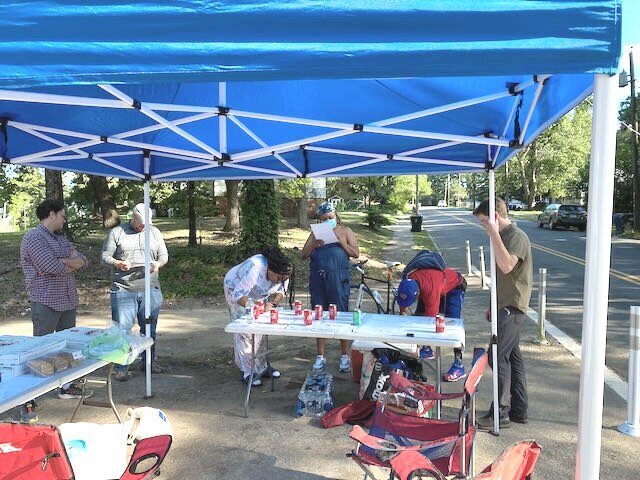
Ellerbee Creek Clean Up

Ellerbee Creek Clean Up

Bike Durham starts off Bike Month with a community clean up at Ellerbee Creek Trail, and Charlie Reece, Durham City Council Member At-Large, makes an appearance.

Bike and Walk to School Day at Merrick-Moore Elementary

Fourth grade students walking around Merrick-Moore Elementary on Bike and Walk AT School Day

Fourth grade students walking around Merrick-Moore Elementary on Bike and Walk AT School Day

Tuesday morning I biked from Sherwood Park in east Durham to Merrick-Moore Elementary School at 2325 Cheek Road in east Durham where students were getting outside to walk around the school campus as part of national Walk and Bike to School Day.*  It was good to see the kids outside, and they clearly enjoyed the break from the classroom, but this was certainly not walking and biking TO school.  The reason this was a walk AT school event was clear when Dr. Vannessa Alford, principal at the school, asked the Kindergarten students why none of them walk to school.  One of them called out “No sidewalks!”

Where the sidewalk ends at Merrick-Moore Elementary

Where the sidewalk ends at Merrick-Moore Elementary

Merrick-Moore Elementary is located on Cheek Road, a two-lane road with no shoulder and incomplete sidewalks.  The school is a key institution in the Merrick-Moore neighborhood, a historically Black neighborhood that has a history of advocating for more walkable streets. “My community has lobbied for many years for safer streets. Sidewalks are needed more than ever,” Bonita Green, neighbor and President of Merrick-Moore Community Development Corporation told me in an email.

This isn’t just an issue at Merrick-Moore Elementary.  Bike Durham’s Safe Routes to School Program Manager Jen McDuffie identified fifteen Durham Public Schools’ elementary schools that don't have safe streets for walking or biking around them.  That’s more than half of the 29 DPS elementary schools.  We know that parents aren’t going to allow their kids to walk or bike to school unless they feel that it’s safe.  Investing in these connections to schools, and addressing other safety concerns that parents and children feel, have to be priorities before every child can experience the joy and independence of walking or biking to school. 

Events like these are one way to raise awareness of the benefits that biking and walking to school can bring to the kids and also the parents.  Two of our daughters attended E.K. Powe Elementary, right around the corner from our house, connected with sidewalks.  When they were in fourth and fifth grades, they would walk independently to and from school.  It was a great feeling of independence for them, and it freed my wife and me from having to race home from work to pick them up each day. 

These events are also an opportunity to identify the obstacles, like poor or missing infrastructure.  This event at Merrick-Moore was organized by Stephen Mullaney, an accelerated teacher at the school, and supported by Bike Durham’s Safe Routes to School Program Manager Jen McDuffie.  It was attended by School Board member Natalie Beyer, City Council members Jillian Johnson and Pierce Freelon, and Durham Transportation department staff Bill Judge and Dale McKeel.  Along with Dr. Alford, we had good conversations about the need to connect Merrick-Moore and the surrounding neighborhoods with sidewalks, and other strategies to advance the outdoor education at the school.

tempImage6MUbzN.gif

As I left the school, I was thankful for a lot of things:  that Bike Durham has this new partnership with the City and DPS to provide Safe Routes to School programming; that there are teachers like Stephen Mullaney and principals like Dr. Alford who are leaders in getting kids outdoors and active; that we have elected leadership that supports investing in sidewalks and bicycle facilities; and that all the pick up trucks were giving me wide berth as they passed me along Cheek Road.  

 *May 5th is actually the national Walk and Bike to School Day.  However, there wasn’t any biking or walking to public schools in Durham today because Wednesdays are Wellness Days for Durham Public Schools, meaning that students don’t have class in-person or remote.   

Challenges to Equitable Transit - A Durham Documentary


“People use transportation just like they use their own car. And if their car wasn’t reliable, let’s say, their car could only crank up every hour, they would be so frustrated! So they have to look at it like that, like this is our car and we need it to be more reliable.”

- Holly McCoy, Transit Rider


In “Challenges to Equitable Transit - A Durham Documentary”, we see and hear the voices of transit riders and transit workers as they describe the main challenges they face using the bus in Durham. These challenges echo ones we’ve heard from other riders, transit workers, and people who live in low-wealth communities of color and that were captured in the first round of public engagement for the Durham Transit Plan update.

Riders are demanding:

  • More frequent service

  • More reliable service

  • More direct service with shorter travel times to jobs and other destinations in Durham and the region

  • Safer walks to bus stops

  • Accessible and comfortable bus stops

  • Expanded paratransit and other curb-to-curb service

A core strategy of the Transit Equity Campaign is to identify and communicate the transportation needs of current transit riders and low-wealth communities of color in Durham to decision-makers and the general public. The Transit Equity Campaign has relayed many of the needs we have heard to those in charge of updating the Durham Transit Plan, but there is no substitute to those officials hearing these needs directly from the riders in their own voices. This is particularly critical as already limited opportunities to listen to riders, such as bi-monthly public meetings at Durham Station, have been discontinued during the pandemic.

The Transit Equity Campaign commissioned two local videographers, John Laww and Saleem Reshamwala, to produce videos that describe the benefits and challenges of Durham’s current transit system through transit rider and worker interviews and showing the rider experience directly.

In addition to “Challenges to Equitable Transit - A Durham Documentary,” we created three shorter video vignettes to capture individual stories and topics. The first of these, “Supporting Transit for Persons With Disabilities,” spotlights Marie Hill Faison, a paratransit operator for GoDurham ACCESS and a Transit Equity Campaign partner. Paratransit is a federally mandated curb-to-curb service for persons with disabilities and is complemented by a county-wide system that fills in gaps in the fixed-route bus system in Durham. The Durham Transit Plan should reduce wait times and expand service levels on local and regional bus and paratransit services to improve the lives of those who cannot drive due to a disability. This would also increase transportation options for people who live or work in parts of Durham County where bus service does not run.

Transit service is only useful if people can safely get to and from bus stops and feel safe and comfortable at the stops themselves. The second vignette, “Walking To and Waiting At the Bus Stop,” focuses on the lack of sidewalks and safe street crossings for people walking to and from bus stops and the poor condition of many of the bus stops in Durham. These issues were identified by every rider we interviewed for these videos. The Durham Transit Plan should ensure that bus stops in Durham have safe sidewalk connections and consistent, dignified waiting conditions at the stop.

The final vignette focuses on a transit journey George A. Long, a longtime GoDurham rider, takes to accompany his friend, Lisa Raiford, to get her COVID-19 vaccination. What could be a better demonstration of how essential transit is in Durham?! George has benefited from a doubling of frequency on the route that serves his apartment, GoDurham Route 12, and newer buses, both of which have been funded through the Durham Transit Plan. The Durham Transit Plan should ensure more frequent service and better buses are provided to more people in Durham to improve access to jobs and services, particularly for low-wealth communities of color.

If you support these priorities, please click the link below to sign on to the Transit Equity Campaign.

Click Here to Join the Transit equity campaign

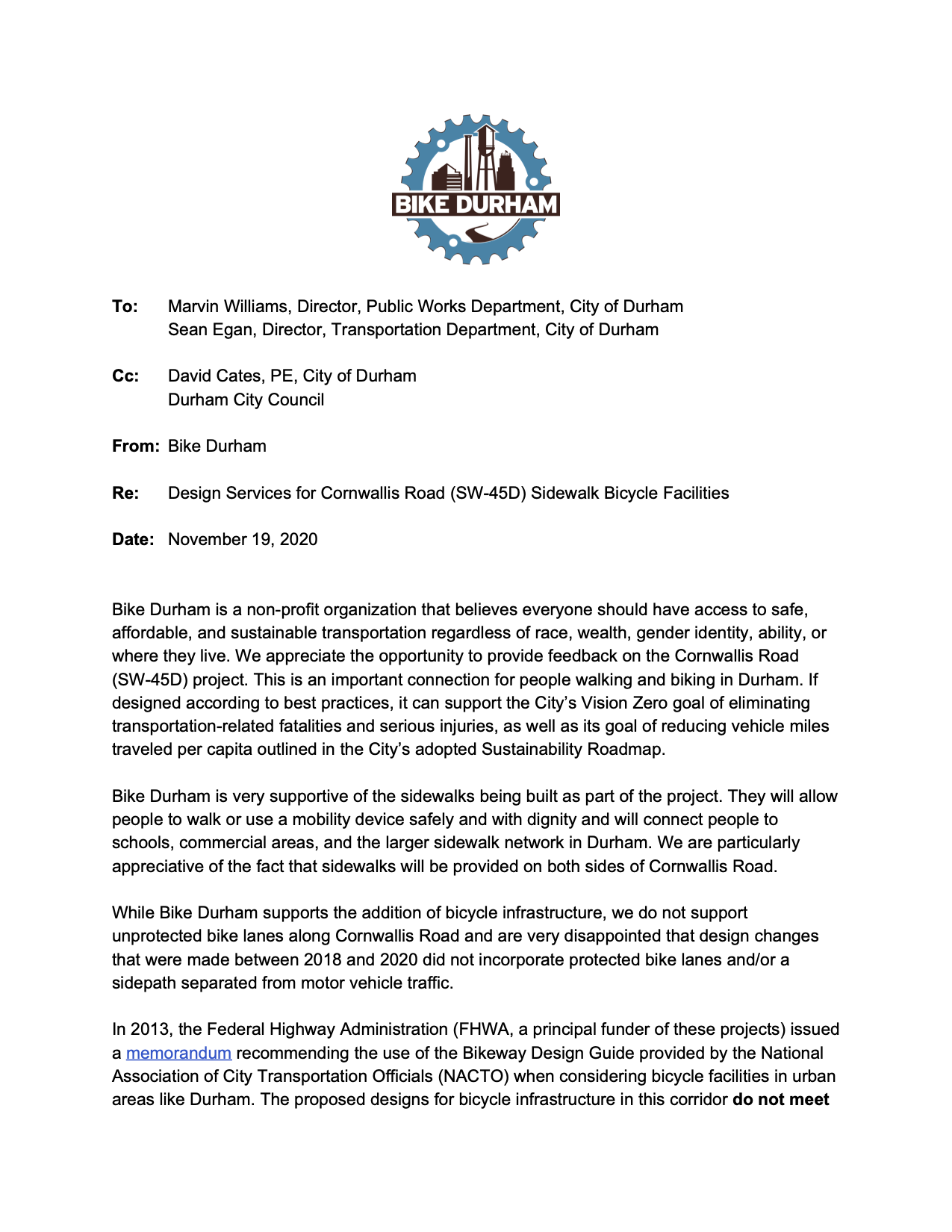
Bike Durham's Letter to the City on Cornwallis Road Project

Cornwallis Project.png

After a long delay, the City is going forward with plans to reconfigure Cornwallis Road from Chapel Hill Road to South Roxboro Street, to be completed in 2025. While we commend the City for improving bicycle and pedestrian facilities, design standards have evolved in the 20 years that have gone by since the plan was initially conceived.

Before the Thanksgiving break, Bike Durham sent a letter to City staff with our feedback on the project. The letter is reproduced in full below. Here are our key recommendations:

  • Separated facilities for those walking, biking, scooting, or rolling must be included in every street project in Durham, including Cornwallis Road.

  • A planning-level estimate of the additional cost and time necessary to complete this project according to best practices should be provided. Without such an estimate, the public, staff, and elected officials cannot adequately weigh whether maintaining the current design is a worthwhile tradeoff.

  • Projects that consider pedestrian, bicycle, or transit elements and/or are initiated by the Durham Transportation Department should be developed through at least 30% engineering by Transportation staff so that the intention and integrity of the projects can be carried through a more advanced design phase.

  • An analysis should be done to determine the causes that lead projects like Cornwallis Road to take over 20 years from conception to completion and recommend corrective actions for future projects.

  • More flexibility needs to be built into the process to allow for changes that reflect new best practices, particularly if projects are going to take decades to complete.